
A successful API response can be the warning. When a requested Shopify version is no longer supported, the platform can serve an accessible version instead. The integration stays available while its contract changes underneath it.
Quarterly compatibility control turns that hidden change into an owned decision. It proves which version is effective, which business invariants still hold, how the next version will be exposed, and how the team recovers before Shopify chooses the timing.
Fall-forward behavior is hidden change
Shopify releases stable API versions quarterly and supports each stable version for at least 12 months. Versioned surfaces include the GraphQL Admin API, Customer Account API, Storefront API, Functions APIs, and webhooks. Some surfaces are unversioned and can change outside that model.
For every dependency, record:
| Field | Why it matters |
|---|---|
| Integration and business owner | Identifies who can decide and who understands impact |
| Surface and requested version | Shows intended contract |
| Effective response or webhook version | Detects fall-forward behavior |
| Scopes and authentication | Exposes access changes and token constraints |
| Critical objects, mutations, and events | Defines the test boundary |
| Current library or SDK | Identifies hidden version handling |
| Last verified date and next retirement | Creates a maintenance trigger |
| Recovery action | Limits incident decision time |
Test business invariants beyond the schema
A query can compile while a business rule changes. Test at three layers:
- Schema: fields, arguments, enum values, nullability, deprecations, and access requirements.
- Behavior: pagination, defaults, error semantics, webhook payloads, timing, and side effects.
- Business invariant: the order total reconciles, inventory changes once, the correct market price is used, consent is respected, and retries do not duplicate work.
Build fixtures around risky states, not only happy paths: partial fulfillment, edits, refunds, multiple currencies, deleted products, missing optional fields, high line counts, and repeated webhook delivery.
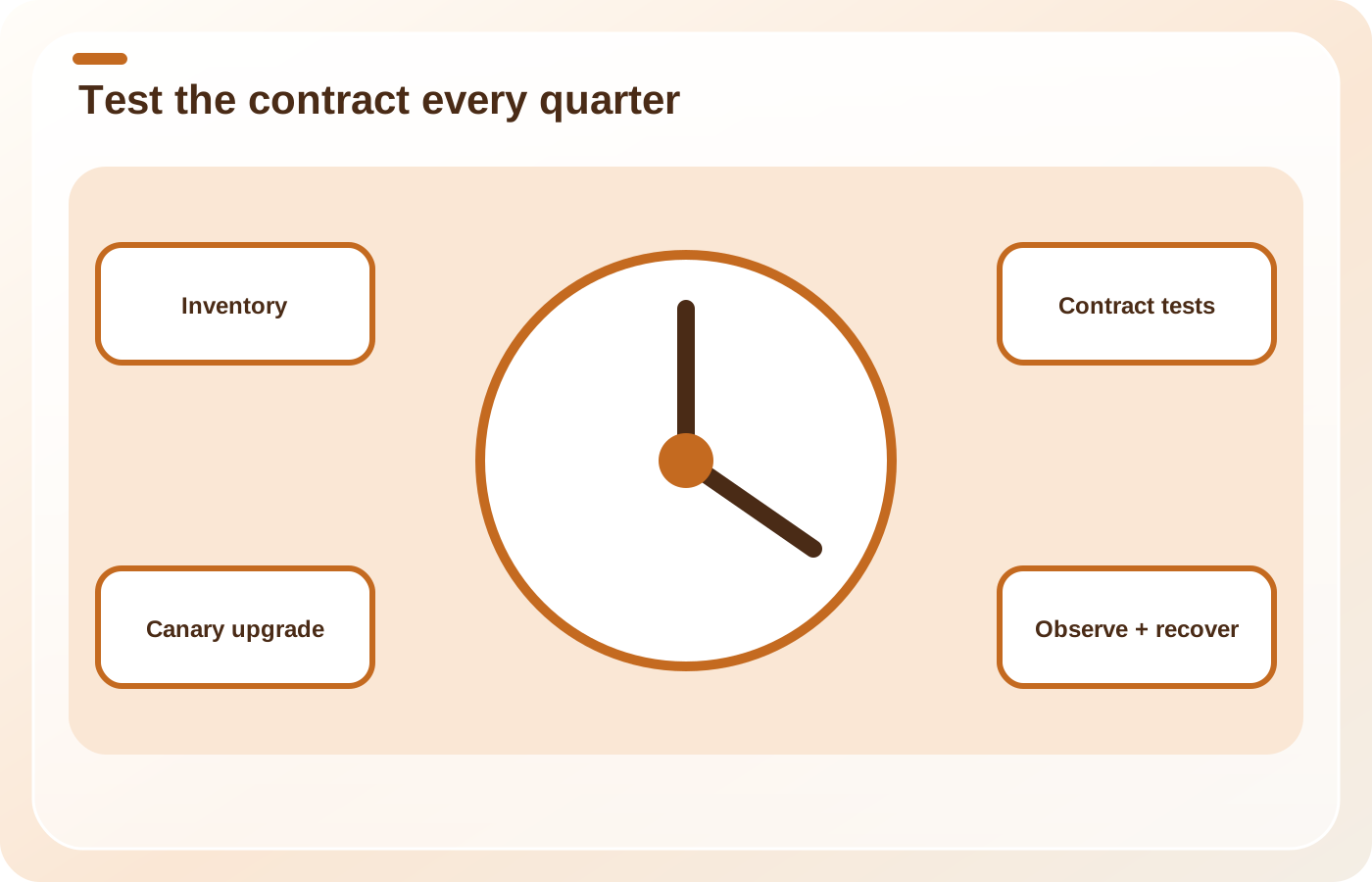
Produce one quarterly evidence packet
At the beginning of each quarter:
- review Shopify's version and developer changelogs;
- compare the current and target schema for used fields;
- scan code and configuration for pinned versions;
- verify the effective API version in responses and webhook headers;
- update the contract-test fixture set;
- run read-only comparisons before write tests;
- record approved differences and unresolved risks.
The output is an evidence package, not a ticket that says "upgrade complete." It should name the target version, affected integrations, test results, accepted transformations, monitoring, and recovery decision.
Replay webhooks as contracts
Webhook payloads are versioned. Consumers should tolerate repeated delivery and should not assume optional fields are always present. Store representative payloads without retaining unnecessary personal data, then replay them against the target consumer in a controlled environment.
Verify signature handling, routing, parsing, idempotency, retry behavior, dead-letter or failure queues, downstream writes, and alerting. Compare the version requested when the subscription was created with the X-Shopify-Api-Version header received.
Canary the version before the fleet
Use a representative development or test store, then a low-risk production cohort when architecture permits. For write operations, compare before and after state and prove retry safety.
Monitor API errors, user errors, latency, webhook failure and retry volume, queue age, reconciliation differences, and affected business tasks. Recovery can mean returning to the prior supported version, disabling a write path, replaying from a safe checkpoint, or switching to a manual process. A retired version cannot be a permanent rollback target.
Keep non-versioned risks in the review
Not every Shopify surface follows the quarterly version model. Libraries, Liquid behavior, OAuth endpoints, Web Pixels, themes, browser behavior, and third-party APIs need their own change controls. The inventory should mark the governing change source instead of forcing everything into one calendar.
Book the next control before closing this one
Search every integration repository and configuration store for Shopify API version strings. Compare requested versions with effective response and webhook versions. Any dependency with no owner, no current supported version, or no business-invariant test becomes a priority maintenance item.
Sources

