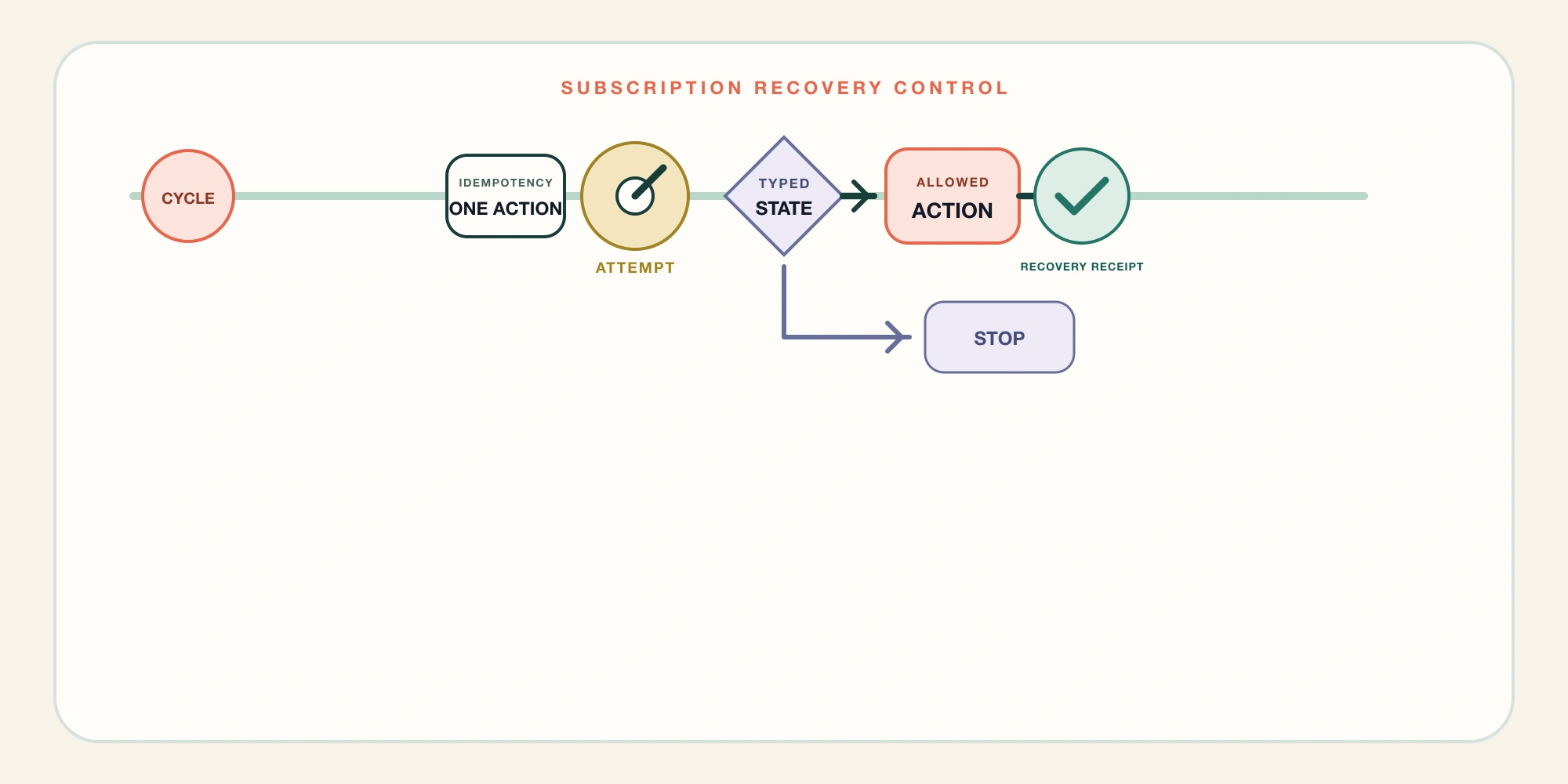

A renewal that does not create an order is not one failure state. It can be a missing billing attempt, an attempt still processing, a customer authentication step, a declined payment, an inventory block, an invalid contract, or a deliberate stop. Changing retry frequency before identifying that state can charge at the wrong time, repeat a message that cannot help, or leave a recoverable contract untouched.
Treat failed-payment recovery as an operating system. Each contract moves through an observable state, one owner is allowed to act, and every action must produce evidence that either the order was created safely or further attempts should stop.
Identify which system owns the renewal
Shopify processes recurring subscription payments and stores the contract and payment method, but the subscription app normally schedules billing, creates subsequent billing attempts, handles failures, and provides merchant and customer management interfaces. The free Shopify Subscriptions app exposes those controls inside Shopify. A third-party app can apply its own schedule, retry logic, notifications, and contract UI.
The first recovery task is therefore ownership, not messaging. Record the app that registered the contract, the system that intended to bill it, the system that created the attempt, the payment processor path, and the place where customer notifications originate. If two tools believe they own retries, pause the weaker path until authority is clear.
| Control | Evidence to capture | Accountable owner |
|---|---|---|
| Billing schedule | Expected cycle, next billing date, timezone, skip or pause state | Subscription app owner |
| Attempt creation | Contract ID, cycle, attempt ID, idempotency key, creation time | Subscription app or integration |
| Payment result | Attempt state, typed error, payment session, transaction or action URL | Shopify payment path plus app diagnosis |
| Inventory and order | Inventory-policy decision, blocked variants, order ID, fulfilment readiness | Merchandising and operations |
| Customer action | Message sent, secure action requested, completion evidence, expiry | Lifecycle and support |
| Contract disposition | Active, paused, failed, cancelled, or expired, with decision reason | Retention policy owner |
Use a six-state recovery machine
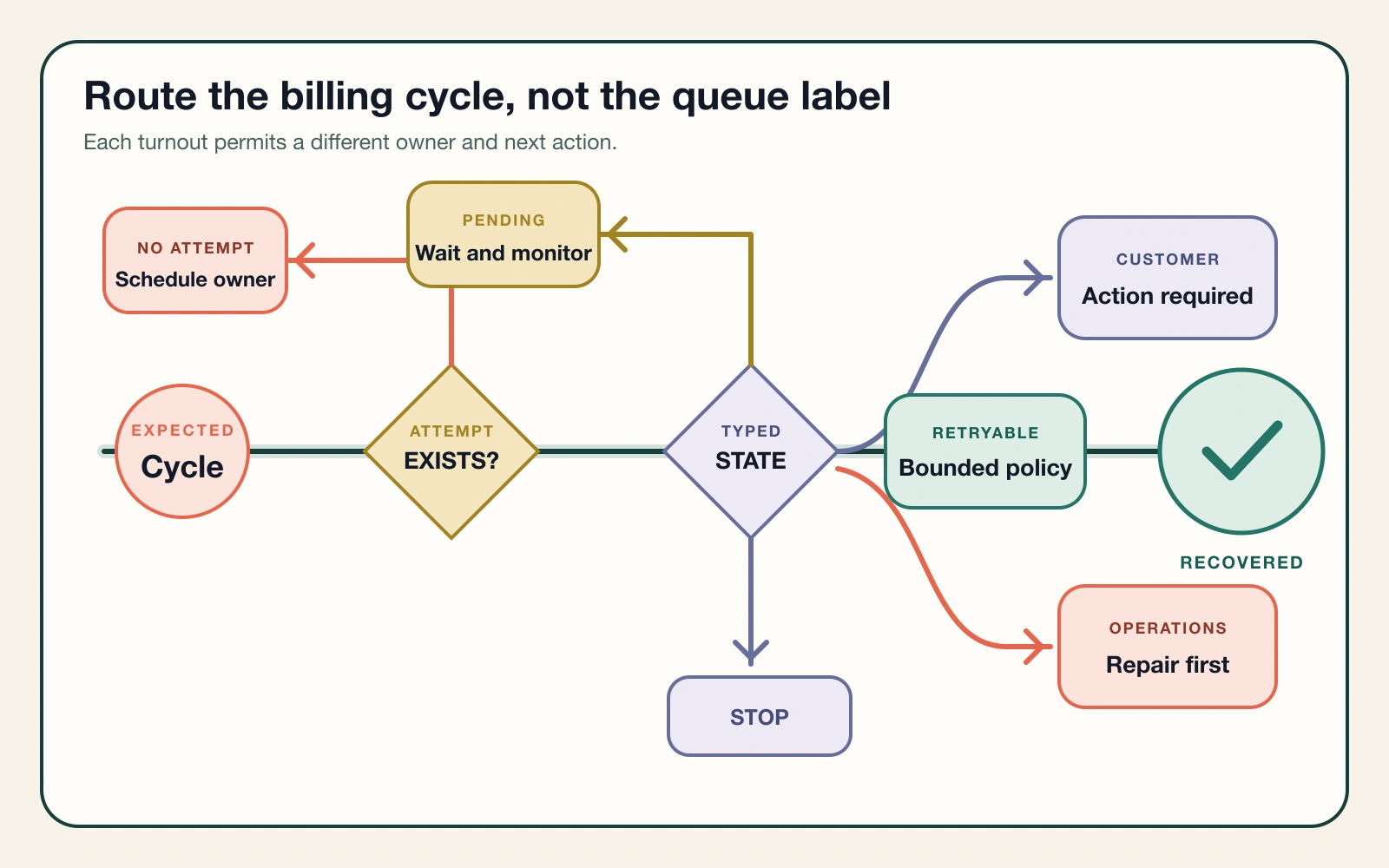
The state machine begins with scheduled intent and ends only with a reconciled order or a recorded stop. It does not assume that every failed cycle should be retried.
| Observed state | Allowed next action | Evidence required to leave the state |
|---|---|---|
| No attempt | Investigate schedule, app job, cycle eligibility, pause, skip, and contract ownership | A valid attempt is created once, or the cycle is intentionally rescheduled or stopped |
| Pending | Wait and monitor the same attempt | The attempt becomes success, action required, or failed; do not create a parallel attempt |
| Customer action required | Send the secure confirmation or payment-update route once through the approved owner | The action completes and a new payment session is observable, or the request expires and follows policy |
| Retryable payment failure | Retry only under the app's documented policy with the same cycle grouped correctly | A successful order is created, the error becomes non-retryable, or the retry ceiling is reached |
| Operational or contract block | Correct inventory, address, gateway, contract, or configuration before any charge attempt | The blocker is fixed and verified against the contract and intended cycle |
| Recovered or stopped | Reconcile order, payment, fulfilment, message, and contract state; suppress further action | The recovery receipt is complete and no duplicate work remains |
The queue label is not the state. A recovery action is safe only when the underlying attempt, contract, payment, inventory, and customer evidence agree.
Create a diagnostic receipt before the next action
One failed-payment row should be inspectable without opening five dashboards. Store a compact receipt that joins the commercial cycle to the technical attempt and the customer-facing consequence. The receipt can live in the subscription app, a support tool, or an internal operations table, provided one identifier links back to Shopify.
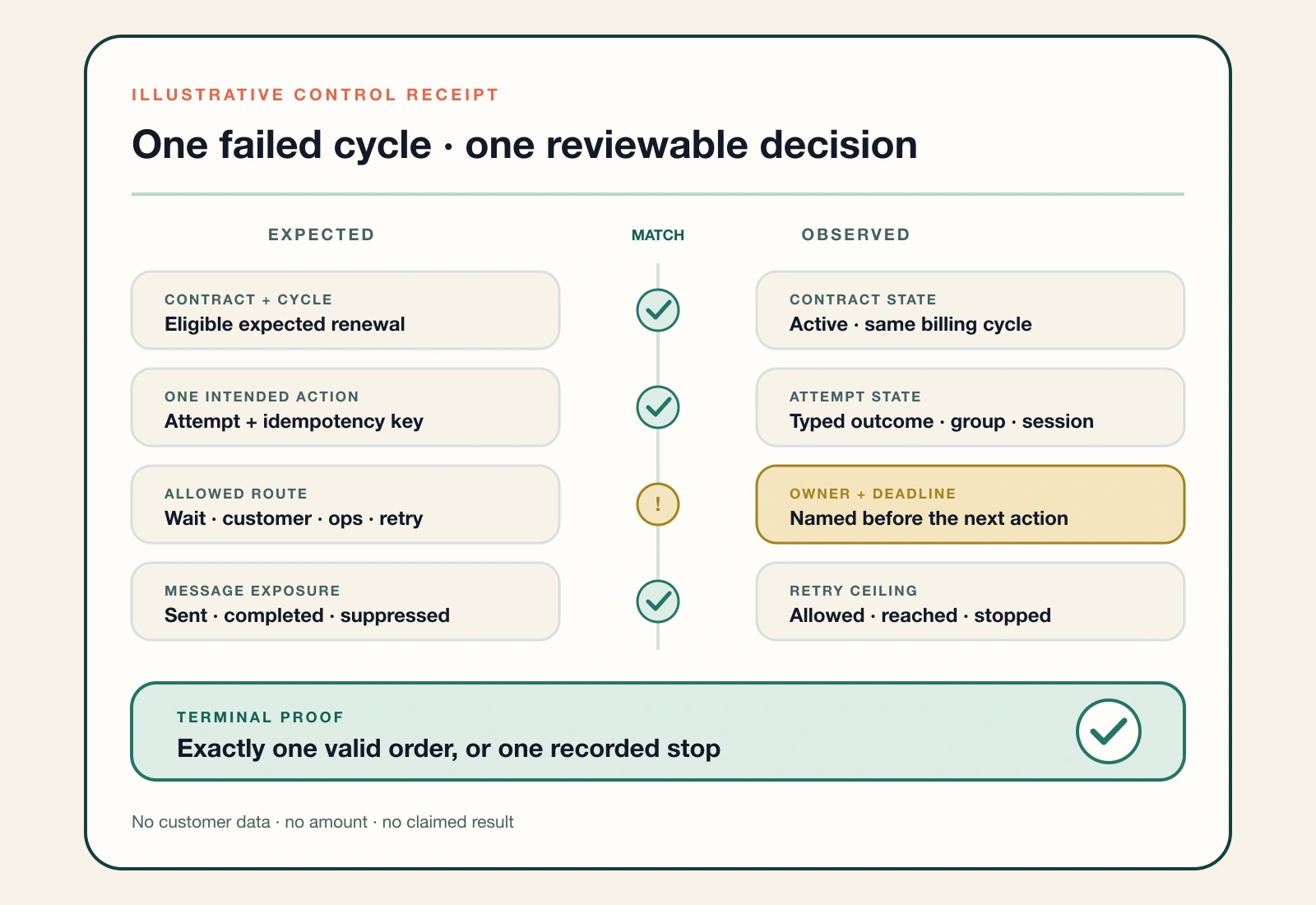
| Receipt field | Why it matters | Failure signal |
|---|---|---|
| Contract and billing cycle | Prevents two teams from acting on different renewals | Cycle cannot be identified or was already skipped |
| Attempt and idempotency key | Distinguishes no attempt from a failed attempt and protects duplicate execution | Multiple keys exist for the same intended action without explanation |
| Attempt state and error class | Routes payment, customer, inventory, and system failures differently | Generic queue text hides the current typed state |
| Payment group and session | Keeps related retries together for diagnosis and reporting | Retry counts rise while unique failed sessions do not |
| Customer message state | Avoids repeated or contradictory requests | More than one system sent the same recovery instruction |
| Owner, next action, and deadline | Prevents a contract from waiting indefinitely | No accountable owner or review time exists |
| Success or stop proof | Suppresses further billing and communication | An order exists but retry or dunning work remains active |
Route the error class before deciding to retry
Shopify's current Admin API describes billing attempt outcomes through a typed state. A successful state links to the resulting order. A pending state represents processing. An action-required state can carry a customer verification route. A failed state carries a typed payment, inventory, general, or unexpected error. Older nullable fields are deprecated in the 2026-04 model, so a subscription app should not build new recovery logic around one generic error string.
| Error route | Typical evidence | Recommended response |
|---|---|---|
| Customer-fixable payment method | Expired, missing, invalid, or incompatible payment method | Send the approved update route, then verify the contract points to a usable method before retry |
| Customer confirmation | Authentication or off-session action required | Use Shopify's secure confirmation path and do not represent the cycle as recovered until the action and order complete |
| Potentially retryable payment | Insufficient funds or a transient provider response | Use the app's bounded retry policy; preserve the cycle, payment group, and message cap |
| Inventory or fulfilment readiness | Insufficient inventory or no enabled allocation | Restock, correct allocation, or make an explicit oversell decision before billing again |
| Merchant or provider configuration | Provider disabled, merchant-account, currency, or gateway compatibility issue | Escalate to the configuration owner and inspect whether failures concentrate by time, method, market, or error |
| Contract or customer invalid | Paused, failed, cancelled, expired, missing customer, or stale agreement | Stop automatic retries until the agreement and customer intent are valid |
A sudden concentration of the same provider or generic error across previously healthy contracts deserves incident treatment. Compare by error code, payment method, currency, market, app release, and time window before asking every customer to replace a card. Shopify's February 2026 changelog also documents a temporary error-mapping issue that changed reported error volumes. Classification changes can therefore alter a dashboard without changing underlying customer behaviour.
Keep retries idempotent, grouped, and bounded
A retry policy is safe only when it cannot create two orders for one intended action. Shopify requires a client-generated idempotency key when an app creates a billing attempt. Reuse the same key for a repeated request whose purpose is to recover from an uncertain transport outcome. Use a new attempt only when the previous outcome is known and the policy authorizes another charge.
- Resolve the contract and exact billing cycle. Confirm it is still eligible and the customer has not paused, cancelled, or skipped it.
- Find the latest attempt and its typed state. If it is pending, monitor it rather than create another attempt.
- For an uncertain request outcome, look up the original idempotency key before sending anything again.
- For a known failed attempt, confirm the error class permits a retry and that the blocking state has changed or the policy explicitly allows waiting.
- Create or request the next attempt through the single owning app, then record the payment group and session relationship.
- On success, reconcile the order, payment, inventory, fulfilment, next billing date, and outbound messages before closing the case.
Shopify exposes payment groups for related retries and payment sessions for attempts that share the payment group, payment method, currency, and amount. Merchant-facing success reporting should count a payment session once. Otherwise a store can appear to have many failures and recoveries when it actually had one failed renewal with several technical attempts.
Make dunning messages follow the state
Dunning is the communication and retry process for collecting a failed recurring payment. It should explain the action the customer can take, not expose internal error codes or send a universal card-update message.
| State | Customer message | Suppression rule |
|---|---|---|
| No attempt or internal scheduling defect | Usually none until the merchant understands whether a charge was intended | Suppress generic failed-card copy |
| Payment method update needed | State that the renewal could not complete and provide the approved secure update route | Suppress when the method is updated, the contract stops, or the link expires |
| Customer confirmation required | Use the Shopify confirmation path and explain that action is needed to complete the renewal | Suppress after completion or expiry; do not send a separate card-replacement demand without evidence |
| Inventory delay | Explain the stock-related delay and the store's next operational step | Suppress payment-blame language and duplicate app notices |
| Provider or platform incident | Delay broad customer contact until scope and customer action are known | Suppress card-update campaigns when no card change can fix the incident |
| Recovered or stopped | Confirm only the outcome the customer needs to know | Suppress every remaining retry and recovery sequence |
Shopify lets merchants send a payment-method update link from the customer profile, and the documented link expires after 48 hours. Treat the send event as an invitation, not recovery proof. The receipt should show whether the customer completed the action and whether the subsequent attempt created the intended order.
Measure recovered billing cycles, not message activity
The primary operating outcome is recovered eligible billing cycles that produce one valid paid order within the declared recovery window. Report it by original failure class and payment session. Retry count, email delivery, opens, and link clicks are diagnostics, not the commercial result.
- ✓Eligible failed billing cycles by error route
- ✓Billing cycles recovered to exactly one valid order
- ✓Median and tail time from first failed state to reconciled order
- ✓Customer actions requested, completed, expired, and repeated
- ✓Contracts paused, cancelled, failed, or intentionally skipped after the ceiling
- ✓Duplicate orders, duplicate messages, unexpected oversells, support contacts, refunds, and chargebacks
- ✓Unowned or stale cases past the declared review time
Segment before changing policy. A higher recovery rate among insufficient-funds cases does not justify retrying invalid agreements or inventory failures more often. A lower apparent success rate after an API error-classification update might be a reporting change. Preserve the raw state, API version, and receipt version so the comparison remains explainable.
Pilot the operating model on one bounded queue
Day 0: freeze the rule
Keep the current retry policy stable. Select one product family or app-owned cohort and exclude active disputes, manual promises, and contract migrations.
Day 1: backfill receipts
Join the latest failed cycle to attempt, error, contract, inventory, customer message, owner, and next action evidence.
Days 2 to 7: route and reconcile
Use the state machine for new and open cases. Review every transition that needed manual interpretation.
Review point
Compare recovered cycles, time to recovery, duplicate-risk signals, message exposure, support work, and unresolved cases with the prior process.
Decision
Keep, revise, or remove the model only after the receipt proves both commercial recovery and safe operations.
Success means every pilot case has an observed state, an owner, an allowed action, and final evidence. Do not broaden the pilot while any case can be acted on by two systems, while a pending attempt can trigger a parallel charge, or while a completed order leaves an active dunning message.
Define the stop and rollback conditions
- Stop automatic retries when the contract is cancelled, expired, failed with no further attempts expected, intentionally paused, or no longer reflects customer agreement.
- Stop the payment route when inventory, address, currency, provider, or merchant configuration must be repaired first.
- Stop all parallel action when an attempt is pending or its outcome is uncertain.
- Rollback a new policy immediately if one cycle creates duplicate orders, one recovered customer receives a further payment demand, or a retry bypasses the declared inventory or contract rule.
- Move to incident handling when one error class rises across previously healthy contracts and no customer-level change explains the concentration.
- Retire the custom workflow when the owning subscription app can provide the same observable states, controls, exports, and evidence with less operational work.
The safest first action this week is not to add retries. Sample twenty recent failed or missing renewals, classify each through the six states, and record where the evidence or owner disappears. Fix that gap before changing the customer message or charge schedule.
Inficial can map subscription ownership, turn billing-attempt evidence into a support-ready recovery receipt, and test a bounded Shopify recovery process without changing live retry rules first.
Frequently asked questions
What should I check first after a Shopify subscription payment fails?
Does Shopify automatically retry every failed subscription payment?
When should a failed subscription payment be retried?
Should I ask every customer to update their card?
Can insufficient inventory cause a subscription order not to be created?
How do I know a subscription payment has actually recovered?
Sources
- Shopify developer documentation: Model a subscriptions solution, accessed September 8, 2026
- Shopify developer documentation: Build a subscription contract, accessed September 8, 2026
- Shopify Admin GraphQL API: SubscriptionBillingAttempt, accessed September 8, 2026
- Shopify Admin GraphQL API: SubscriptionContract, accessed September 8, 2026
- Shopify developer changelog: SubscriptionBillingAttemptState, accessed September 8, 2026
- Shopify developer changelog: New payment error codes and classification, accessed September 8, 2026
- Shopify developer changelog: Payment groups and sessions, accessed September 8, 2026
- Shopify Help Center: Managing Shopify Subscriptions app settings, accessed September 8, 2026
- Shopify Help Center: Managing subscription contracts, accessed September 8, 2026
- Shopify Help Center: Viewing and managing customers' subscriptions, accessed September 8, 2026

