
A declining Shopify page does not automatically need a rewrite. Demand may have shifted, Google may credit another canonical, a product may be temporarily unavailable, or two pages may now answer the same query. Editing before diagnosing can preserve the wrong URL and erase the evidence needed to choose safely.
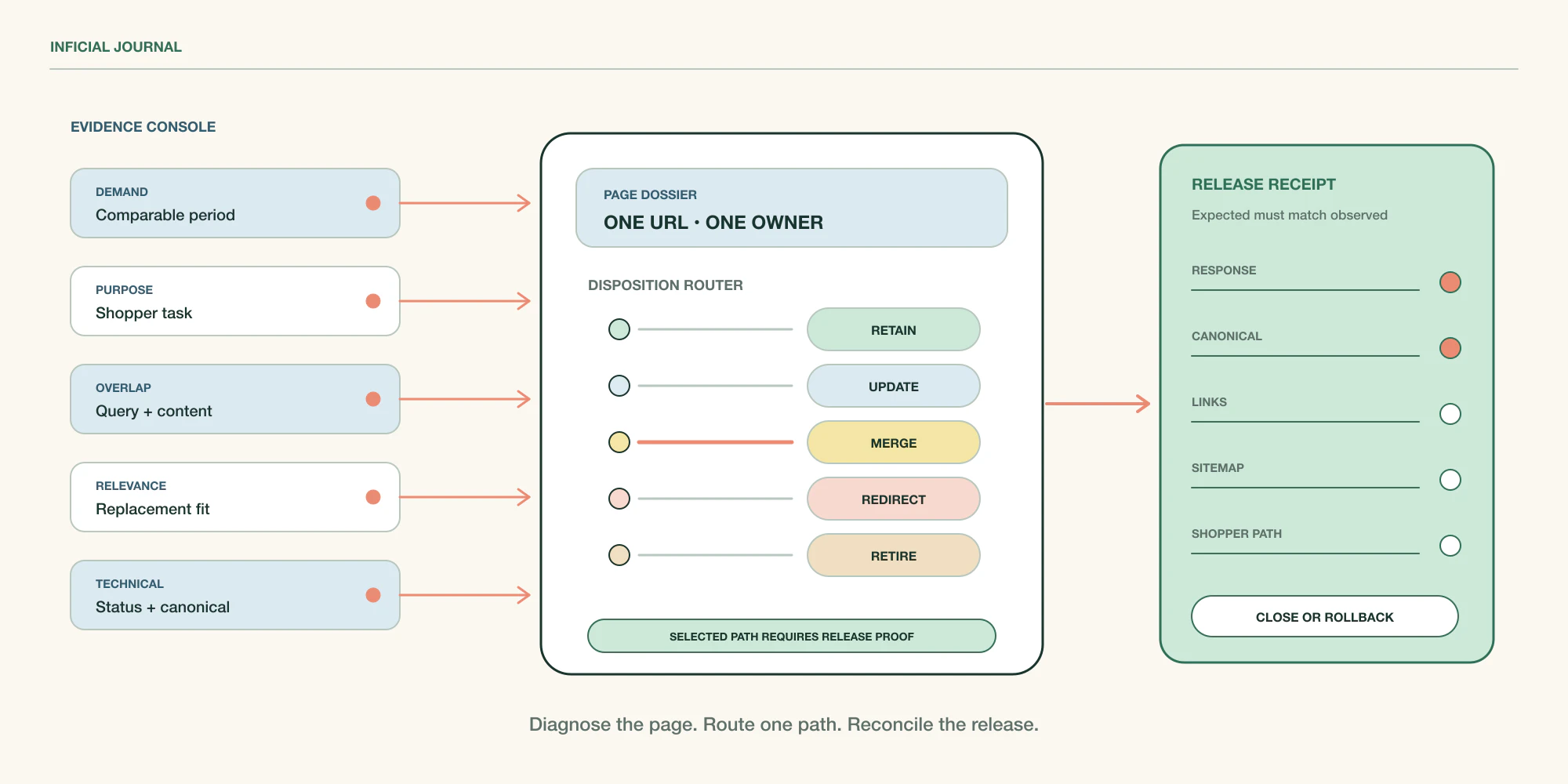
Treat content decay as a disposition decision. For each page, choose one outcome: retain, update, merge, redirect, or retire. The choice needs a page-level record that joins search evidence with shopper purpose, inventory or policy state, links, implementation risk, an owner, and a review date.
Prove decay before prescribing a fix
Start with a bounded comparison, such as the latest eight or twelve complete weeks against a seasonally sensible earlier period. Google recommends weekly or monthly aggregation when day-of-week noise could distort a date comparison. Keep the same search type, country, device, and page boundary.
Read clicks, impressions, query mix, click-through rate, and average position together. A fall in impressions across the whole query cluster suggests changed demand or eligibility. Stable impressions with lower clicks can point to a result presentation or intent mismatch. A different canonical receiving the impressions can make the original URL look weak even when the topic still performs.
| Observed pattern | Check before editing | Why it changes the decision |
|---|---|---|
| Clicks and impressions fall together | Demand, seasonality, indexing, market, device, and query mix | An update cannot restore demand that moved elsewhere |
| Impressions hold, clicks fall | Result title, competing formats, price or availability, and intent fit | The page may need a presentation or offer correction |
| Two URLs appear for the same query | Canonical assignment, internal links, page purpose, and content overlap | A merge may be safer than two independent updates |
| Traffic is low but assisted journeys continue | Internal navigation, support use, backlinks, and policy value | The page may deserve retention despite weak last-click revenue |
| A product is unavailable | Restock plan, substitute relevance, market inventory, and customer expectation | Temporary unavailability is not the same as permanent retirement |
Operating rule: a metric can open an investigation, but it cannot select the disposition alone. Search Console also omits some query rows and generally assigns page data to Google's selected canonical.
Build one page-level disposition contract
Create one row per canonical candidate, not one row per keyword. Record the URL, page type, market, primary shopper task, valid claims, inventory or policy state, leading query cluster, links, conversions or assisted journeys, current status and canonical, last material update, and named owners.

| Disposition | Use when | Required release contract |
|---|---|---|
| Retain | Purpose, claims, and customer path remain valid; decline is not page-specific or change cost exceeds likely value | Keep URL and content stable; set a new review trigger |
| Update | The same URL and intent remain correct, but facts, examples, structure, or result presentation are stale | Preserve useful material; document changed claims and recheck render, canonical, and tracking |
| Merge | Two or more pages serve materially overlapping intent and one destination can carry the combined job | Choose the stronger destination, move unique value, update internal links, and redirect each replaced URL |
| Redirect | The old resource moved or has one clear replacement that satisfies the same shopper task | Map source to relevant destination, prevent chains, test response and landing relevance |
| Retire | The resource is gone, unsafe, obsolete, or has no relevant replacement and no required customer role | Remove internal discovery, update the sitemap, and return a proper 404 or 410 |
Use vetoes, not a weighted score
A neat score can hide a fatal condition. Use explicit vetoes first. A page with an inaccurate safety claim cannot be retained because it still earns clicks. A discontinued product cannot be redirected to a broad collection merely because both share a category word. A policy page cannot be retired because it produces no direct revenue.
- ✓Accuracy veto: a material claim, price, compatibility statement, or policy is no longer valid.
- ✓Purpose veto: the proposed destination does not complete the same shopper task.
- ✓Replacement veto: a redirect target requires the visitor to restart the decision.
- ✓Overlap veto: the destination would become a confused page serving incompatible intents.
- ✓Operational veto: no owner can maintain the merged or updated page.
- ✓Evidence veto: tracking, canonical assignment, or inventory state is too uncertain to justify an irreversible change.
For redirects, use this test: “A visitor requesting the old URL can continue the same task on the destination.” If it fails, keep the page, find a closer replacement, or return a true not-found response. Google explicitly warns against sending many old URLs to an irrelevant destination.
Release one cohort with a reversible receipt
Do not clean an entire archive in one release. Select a coherent cohort, such as ten aging guides or one discontinued-product family. Freeze unrelated SEO changes, save the original content and mappings, and record a baseline before touching Shopify.

- Baseline: export the disposition rows, query and page comparisons, landing journeys, links, response state, canonical, and sitemap membership.
- Stage: prepare updated copy, destination content, redirect mappings, internal-link changes, and owner approvals away from the live theme or production content.
- Verify: test the rendered page, status code, redirect hop, canonical, robots state, internal links, sitemap, analytics, and relevant market variants.
- Observe: annotate the release date and compare the same page and query boundaries after enough complete data exists.
- Close or roll back: record the result, exceptions, redirect chains, shopper defects, next review, and restoration decision.
Shopify can create redirects when URLs change and supports bulk redirect management, but its redirects work from paths that return 404 and some path prefixes are reserved. Test the actual storefront response. An admin row is not proof that the shopper receives the expected destination.
Judge correctness before search outcomes
The first review asks whether the release behaves as designed. The later review asks whether the selected disposition still looks responsible. Do not turn a coincident ranking change into a causal claim. Google notes that sentiment, news, competing pages, and other events can move performance around a page change.
| Review layer | Pass evidence | Stop or rollback signal |
|---|---|---|
| Technical | Expected status, one-hop redirect, canonical, robots, sitemap, links, and rendered content | Loop, chain, soft 404, wrong canonical, broken tracking, or market mismatch |
| Search | Comparable impressions, clicks, query mix, and canonical credit on the intended boundary | Replacement loses the intended query set or an unexpected URL takes over |
| Shopper | Destination continues the task and key internal journeys remain usable | Visitors reach a broader, unavailable, contradictory, or broken experience |
| Operations | Owner, claims, inventory state, and next review remain current | No owner, stale merged page, recurring redirect edits, or unresolved support issue |
Keep ownership after the cleanup
The content estate will decay again unless new pages enter with an owner, purpose, review trigger, and exit rule. Put the disposition contract beside campaign planning, product retirement, policy review, and migration work. That makes cleanup a controlled operating process rather than an annual deletion event.
- Content or merchandising owns purpose, claims, and replacement relevance.
- SEO or growth owns the comparison boundary, query evidence, and observation record.
- Development owns response, redirect, canonical, sitemap, and rendered-state verification.
- Customer support flags stale answers and broken post-purchase journeys.
- One approver accepts irreversible retirement and the limits of the evidence.
Take one safe next action
Choose five URLs that triggered the concern. Fill the contract without editing them. Success is not a traffic increase; it is five defensible dispositions with no unresolved accuracy, relevance, or ownership veto. Review the evidence after one complete reporting window. If the team cannot explain a redirect destination or retirement in one sentence, keep that URL unchanged and investigate further.
Frequently asked questions
What is content decay in Shopify SEO?
Should I update or delete old Shopify blog posts?
Should a discontinued Shopify product redirect to a collection?
How long should I measure a content update?
Does a 301 redirect preserve all Shopify SEO value?
Can Search Console alone decide which pages to prune?
Sources
- Google Search Console Help: Advanced filtering and comparison, accessed 8 September 2026
- Google Search Console Help: Dimensions and data groupings, accessed 8 September 2026
- Google Search Console Help: Common tasks and use cases, accessed 8 September 2026
- Google Search Central: Site moves and migrations, accessed 8 September 2026
- Google Search Central: Troubleshoot crawling errors, accessed 8 September 2026
- Google Search Central: Redirects and Google Search, accessed 8 September 2026
- Shopify Help Center: Creating and managing URL redirects, accessed 8 September 2026
- Shopify Help Center: Manage blogs for your online store, accessed 8 September 2026