
Faceted navigation is not one SEO problem. It is a URL-state governance problem.
A Shopify collection may expose color, size, material, price, availability, vendor, and product-type filters. Parameter order, multi-selects, sorting, pagination, Markets, themes, and apps can turn those choices into many crawlable URLs. The mistake is giving every URL the same treatment.
The advanced fix is a versioned control matrix. Each filter pattern gets one search role, one normalized URL form, one response contract, one discovery policy, and one owner. The theme, apps, robots rules, internal links, sitemap, and monitoring then have to obey that record.
Give every filter state one search role
The matrix separates questions that are often collapsed: Can Google discover the URL? May it crawl the URL? Is the page eligible for indexing? If the page is a duplicate, which URL should consolidate its signals?
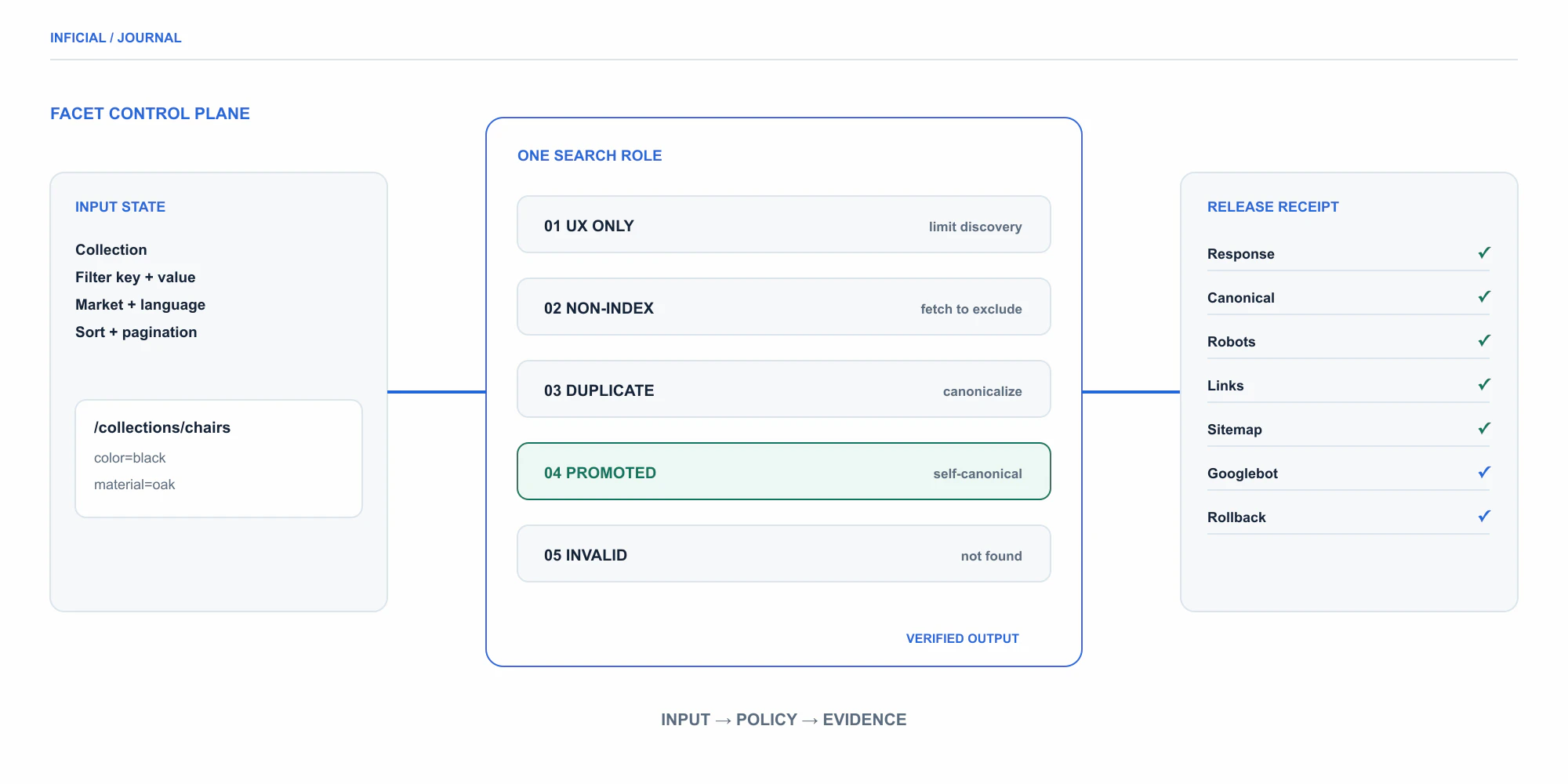
| State | Search role | Required contract | Example |
|---|---|---|---|
| UX-only | Shopper refinement with no independent search purpose | Limit systematic discovery or crawling; never rely on page directives Google cannot fetch | Sort order or redundant multi-select permutation |
| Crawlable, non-indexable | Temporary state Google must fetch to exclude | Return a normal response with noindex; exclude from sitemap | Cleanup transition while old URLs leave the index |
| Canonicalized duplicate | Equivalent content with a preferred URL | Allow crawling; canonicalize consistently; link the preferred form | Same values in a different parameter order |
| Promoted landing page | Durable, distinct search destination | Indexable, self-canonical, internally linked, sitemap-listed, maintained | Curated oak dining chairs collection |
| Invalid or empty | No valid resource | Return the correct not-found response and remove the generating link | Impossible size and material combination |

These roles are mutually exclusive. A crawl-blocked page cannot depend on Google reading its noindex. A promoted page should not canonicalize elsewhere. An invalid state should not redirect indiscriminately to the parent collection.
Editorial callout: crawl control is not a ranking lever by itself. It is a consistency system. Judge it first by whether URLs are discovered, fetched, canonicalized, indexed, or rejected exactly as the approved contract says.
Write the registry as executable policy
Inventory patterns, not isolated URLs. Collect links from the rendered storefront, inspect theme snippets and app-owned routes, and record how Search & Discovery values become URL parameters. Then create one row per pattern.
| Registry field | Decision to record | Release evidence |
|---|---|---|
| Identity | Collection family, filter key, allowed value, market, language | Value maps to a real merchandising attribute |
| Normal form | Parameter name, encoding, order, multi-select rule | Equivalent states resolve or point to one form |
| Search role | One of the five approved states | Exactly one role is assigned |
| Response | Status, rendered canonical, robots directive | Live HTML matches the state |
| Discovery | Anchor behavior, sitemap inclusion, navigation placement | Only intended routes are emitted |
| Assortment | Availability rule and zero-result behavior | Market-aware fixtures pass |
| Ownership | SEO, merchandising, engineering, app owner | Every failure has an accountable owner |
| Lifecycle | Proposed, approved, live, retiring, rolled back | Old rules cannot survive silently |
Attach a registry version and release ID. Without them, a spreadsheet can drift from the theme and a code change can lose the business reason for an exception.
Enforce five invariants
- One shopper state has one normalized URL form.
- One URL pattern has one search role.
- Any page-level directive the policy relies on is observable to Google.
- Internal links and sitemap membership agree with the promoted state.
- Invalid states return the expected response in every affected market.
Treat an invariant failure as a release defect, not an interesting Search Console observation.
Work one Shopify filter state end to end
Consider this illustrative state: /collections/chairs?filter.v.option.color=black&filter.p.m.custom.material=oak
First, define its identity: black, oak chairs in a specific market and language. Then test whether reversing the two parameters, changing case, or repeating a value produces the same shopper state. The link generator should emit one preferred ordering; equivalent reachable forms should not become competing internal links.
Next, assign the search role. If this combination exists only for on-site refinement, keep it UX-only. If it is materially equivalent to another URL, classify it as a duplicate and consolidate to the preferred form. If it has no valid assortment, return the intended not-found response. Promote it only if the refined collection passes every gate below.
Finally, create fixtures for the normal form, reversed parameters, pagination, sorting, an out-of-stock value, and an empty combination. Record the expected status, canonical, robots directive, outgoing links, and sitemap state. Repeat market-sensitive fixtures with the same locale and catalog context a shopper receives.
Promote only states the team can maintain
Indexable facet pages are maintained search products. Demand alone is insufficient.
- Intent: the query represents a distinct product need, not merely a filter interaction.
- Assortment: relevant inventory remains useful over a meaningful period. Set a store-specific rule; do not borrow a universal product count.
- Merchandising: the result set and ordering help that intent rather than mirroring the parent collection.
- Content: the title, heading, supporting copy, and links can explain the refined choice without filler.
- URL: the state has one stable, auditable form across casing, encoding, order, and multi-select behavior.
- Signals: the page can self-canonicalize, receive crawlable internal links, and enter the sitemap.
- Owner: someone owns inventory failure, review cadence, retirement, and redirects.
A failure on assortment durability or ownership should veto promotion even when keyword tools show demand.
Keep crawl, index, and canonical controls separate
Robots.txt controls crawling. A robots meta directive controls index eligibility after a page is fetched. A canonical is a consolidation signal for duplicates. None replaces the others.
For a UX-only pattern, first stop the storefront from emitting unnecessary crawlable links. If a robots rule is still justified, test its exact matches and exclusions. Shopify cautions that its default robots configuration is designed for the platform, so treat changes to robots.txt.liquid as production code with review and rollback.
For a noindex transition, preserve crawl access. For a duplicate, verify the rendered canonical and make internal links advertise the preferred form. For a promoted state, verify a self-canonical, indexable response plus consistent navigation and sitemap signals.
Do not use redirects as the primary normalizer after the theme has already created permutations. Fix the generator. Redirects may still be appropriate for retired, externally linked URLs, but that is a migration decision with its own mapping and tests.
Measure a release with a verification receipt
Start with implementation evidence, not rankings. A release receipt should contain:
- registry version and release ID;
- every fixture's expected and observed response;
- relevant Page indexing group changes;
- sampled URL Inspection results, including declared and Google-selected canonicals where available;
- verified Googlebot requests from retained server or edge logs;
- a release annotation, decision, owner, and next review date.
| Signal | Decision it supports | Limitation |
|---|---|---|
| Fixture pass rate | Does implementation still match policy? | Samples do not prove full coverage |
| Discoverable URLs by state | Is the storefront emitting intended forms? | Crawls can miss rare paths |
| Verified Googlebot requests | Did request distribution change? | Requires verification and log retention |
| Canonical agreement | Is Google selecting the intended URL? | URL Inspection is sampled |
| Indexed promoted fixtures | Are approved pages eligible and observed? | Indexing is not guaranteed |
| Empty-state responses | Are invalid combinations failing honestly? | Market context can change results |

Search Console Crawl Stats supplies host-level context, not a complete path-filterable crawl history. Use verified server or edge logs for URL-pattern analysis, classified with the same registry version.
Set alert thresholds from the store's baseline and risk tolerance. There is no universal percentage for excessive facet URLs, guaranteed crawl saving, ranking gain, or revenue uplift.
Release and rollback without mixing policy layers
Test the registry and fixtures in a theme preview or equivalent environment. Check desktop and mobile because storefront controls may emit different links. Release one control family at a time when practical; changing robots rules, canonicals, link generation, sitemap membership, and landing-page content together obscures the cause of failures.
- Configuration rollback: restore the earlier theme, app configuration, or robots file.
- Policy rollback: restore the earlier registry version and expected fixtures.
The second layer matters because a technical revert can otherwise leave an undocumented policy in place. Define the owner who can stop rollout, preserve before-and-after receipts, and retire temporary noindex states rather than letting them become permanent.
Limitations and non-fit cases
Google's crawling and indexing systems are not fully observable. Reports use different scopes and delays, Google may choose a canonical other than the declared one, and recrawling takes time. This framework improves control and diagnosis; it does not guarantee indexing or performance.
Do not over-engineer a small store with a few stable filters and no evidence of duplicate discovery. Do not promote a refined page when inventory changes too quickly to keep its promise. Do not build a registry without an owner and review cadence. In those cases, preserve Shopify's defaults, keep the shopper experience simple, and test only the specific problem you can verify.
Safe next action
Choose one high-volume collection and inventory ten representative filter states without changing the store. Include one parameter permutation, one empty combination, and one market-sensitive state. Record the search role, normalized URL, response, canonical, robots behavior, discovery path, and owner. If the team cannot agree on those ten rows, it is not ready to edit robots.txt or promote filter pages.
Frequently asked questions
Should Shopify filter URLs be indexed?
Should I block Shopify filter parameters in robots.txt?
Is a canonical tag enough to control faceted navigation?
How should parameter order be handled?
What should an empty filter combination return?
How do I measure whether the cleanup worked?
Can Shopify Search & Discovery solve this alone?
Sources
- Google Search Central: Crawling December, faceted navigation, accessed 3 September 2026
- Google Search Central: Robots meta tag specifications, accessed 3 September 2026
- Google Search Central: Canonical URL consolidation, accessed 3 September 2026
- Google Search Central: URL structure best practices, accessed 3 September 2026
- Google Search Central: Ecommerce site structure, accessed 3 September 2026
- Google Search Central: Troubleshoot crawling errors, accessed 3 September 2026
- Google Search Central: Ask Google to recrawl URLs, accessed 3 September 2026
- Shopify Help Center: Editing robots.txt.liquid, accessed 3 September 2026
- Shopify Help Center: Adding filters with Search & Discovery, accessed 3 September 2026
- Shopify developer documentation: Support storefront filtering, accessed 3 September 2026
- Shopify Liquid reference: filter object, accessed 3 September 2026