
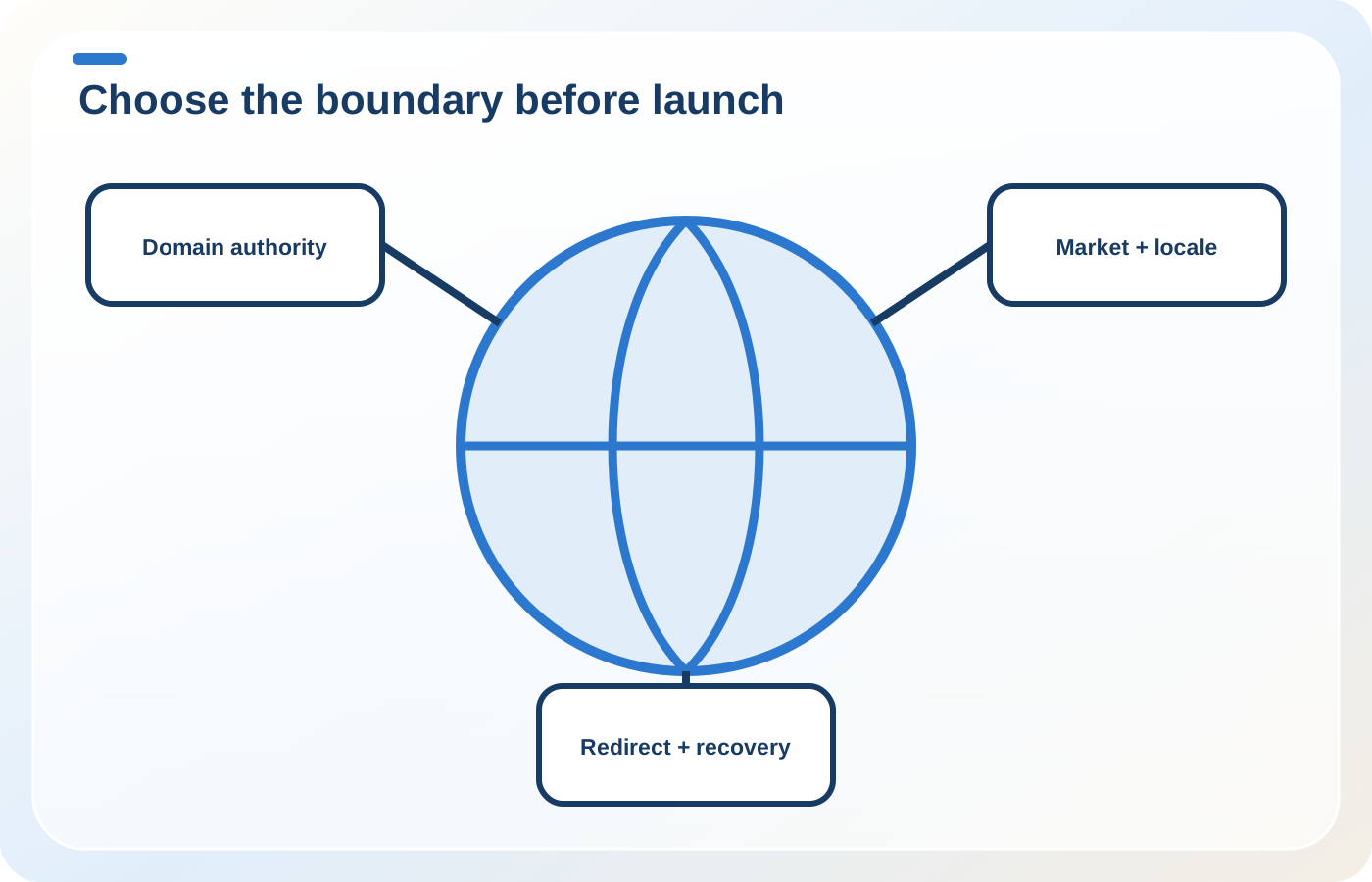
A market URL is an operating boundary disguised as a technical setting. Put France in a subfolder and teams share one domain authority and release surface. Put it on a country domain and DNS, ownership, monitoring, recovery, and legal responsibilities separate.
Make that choice before localization and redirect mapping. Changing it later is another migration, with another set of campaign links, customer routes, crawler signals, and failure paths to reconcile.
Your URL model is an operating model
Ask who owns domains, DNS, translations, localized merchandising, legal content, tax and duty configuration, paid destinations, Search Console properties, and incident response in each market.
If the same team operates one catalog and shared content with regional adjustments, subfolders can reduce infrastructure and authority fragmentation. If markets require independent domain ownership, governance, or legal presence, a subdomain or country domain might be justified despite added operational work.
Compare models by ownership, not aesthetics
Shopify documents three market URL strategies:
| Model | Authority and operations | Migration implication |
|---|---|---|
| Subfolder | Shares the primary domain and is simplest for most stores | Central redirect map and shared domain operations |
| Subdomain | Clear separation with separate DNS and search-property considerations | Each host needs launch and monitoring controls |
| Country domain | Strong local signal and independent domain requirements | Highest ownership, registration, redirect, and recovery burden |
Do not choose a country domain because it looks more local if the business cannot maintain registration, DNS, localized content, customer service, and market-specific monitoring. Do not choose a subfolder merely for simplicity if the market has a genuinely separate operating and legal boundary.
Bind market, locale, currency, and catalog
Build the source inventory with hostname, path, language, country, currency, canonical, hreflang cluster, indexability, product availability, and destination market.
A path such as /fr/ can mean language, country, or both on a legacy platform. Shopify market subfolders can combine language and country codes on secondary markets. Preserve the meaning before generating destinations.
For each source URL, record:
- intended country and language;
- destination domain and subfolder;
- localized product availability;
- content replacement or translation status;
- canonical and hreflang expectation;
- redirect decision;
- paid, email, affiliate, QR, and support references;
- owner and deactivation path.
Test routes as customers and crawlers
Shopify states that configured Markets domains, languages, and localized content receive automatic hreflang tags, canonical URLs, and international sitemap handling. Search crawlers are excluded from automatic customer redirection so they can access requested regional URLs.
Test these as separate cases:
- Direct request to each market URL.
- Customer arriving from a matching and nonmatching region.
- Customer changing country and language selectors.
- Known crawler requesting each localized path.
- Campaign URL with an explicit country parameter.
- Product unavailable in a market.
- Market deactivation or domain disconnection.
Do not infer crawler behavior from a browser redirected by location. Inspect the rendered canonical, hreflang set, sitemap membership, response status, and indexability for the exact URL.
Design the exit before the entry
Shopify warns that deactivating a market that uses subfolders can leave those URLs unavailable, and removing a market domain can create 404 responses. Decide where customers and crawlers should go if a market closes, a domain expires, or localized content is withdrawn.
Keep domain-renewal ownership, DNS access, redirect capability, and a market retirement map in the operating record. A market should not depend on one person's registrar account or an undocumented app rule.
Recognize when one store is the wrong boundary
URL structure cannot solve independent inventory, checkout, payment, regulatory, operational, or release requirements. If regions need fundamentally separate commerce operations, compare a multi-store model before forcing the separation into Markets URLs alone.
Map one market end to end
Create one row per active market and language. Add domain model, operating owner, content owner, domain renewal, Search Console property, localization completeness, customer-routing test, crawler test, and deactivation destination. Any blank field is an architecture risk before migration.
Sources
- Shopify Help Center, International SEO for markets, accessed August 24, 2026
- Shopify Help Center, Assigning domains and languages to markets, accessed August 24, 2026
- Shopify Help Center, International domains, accessed August 24, 2026
- Google Search Central, Site moves with URL changes, accessed August 24, 2026