
Replatforming to Shopify should not begin with a single full import followed by launch-day checks. A safer approach is to rehearse the migration with representative data, compare the result with the source platform, fix the mapping, and repeat before the final cutover.
For US ecommerce teams, the rehearsal is where product structure, customer access, order history, tax, shipping, payments, and redirects can be tested together. It turns migration from a transfer task into an evidence-based launch decision.
Why a rehearsal is different from a test import
A test import answers a narrow question: can a file or API job create records in Shopify? A rehearsal asks whether the resulting store can support real customer and operational journeys.
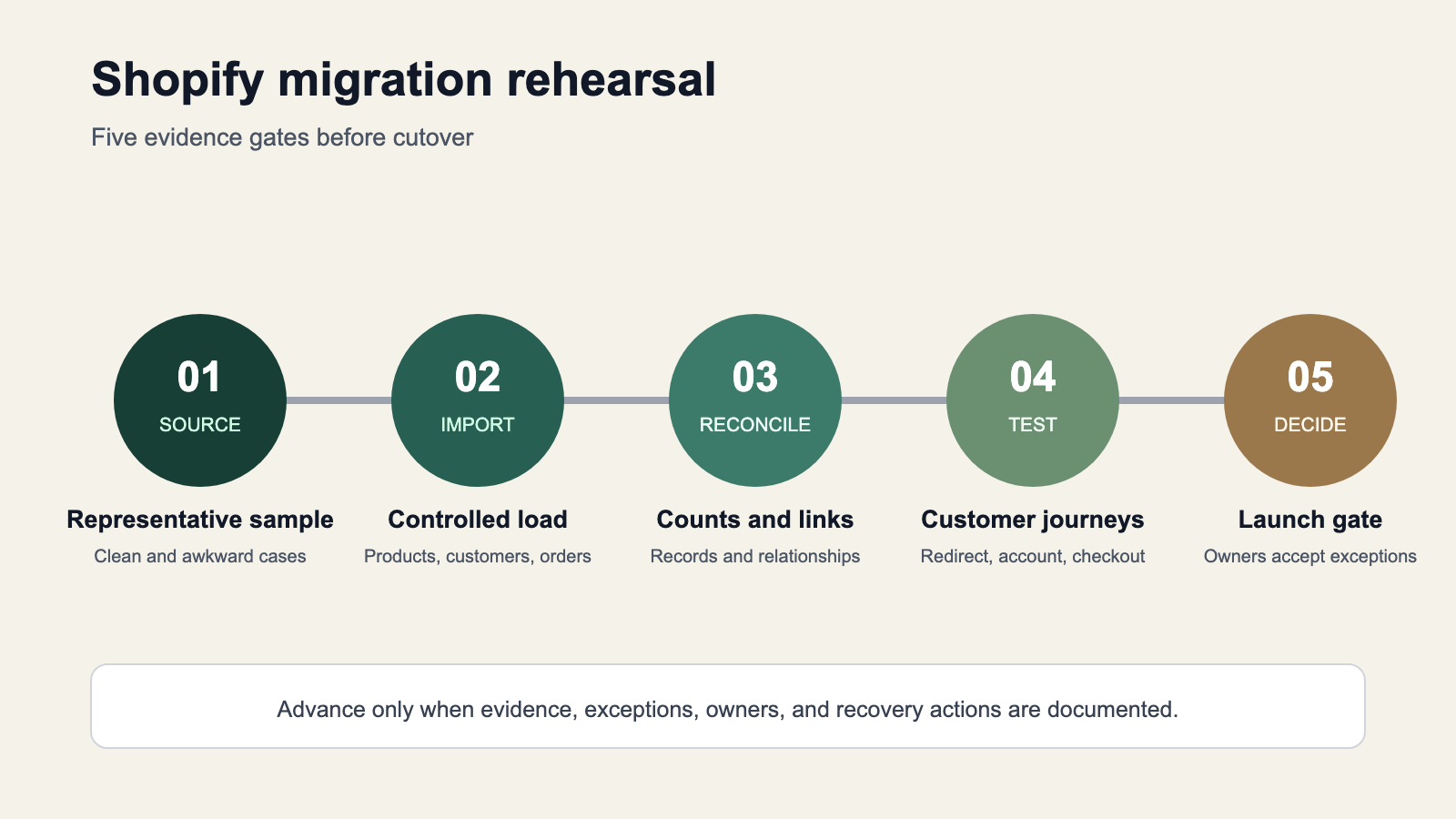
Shopify recommends importing products first, then customers, then historical orders so that the records can be connected correctly. That sequence is necessary, but it does not prove that relationships, variants, inventory, customer access, or reporting behave as intended.
The rehearsal should use a controlled sample that includes awkward cases: a product with several variants, an archived item, a customer with more than one address, a refunded order, a discount, a tax-exempt customer, and an order containing a product that is no longer sold. The sample should reflect the business, not simply what is easiest to import.
Build the data contract before mapping fields
Start with a data contract, a plain-language record of what will move, what will be transformed, what will remain in an archive, and who accepts each limitation.
For products, define how source IDs, handles, SKUs, options, media, collections, metafields, inventory locations, and publication status map into Shopify. Be cautious when updating product CSV option values. Shopify notes that changing option values can create new variant IDs, which can break third-party dependencies on those IDs.
For customers, document the account experience as well as the fields. Shopify customer CSV imports cannot migrate passwords from another platform. If the chosen account model requires customers to set new credentials, the communication, support path, and timing need approval before launch.
Historical orders need their own decision. Shopify lists migration apps and its order and transaction APIs as routes for importing them. Imported orders also have operational consequences. Shopify warns that staff with new-order notifications enabled can receive an email for every historical order imported. Notification settings belong in the runbook, not in a last-minute note.
Reconcile the result, not just the job log
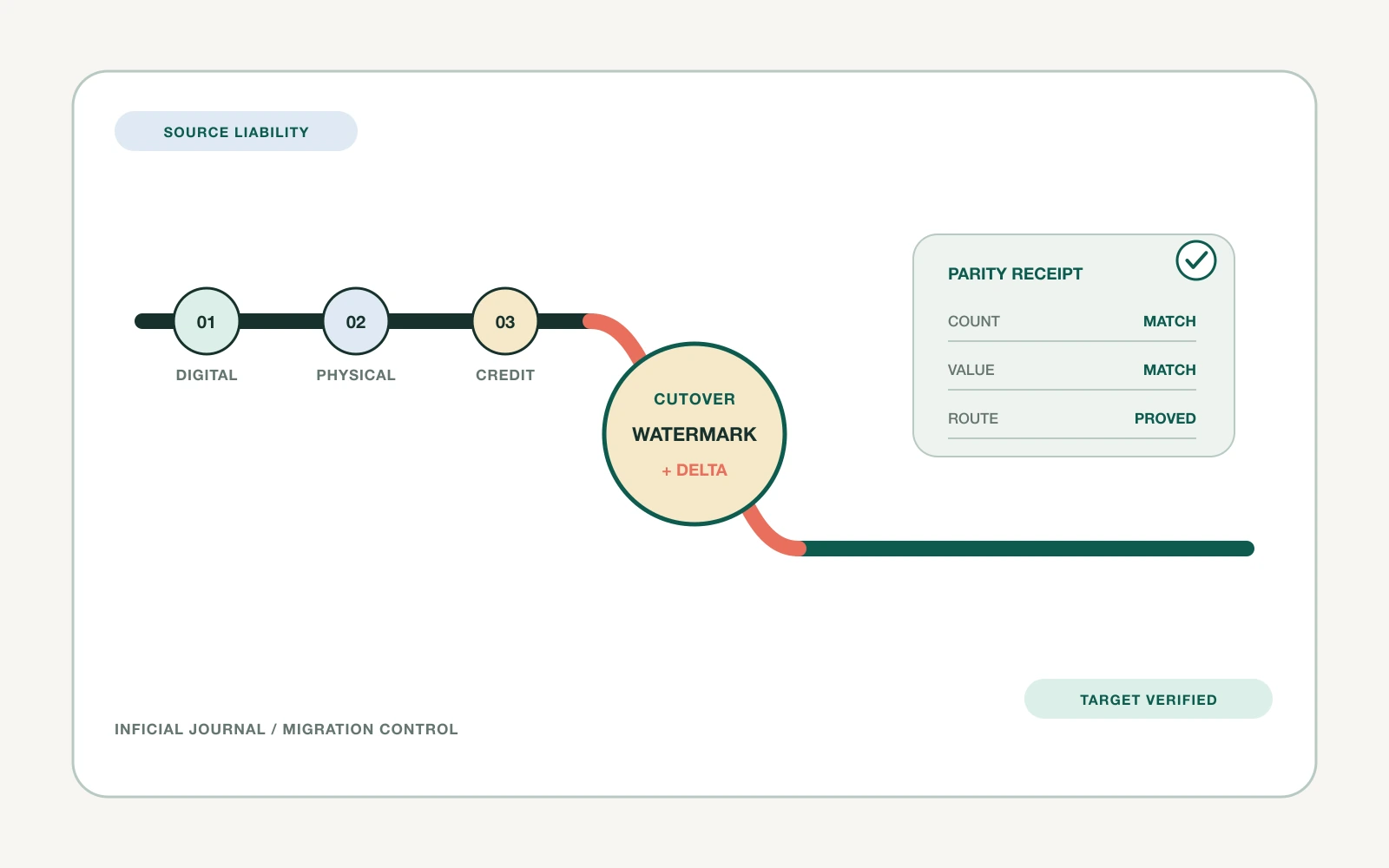
An import can report success while the storefront result is incomplete. Reconciliation compares the source extract, the transformed file, and the Shopify destination.
- Counts: products, variants, customers, addresses, orders, discounts, pages, and redirects.
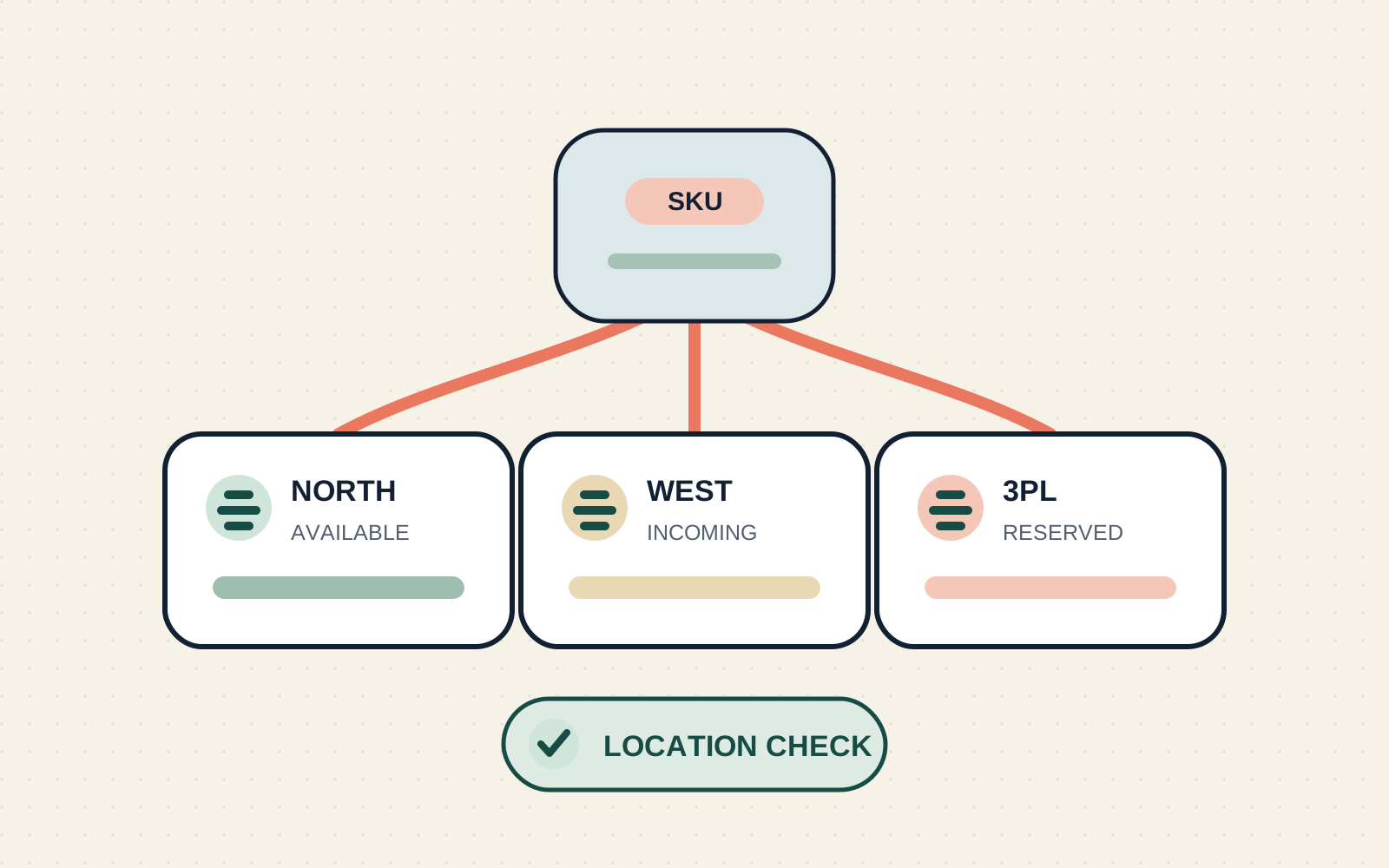
- Relationships: variants attached to the right products, orders attached to the intended customers, and inventory assigned to the correct locations.
- Experience: product pages, collection rules, account access, search, cart, checkout, notifications, taxes, shipping, refunds, and integrations.
Record exceptions explicitly. A difference can be accepted, fixed, or deferred, but it should not disappear inside a spreadsheet. The launch approver needs a short exception register with impact, owner, decision, and recovery path.
Test redirects as customer journeys
Shopify URL structures can differ from those on the source platform. Build the redirect map from the existing URL inventory, then test old URLs against their intended destinations.
Do not assume every path can be redirected. Shopify reserves several path prefixes and only applies redirects from URLs that are broken. Google also recommends testing redirects, removing temporary crawl blocks, and verifying both the old and new site variants in Search Console when URLs change.
This is more than an SEO check. Old product links may appear in email, paid media, support articles, wish lists, and customer bookmarks. Sample each important source and confirm that the destination satisfies the same intent. Avoid sending every retired URL to the home page.
Run complete checkout scenarios
Shopify recommends placing at least one test order during store setup or after payment-setting changes. A migration rehearsal should go further and cover the combinations that matter to the business.
For a US store, include representative states, shipping zones, tax outcomes, discount rules, inventory locations, payment methods, notification emails, cancellations, refunds, and any subscription or fulfillment integration in scope. Shopify states that payment test mode prevents customers from placing live orders, so the rehearsal window and ownership must be controlled.
Test from the customer side and the admin side. A successful order confirmation page is not enough if inventory, tax, fulfillment, analytics, or downstream systems receive the wrong data.
Make launch approval evidence-based
End the rehearsal with a short gate review. Each workstream owner should state what passed, what failed, what remains open, and whether the recovery plan is credible.
The final cutover plan should specify the source-data freeze, last delta import, DNS change, payment activation, redirect activation, smoke tests, monitoring window, and rollback authority. Rollback does not always mean restoring the old platform. It can mean pausing checkout, reversing DNS, disabling a faulty integration, or routing support to a controlled manual process.
A rehearsal adds work before launch, but it replaces guesswork with observable evidence. That is the real purpose: not a perfect migration, but a store whose known risks are visible, owned, and acceptable.
Inficial can help plan the data contract, rehearsal, cutover, and post-launch ownership for a Shopify migration. The goal is a launch decision backed by evidence, not optimism.
Sources
- Shopify Help Center: Migrate to Shopify
- Shopify Help Center: Using CSV files to import and export products
- Shopify Help Center: Importing and exporting customer lists
- Shopify Help Center: Creating and managing URL redirects
- Shopify Help Center: Placing a test order
- Google Search Central: Site moves and migrations