
A redirect CSV can pass an import check while sending a discontinued product, a high-authority guide, and an old campaign to the same irrelevant page. The file is valid. The migration is not.
Treat the map as a directed graph. Every source needs a defensible destination or an explicit decision to end. Every path should survive an adversarial question: where does this customer, crawler, campaign, or support bookmark land in one hop?
A redirect spreadsheet hides a graph
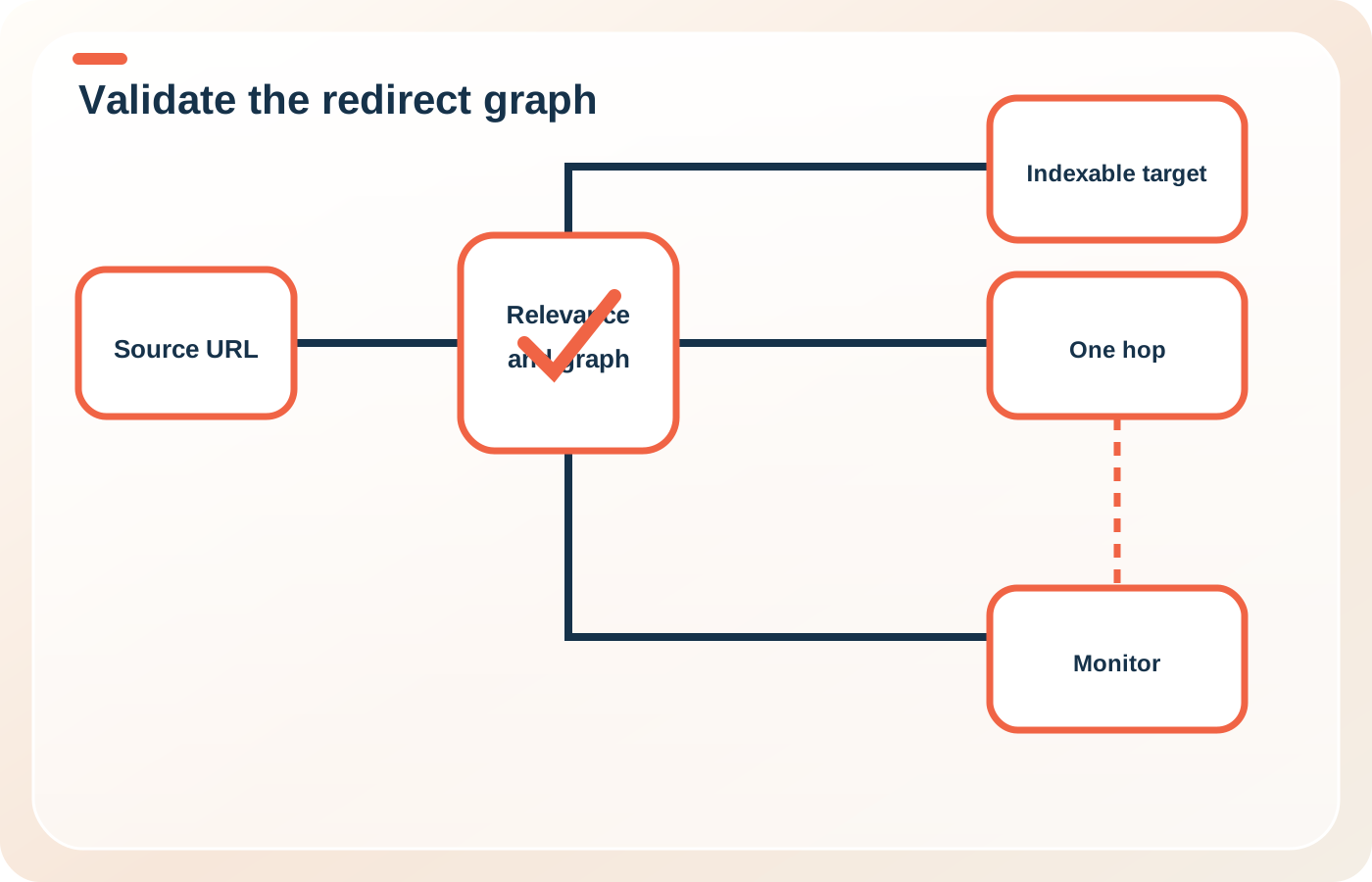
Each old URL is a source node. Each Shopify URL is a destination node. A redirect is an edge with an intended meaning: replacement, consolidation, retirement, or temporary routing.
That model exposes defects a row-by-row review misses. Two old product URLs might legitimately consolidate into one canonical product. Two hundred unrelated blog, collection, and product URLs should not all point to the homepage. Google explicitly advises against redirecting many old URLs to one irrelevant destination. Shopify also reserves several path prefixes, including /cart, /orders, and /apps, so not every desired source path can be represented as a standard Shopify URL redirect.
Build the inventory from six evidence sets
Do not start with the current CMS export alone. It often omits expired campaigns, parameters, legacy category paths, translated URLs, PDF assets, and pages generated by apps.
Build a source inventory from at least these records:
| Evidence | What it contributes | Important limit |
|---|---|---|
| Current crawl | Live status, canonicals, internal links | Misses orphaned URLs |
| Search Console exports | URLs receiving impressions or clicks | Limited historical window |
| Analytics landing pages | Customer entry paths | Tracking gaps can hide demand |
| Backlink export | Externally referenced URLs | Tool coverage varies |
| XML sitemaps | Intended indexable inventory | Can contain stale entries |
| Paid, email, QR, and support links | Operational traffic outside organic search | Often owned by separate teams |
Assign every URL a stable source identifier. Keep the original URL, normalized path, current response, canonical target, page type, market, language, traffic evidence, external-link evidence, owner, proposed disposition, and destination.
Give every source URL a disposition
Use four dispositions:
- Equivalent replacement: the same product, article, policy, or collection exists on Shopify.
- Intent-preserving consolidation: several sources can reasonably resolve to one stronger destination serving the same need.
- Retirement with a useful parent: the exact resource is gone, but a close category or guidance page answers the next question.
- Gone: no relevant destination exists. Preserving a misleading route can be worse than returning a clear not-found response.
The mapping reviewer should be able to explain the destination without reading the slug. If the explanation is only "closest keyword match," the edge is not ready.
Try to break the graph before launch
Relevance failure
Compare source purpose, content type, market, language, product identity, and customer task. A discontinued product should not automatically route to a collection if the collection cannot help the visitor find a successor.
Graph failure
Reject loops and chains. Every accepted source should resolve directly to the final destination. Chains add latency and make later maintenance harder.
Destination failure
Fetch the destination in the intended market and verify a successful response, self-consistent canonical, indexability, usable content, and correct locale. A redirect to a soft 404 or unavailable market page has not preserved the path.
Platform failure
Test the exact CSV against Shopify's redirect rules. Reserved prefixes, account routes, app proxies, and query-dependent behavior need separate handling. Record any source that requires an edge-layer rule, application route, campaign update, or deliberate retirement.
Turn cutover logs into a live queue
Freeze the approved mapping version. Run a pre-cutover test against the destination store, then rerun it immediately after domain or routing changes. Monitor high-value source URLs, 404 volume, redirect response distribution, destination availability, sitemap processing, organic landing pages, paid destinations, and support contacts.
Use thresholds tied to action. For example, a critical campaign URL returning 404 is an immediate correction. A rise in long-tail 404s may require classification before bulk changes. The SEO owner should decide relevance; engineering should own implementation; merchandising and content owners should approve replacements; the release lead should control the cutover version.
Rollback is not always a DNS reversal. It can mean restoring the previous redirect file, pausing campaign changes, reopening a retired destination, or routing a critical source to a temporary but relevant page while the permanent destination is repaired.
Let low-value URLs end cleanly
Do not redirect malware paths, internal search results, faceted combinations with no useful equivalent, expired one-time campaign mechanics, or unrelated deleted content merely to reduce a 404 count. A clean 404 with useful navigation is preferable to a deceptive redirect.
Run a 60-minute redirect attack
Take the 100 source URLs with the strongest combined search, backlink, campaign, and support evidence. Add disposition, destination, owner, and reason. Then run graph checks for chains, loops, many-to-one concentration, reserved prefixes, and destination status. That sample will reveal whether the larger migration map is an engineering task, a content decision, or both.
Sources