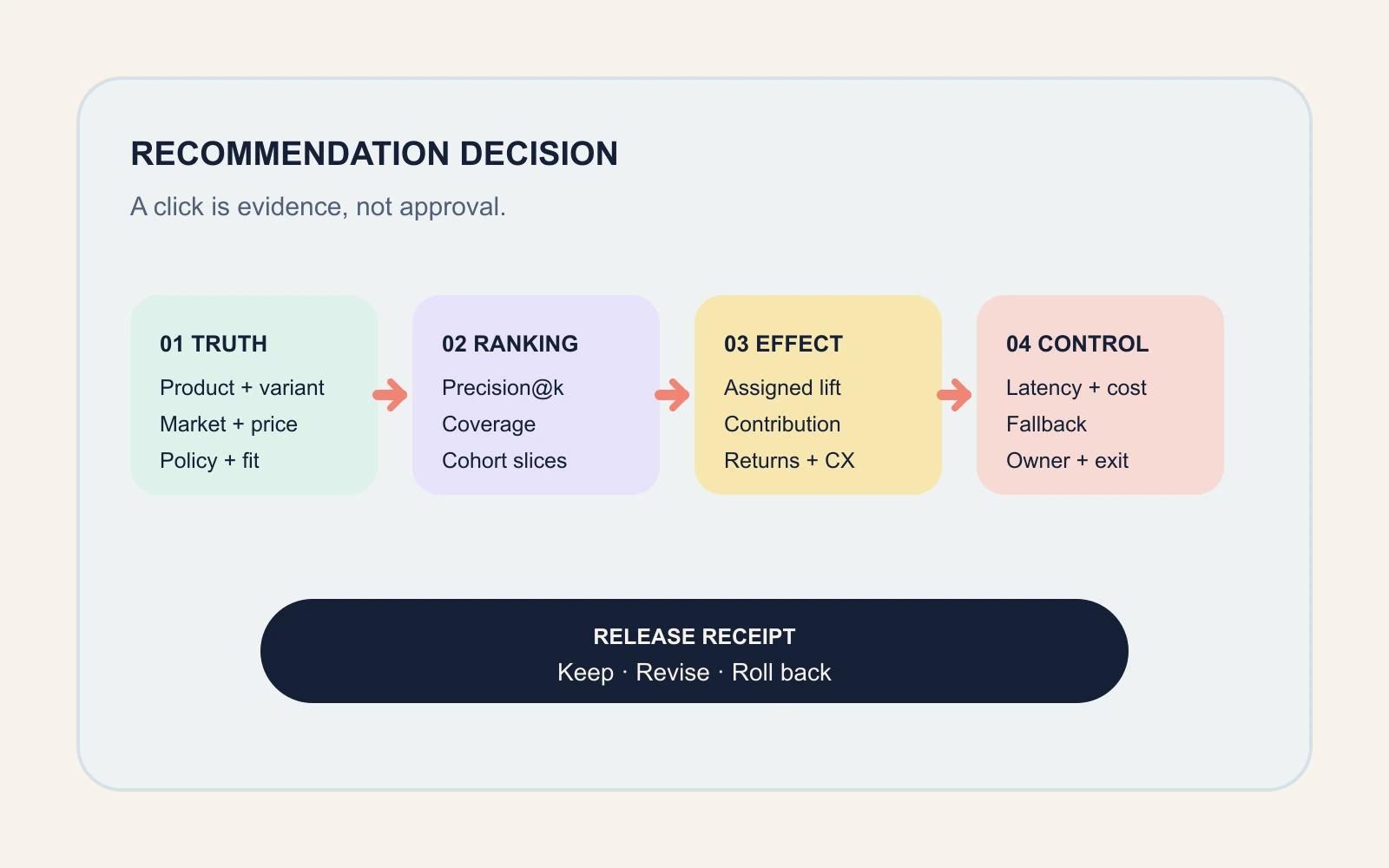

An AI merchandising tool moves high-margin products to the top of a collection. The approved change quietly buries the new range your campaign promised to feature.
This is an uncontrolled store change: the team approved an idea without approving the Shopify objects, blast radius, or reversal.
Give the AI merchandising agent a narrow authority envelope
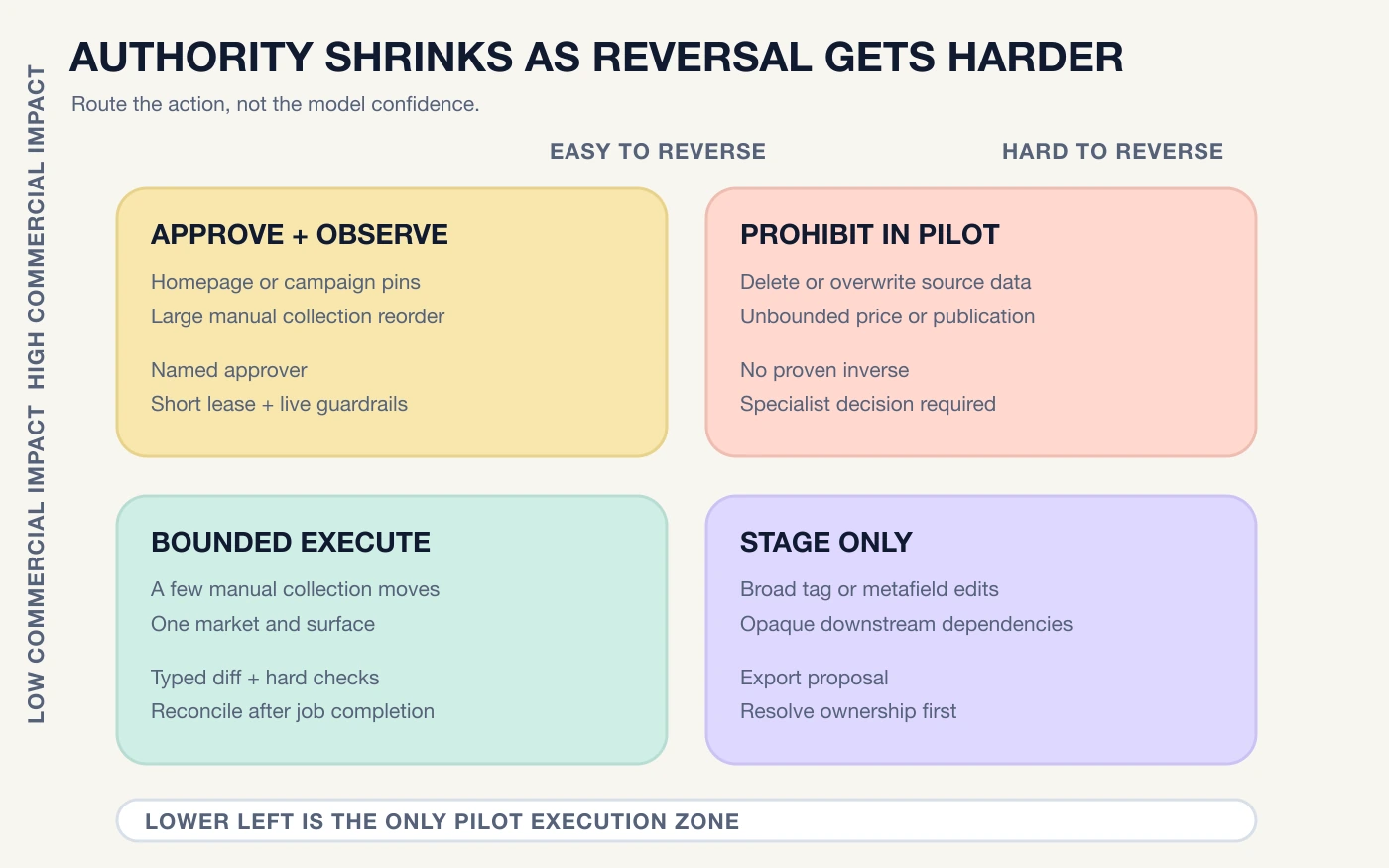
Start with the action, not the model: summarising slow sellers differs from reordering a collection. Define what the system may read, propose, stage, execute, and never touch.
| Action class | Default authority | Reason |
|---|---|---|
| Analyse sales, stock, search, and margin | Read and propose | No storefront change |
| Draft order, synonym, boost, badge, or rule | Stage for review | Needs an exact diff |
| Apply a few moves in one manual collection | Bounded execution | Small reversible scope |
| Change price, availability, publication, or a campaign promise | Specialist approval | Consequences compound |
| Delete products or make an unbounded catalog change | Prohibited in pilot | Recovery is inadequate |
Do not use model confidence as permission. It describes model output, not merchant risk. Authority should depend on the mutation, affected products and markets, reversibility, and approved policy.
Make every proposal a typed, expiring diff
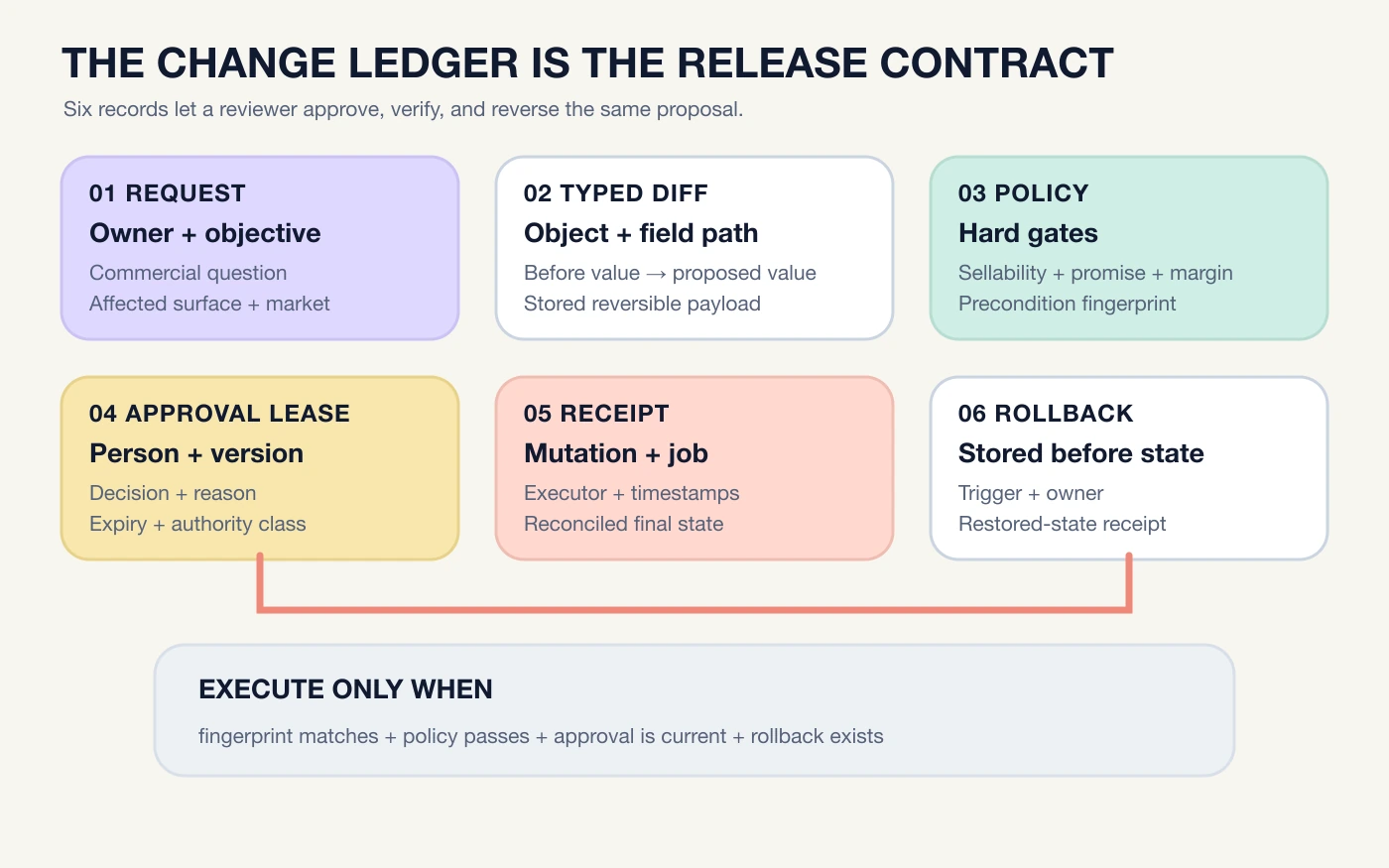
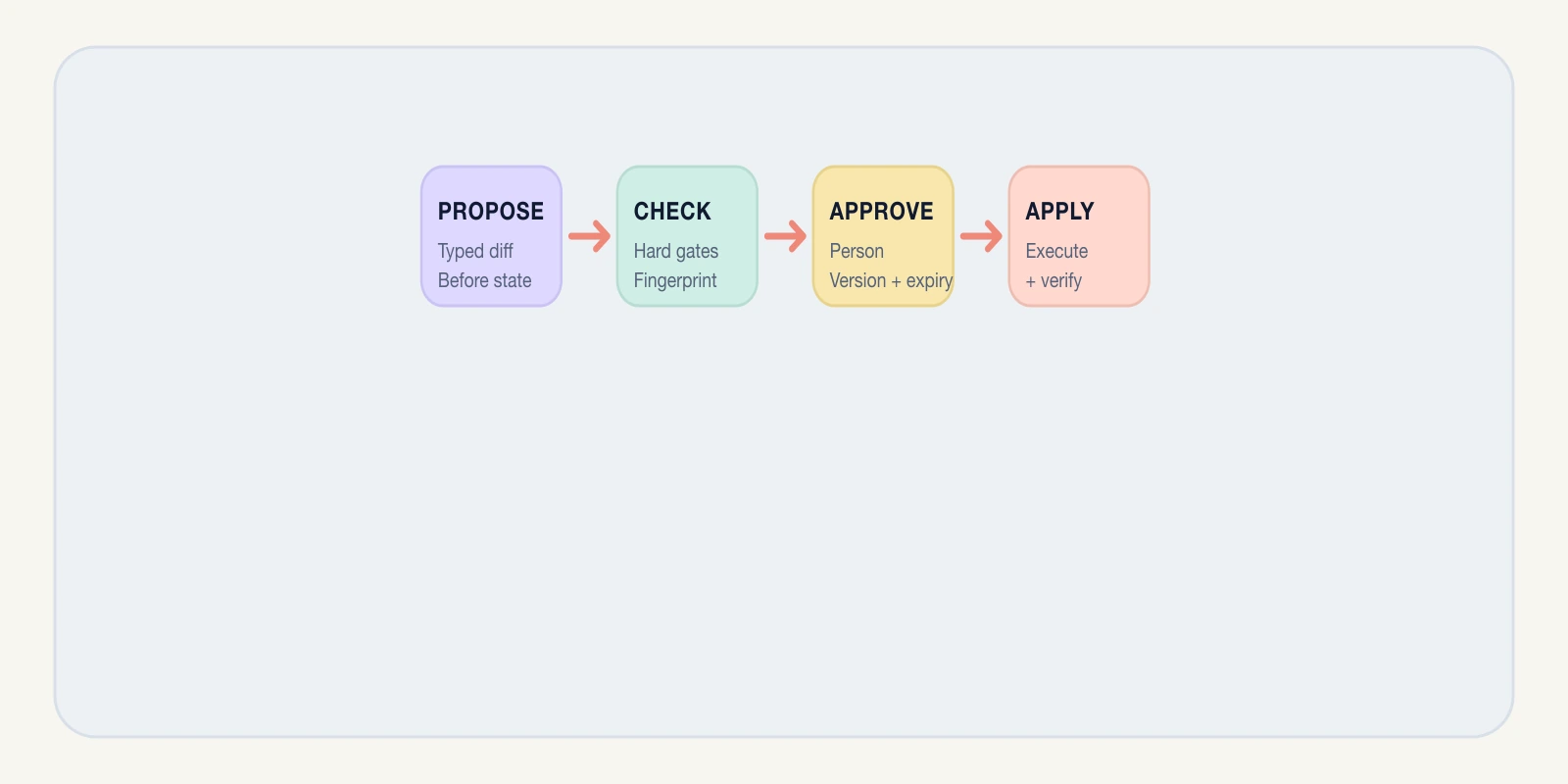
A useful proposal is an executable release candidate. Store resource IDs, field paths, before and proposed values, source snapshot, model and prompt version, objective, affected surfaces, and reversible payload.
Add a precondition fingerprint, approval expiry, and policy version. If a protected field changes before execution, the approval is stale; recompute the diff and ask again.
| Ledger field | Question it answers | Failure if missing |
|---|---|---|
| Objective and owner | Which decision does this serve? | A proxy lacks accountable intent |
| Typed diff | Which objects and values change? | Wording is approved, not execution |
| Precondition fingerprint | Is the starting state current? | Old approval mutates new state |
| Approval lease | Who approved which version, until when? | Approval carries into regeneration |
| Reconciliation receipt | Did the intended state settle? | API acceptance looks like truth |
| Rollback object | What restores the prior state? | Recovery depends on memory |
Human approval is a control only when the human receives a bounded decision. “Approve the AI plan” is not a bounded decision.
Run non-compensating invariants before human review
Remove proposals that should never consume review time. Deterministic checks can verify market sellability, required inventory, campaign pins, price and margin rules, exclusions, and collection mode.
These are non-compensating gates: predicted revenue cannot cancel an unavailable product, prohibited claim, missing market, or violated launch commitment. Return each failure with a named reason.
| Invariant | Evidence | Escalation |
|---|---|---|
| Sellability | Status, market, inventory, variant | Catalog owner |
| Commercial floor | Cost, price, discount, fulfilment | Finance owner |
| Merchandising promise | Pins, launch dates, exclusions | Merchandising lead |
| Change size | Objects, markets, surfaces | Release owner |
| Reversibility | Before state and tested inverse | Engineering |
Separate approval, execution, and reconciliation
Use separate identities where possible: the proposal worker reads, while a narrow executor accepts only a signed, unexpired proposal. Shopify documents that `write_products` covers products, variants, and collections, so application controls still matter.
OpenAI's Agents SDK offers one pattern: pause before an approval-gated tool call, store decision state, then resume after approval or rejection. This does not replace merchant policy, identity, or audit design. Other stacks need an equivalent boundary.
Shopify collection changes can be asynchronous. `collectionReorderProducts` applies moves sequentially to a manual collection and returns a job. Verify completion, query the affected state, and compare it with the approved diff. Shopify warns that webhooks can arrive out of order, be duplicated, or be missed. Use them as signals, then reconcile.
Pilot one manual collection and price the review queue
Use one manual collection, one market, and a product cohort. The 14-day window and move count are illustrative; adapt them to traffic, seasonality, campaigns, and capacity.
- Freeze the baseline order, eligibility, outcome, guardrails, and observation window.
- Reject any proposal without IDs, before state, rationale, and rollback object.
- Run invariants, then record the merchandiser's decision and reason.
- Execute a few approved moves. Poll the Shopify job and reconcile the final order.
- Compare eligible sessions with baseline while holding other changes stable.
- Review rejections, concentration, incidents, and rollback before expanding authority.
| Measure | Why it matters | Decision use |
|---|---|---|
| Invariant pass and rejection reasons | Proposal usability | Fix inputs or policy |
| Review minutes per accepted change | Queue cost | Set capacity |
| Change-to-decision latency | Proposal staleness | Expire or reprioritise |
| Contribution and conversion | Commercial value | Compare with baseline |
| Concentration and new-range exposure | Incumbent reinforcement | Add cohort guardrails |
| Reconciliation and rollback rate | Control instability | Pause expansion |
Price model and data use, policy checks, review time, execution, monitoring, incidents, and vendor fees. Set an approval-queue latency budget because expired proposals are waste.
Write rollback and vendor exit before expansion
Success signal: executed changes match approved diffs, hard invariants pass, review stays within budget, the commercial outcome improves without a guardrail breach, and rollback restores baseline.
Rollback condition: stop execution when a precondition is stale, a gate fails, reconciliation differs, a guardrail is breached, or a move is unexplained. Restore the stored before state, reconcile again, and keep the deterministic baseline active.
Do not use Shopify's store activity log as the release record. Shopify says it is view-only, non-exportable, and displays at most 250 results. Keep an independent ledger of proposals, decisions, receipts, policy versions, and rollback payloads.
Exit when the vendor cannot export the ledger, reproduce proposals on frozen inputs, respect narrow execution, support revocation, or prove deletion. Retain schemas, policies, reason codes, snapshots, and the executor interface. NIST's AI RMF also calls for documented oversight, monitoring, and safe decommissioning.
Frequently asked questions
Should an AI merchandising tool be allowed to reorder Shopify collections automatically?
What exactly should a merchandiser approve?
How do we prevent AI merchandising from promoting only existing bestsellers?
How should we measure the cost of human approval?
What is the safest rollback for an AI merchandising change?
What must an AI merchandising vendor provide before renewal?
No commercial relationship, sponsorship, affiliate arrangement, or endorsement is implied. Platform capabilities and policies can change, so verify them before implementation.
Sources
- Shopify developer documentation: collectionUpdate, accessed September 4, 2026
- Shopify developer documentation: collectionReorderProducts, accessed September 4, 2026
- Shopify developer documentation: Manage access scopes, accessed September 4, 2026
- Shopify developer documentation: About webhooks, accessed September 4, 2026
- Shopify Help Center: Activity logs in the Shopify admin, accessed September 4, 2026
- OpenAI Agents SDK: Human-in-the-loop, accessed September 4, 2026
- NIST AI Risk Management Framework Core, accessed September 4, 2026