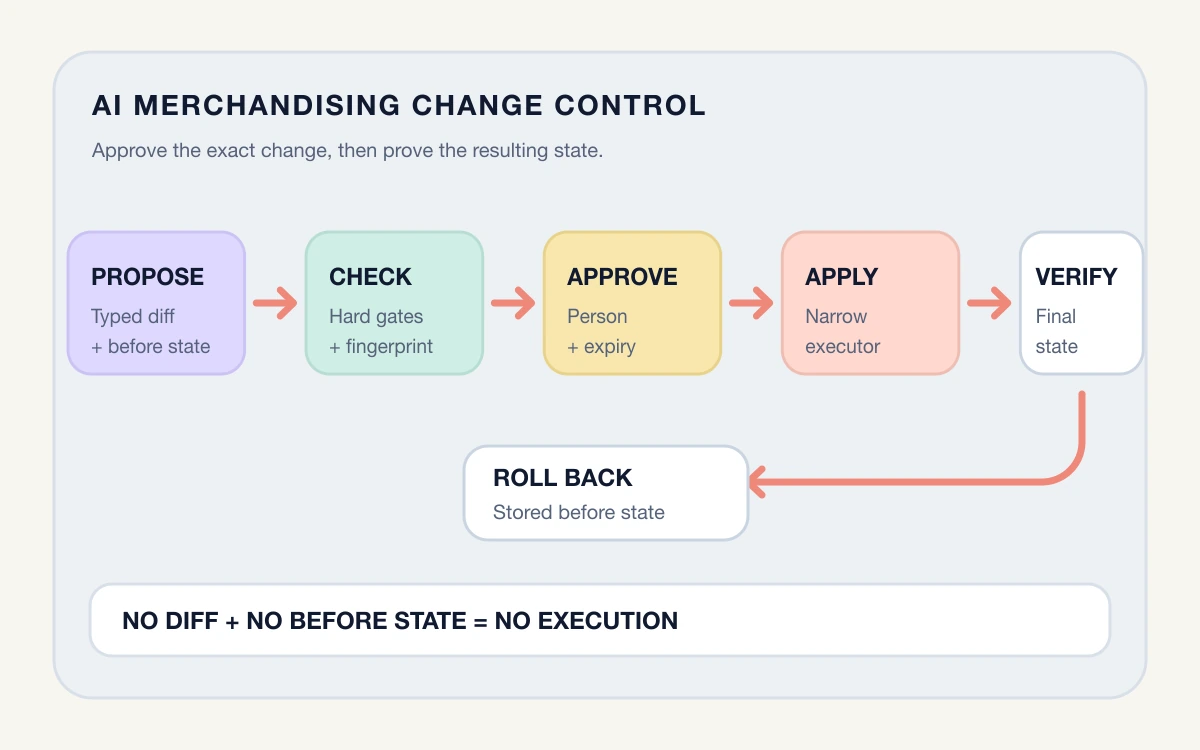

The recommendation test reports a higher click-through rate. The result looks decisive until the team asks which sessions were eligible, which products were actually visible, how often the model fell back, and whether margin, returns, or support demand changed. Nobody can reconstruct the denominator, so the apparent win cannot support a release decision.
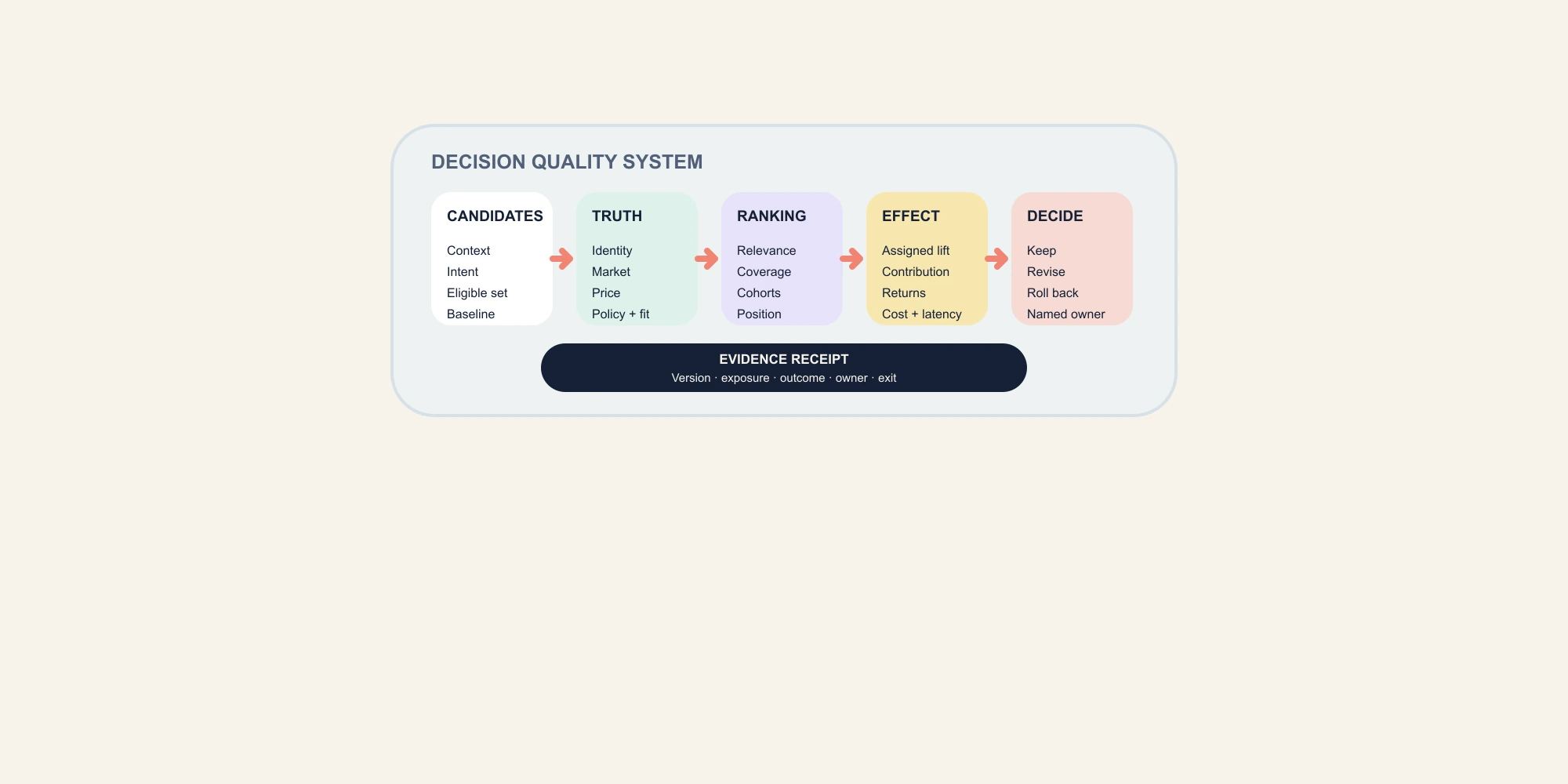
Experienced teams do not need another list of recommender metrics. They need an evidence chain that survives five questions: Was the decision valid? Was the ranking useful? Was the observation biased by exposure? Did the system create incremental commercial value? Can the store operate and reverse it safely?
Define the decision unit before the metric
A product-detail complementary block, a cart cross-sell, a substitute finder, and a conversational shortlist are different decisions. They have different candidate universes, shopper intent, exposure conditions, risk, and attribution windows. Combining them into one recommendation CTR produces a number without a stable meaning.
Write one decision contract per surface and intent. The contract should name the assignment unit, eligibility moment, candidate query, hard exclusions, ranking objective, visible slot definition, baseline, outcome window, guardrails, reviewer, and rollback authority. Version the contract when any of those change.
| Contract field | Decision to freeze | Evidence required |
|---|---|---|
| Unit and eligibility | Session, shopper, cart, or request; exact moment it becomes eligible | Eligibility event and exclusion reason for every resolved request |
| Candidate universe | Products and variants allowed for this market, channel, and intent | Versioned catalog query plus candidate and exclusion counts |
| Objective | Relevance, attach opportunity, contribution, discovery, or a constrained combination | Formula, weight version, and owner-approved trade-off |
| Exposure | What counts as viewable, at which slot, for how long | Impression ID, position, visible state, timestamp, and surface version |
| Outcome | Cart, order, contribution, return, cancellation, support, or another decision event | Join contract, observation window, and late-arriving-event rule |
| Control | Baseline, holdout, fallback, review cadence, and stop authority | Assignment log, tested fallback receipt, and signed release decision |
A rate is not trustworthy until its denominator has an owner. If assigned, resolved, exposed, and measured populations cannot be reconciled, pause the decision before debating uplift.
Build a replayable receipt for every recommendation
Create the receipt when the recommendation surface resolves, not after the click. Record a pseudonymous decision ID, contract version, market, locale, shopper-state class, source product or query, candidate-set version, exclusions, feature timestamp, model or rule version, ranked product and variant IDs, scores, slot positions, fallback state, latency, cost allocation, and experiment assignment.
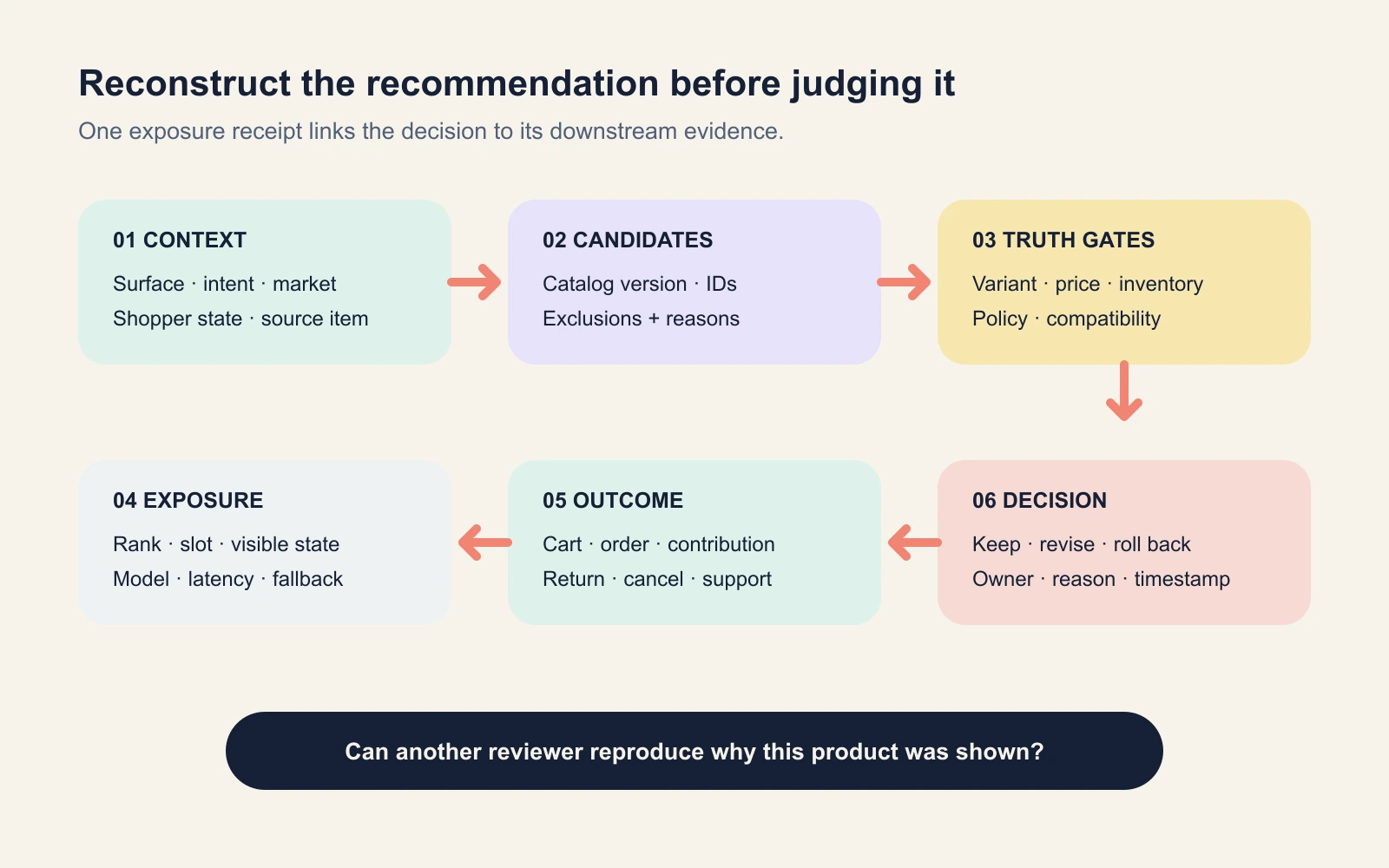
Shopify's Ajax Product Recommendations API accepts related and complementary intent and a result limit from one to ten. ShopifyQL exposes recommendation sessions, clicks, cart additions, and conversion rates. Those platform signals are useful, but they do not automatically preserve the merchant's candidate query, exclusion logic, assignment, margin, post-purchase outcomes, or model version. The merchant receipt closes that gap.
Reconciliation should be routine. For one contract version and time window, count eligible units, assigned units, resolved decisions, viewable exposures, joined orders, late outcomes, fallbacks, and excluded observations. Explain every transition. Silent loss between stages is not cleaning; it is missing evidence.
Separate validity gates from ranking quality
A recommender may rank only inside the set it is permitted to show. Resolve product and variant identity, then test publication, market availability, price, inventory policy, product status, channel eligibility, current-cart exclusion, restrictions, and compatibility. An invalid candidate does not become acceptable because the remaining list has a high relevance score.
Shopify applies different requirements to related and complementary recommendations. Complementary products require inventory above zero; related products can still appear when continue selling after stock reaches zero is enabled. Both must be active, priced above zero, published to the Online Store, and absent from the current cart. Merchant policy can be stricter than the platform rule.
| Layer | Question | Decision treatment |
|---|---|---|
| Product truth | Is the identity, variant, price, availability, claim, and compatibility current? | Critical failure suppresses the item and opens a data incident |
| Commerce eligibility | May this shopper buy this item in this market and channel? | Any prohibited result fails the displayed decision |
| Ranking quality | Does the order satisfy the stated shopper job better than the baseline? | Compare by intent and cohort after hard gates pass |
| Exposure integrity | Was the result actually viewable, in the recorded position, under the assigned experience? | Quarantine corrupt observations and repair instrumentation |
| Commercial effect | Did assigned eligible units create acceptable incremental value and customer outcomes? | Apply the predeclared decision rule and guardrails |
| Operational control | Did latency, cost, fallback, review, privacy, and incident paths remain inside policy? | Hold or roll back when a control boundary fails |
Design the judgment set as a versioned test asset
Build the evaluation set from representative traffic and deliberately difficult cases. Stratify by surface, intent, market, device, shopper state, catalog size, price band, product lifecycle, sparse-history products, high-return categories, restricted products, and missing attributes. Keep the sampling frame and inclusion logic beside the labels.
Define graded relevance before reviewers see model output. A practical rubric might distinguish exact fit, acceptable alternative, weak relation, and invalid. Require each judgment to cite the product or policy fact that supports it. Double-label the risk-bearing strata, measure agreement, and adjudicate material disagreements. Reviewer conflict is evidence about an underspecified merchandising rule, not noise to average away.
- Use precision at k when the cost of irrelevant top results matters.
- Use recall at k when missing a known set of suitable products matters.
- Use a position-aware ranking metric when the order among relevant products matters.
- Report coverage and exposure concentration by product cohort so popular products cannot hide a weak long tail.
- Compare against manual merchandising and the current deterministic or Shopify baseline on the same frozen cases.
- Keep a release split untouched by prompt changes, rule tuning, label discussion, and vendor demonstrations.
Do not choose a universal sample size from an article. Size the set to cover the decision's critical strata and the errors the business refuses to tolerate. For sparse strata, show case counts and reviewer evidence instead of reporting a precise percentage that suggests more certainty than the data supports.
Treat clicks as exposure-biased observations
Historical interaction data is produced by the previous ranking policy. Products placed high receive more opportunities to be clicked; products never exposed cannot earn a click. Microsoft research on click-based recommender evaluation documents position bias in implicit labels, and Google's machine-learning guidance warns that positional features can create feedback loops.
Record position, surface layout, eligibility, ranking policy, and exploration state with each exposure. If a team uses propensity weighting or another counterfactual correction, document the exposure model, clipping rule, diagnostics, and sensitivity analysis. Google Research has shown that propensity can depend on attributes beyond position and layout alone. A sophisticated estimator does not repair missing exposures, unknown assignment, or a changing catalog.
Offline evaluation answers whether the candidate behaves better on the frozen evidence. It does not prove that the live system will create incremental profit. Use it to reject unsafe or clearly weak candidates and to choose what deserves an online test.
Run the online test on assigned eligible units
Choose the assignment unit from the contamination risk. Session assignment may suit an anonymous product-page surface; shopper assignment may be safer when personalization or repeat visits create carryover. Cart, market, device, and surface rules must be fixed before assignment. Analyze all assigned eligible units, including people who never click. That intent-to-treat view protects the causal comparison from post-treatment selection.
| Experiment control | Predeclared decision | Failure signal |
|---|---|---|
| Assignment | Unit, randomization key, eligibility moment, and allocation | Sample-ratio mismatch or repeated assignment across variants |
| Baseline | Exact manual, native, or deterministic experience and version | Control changes during the observation window |
| Primary outcome | One outcome, window, direction, and minimum decision value | Several interchangeable primary metrics or post-hoc selection |
| Guardrails | Contribution, returns, cancellations, support, latency, cost, privacy, and concentration | A hard boundary is averaged into a composite score |
| Observation | Minimum exposure, duration, uncertainty method, and late-event handling | Repeated peeking changes the stop rule |
| Integrity | Assignment-to-exposure and exposure-to-order reconciliation | Missing joins differ by variant or cohort |
Before reading lift, test allocation and instrumentation. A sample-ratio mismatch can indicate broken randomization, eligibility drift, blocking, or missing events. Compare assignment counts with resolved decisions and viewable exposures by variant and cohort. If one experience fails to render more often, a conversion comparison among exposed sessions is already selected.
Read economics and customer harm on compatible denominators
Revenue attributed to recommendation clickers is not incremental value. Estimate the difference between assigned experiences, then translate it into contribution after discounts, cost of goods, payment, fulfillment, expected returns, vendor fees, and inference or retrieval cost. Keep assumptions versioned and show a sensitivity range when return or fulfillment costs arrive late.
Match each guardrail to its population. Returns belong on assigned orders or units, compatibility contacts may belong on assigned sessions or orders, latency belongs on resolved decisions, and cost belongs on all attempted decisions, including timeouts and fallbacks. A single denominator across these measures can hide the exact path that is failing.
- Track p50 and p95 decision latency, plus timeout and fallback rates, by surface and intent.
- Allocate model, retrieval, tool, retry, and platform cost to attempted and completed decisions.
- Measure product-cohort exposure share and concentration before and after release.
- Join returns, cancellations, and support reasons at product or variant level without retaining unnecessary customer fields.
- Set access, retention, aggregation, and deletion rules before real customer data enters the evaluation.
Use a release state machine, not a composite score
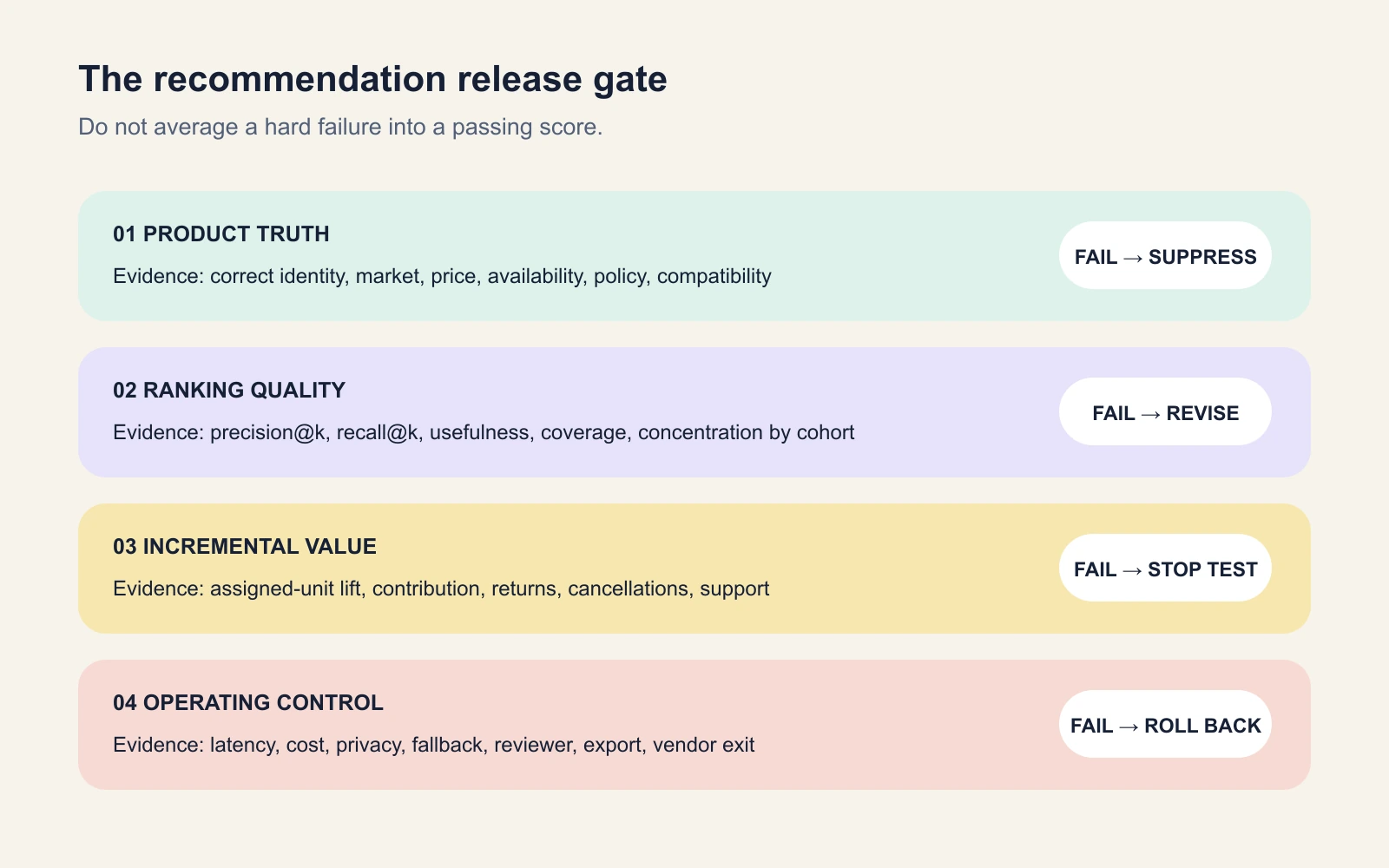
Do not convert validity, relevance, incrementality, and operations into one weighted score. A high ranking score cannot compensate for an unavailable product, broken assignment, privacy incident, or failed rollback. Move the candidate through explicit states with evidence requirements.
| State | Entry evidence | Allowed action | Exit condition |
|---|---|---|---|
| Shadow | Versioned contract, replayable receipt, frozen judgment set | No shopper-visible output | Hard gates and baseline comparison pass |
| Bounded | Reconciled assignment and exposure on one surface and cohort | Small controlled shopper test | Decision rule passes without a guardrail breach |
| Expanded | Stable cohort results, owned incidents, proven fallback | Add only evidence-covered cohorts | Review window closes or evidence expires |
| Hold | Uncertain effect, weak stratum, or repairable instrumentation | Keep baseline; gather named evidence | Repair and rerun from the affected gate |
| Rollback | Critical truth, privacy, integrity, customer, or operational failure | Route all affected traffic to baseline | Root cause fixed and rollback rehearsal passes |
Evidence expires. Catalog mix, product lifecycle, market rules, theme layout, model version, and traffic composition can all move after approval. Record which changes force a partial rerun and which invalidate the whole release receipt. NIST's AI Risk Management Framework calls for testing under deployment-like conditions, ongoing production monitoring, documented limits, and defined human oversight.
Name failure owners before the pilot
| Failure | Immediate containment | Owner and evidence |
|---|---|---|
| Wrong product, variant, market, price, restriction, or compatibility | Suppress the item and serve the deterministic baseline | Product-data and merchandising owners inspect the decision receipt |
| Empty or weak candidate set | Show the approved manual set or no recommendation | Merchandising reviews candidate coverage and exclusions |
| Assignment or outcome mismatch | Pause the causal decision while preserving the safer route | Analytics reconciles eligibility, assignment, exposure, and order joins |
| Latency, rate-limit, or dependency breach | Stop optional work and fall back within the surface deadline | Engineering reviews p95 traces, retries, and unfinished work |
| Commercial or customer guardrail breach | Stop the affected cohort rather than averaging it away | Founder, finance, CX, and data owners review assigned-unit evidence |
| Vendor export or disable failure | Block expansion and isolate credentials and data flows | Security and engineering execute the exit runbook |
Pilot one surface with a reversible decision
- Choose one recommendation surface, one intent, one market, and a bounded product cohort.
- Freeze the decision contract, candidate query, baseline, model or rule version, and receipt schema.
- Replay representative and adversarial cases; double-label the risk-bearing strata and adjudicate disagreements.
- Run shadow mode and failure injection until truth, eligibility, logging, latency, cost, and fallback paths reconcile.
- Start random assignment only after the allocation and exposure checks pass.
- Review hard failures continuously and commercial evidence only at the predeclared decision points.
- Promote only the cohorts with evidence; hold, revise, or roll back the rest.
The success signal is a valid and reproducible decision chain: no critical truth or eligibility failure in the reviewed release evidence, ranking improvement over the named baseline in priority strata, interpretable incremental commercial effect, and no breach of customer, privacy, latency, cost, concentration, or operational guardrails. The merchant sets numeric thresholds from its baseline, minimum decision value, uncertainty, and risk tolerance before assignment.
Roll back immediately when a critical invalid recommendation reaches a shopper, privacy or security is uncontained, assignment or outcome corruption makes the result uninterpretable, or a predeclared stop boundary is breached. Exit the vendor when it cannot export the contract, configuration, receipts, and reviewer evidence; cannot disable cleanly; prevents restoration of the deterministic baseline; or repeatedly misses written remediation obligations.
Take one safe action this week
Select one recommendation surface and reconstruct fifty recent decision contexts without customer identifiers. Rebuild the eligible candidate set, record every exclusion, label the ranked results against a written rubric, and reconcile eligible, resolved, exposed, clicked, and ordered counts. Fifty is an operational starting worksheet, not a statistical claim.
Do not change the live model during this audit. The first mismatch tells you where to invest next: catalog truth, candidate rules, reviewer policy, ranking, exposure instrumentation, experiment design, or vendor control.
Inficial can help Shopify teams define the recommendation contract, build the evaluation set and receipt, reconcile the controlled pilot, and prove the fallback and exit path before recommendations reach more shoppers.
Frequently asked questions
Why is click-through rate insufficient for AI product recommendation evaluation?
Which offline metrics should an ecommerce recommender use?
How large should a recommendation evaluation set be?
What should be randomized in a recommendation experiment?
How should a team account for position bias in recommendation clicks?
What evidence should a recommendation vendor export?
Sources
- Shopify developer documentation: Product Recommendations Ajax API, accessed September 3, 2026
- Shopify developer documentation: Storefront API productRecommendations query, accessed September 3, 2026
- Shopify developer documentation: ShopifyQL product recommendation conversions schema, accessed September 3, 2026
- Shopify Help Center: Customize product recommendations with Search & Discovery, accessed September 3, 2026
- Google for Developers: Recommendation systems scoring, accessed September 3, 2026
- Google for Developers: Rules of Machine Learning, accessed September 3, 2026
- Google for Developers: Machine Learning metrics glossary, accessed September 3, 2026
- Google Research: Attribute-based Propensity for Unbiased Learning in Recommender Systems, accessed September 3, 2026
- Microsoft Research: Effects of Position Bias on Click-Based Recommender Evaluation, accessed September 3, 2026
- NIST AI Risk Management Framework Core, accessed September 3, 2026