
The demo answers one product question perfectly. Then a shopper asks a vague follow-up, the assistant makes two retrieval calls, produces a long answer, hits a rate limit, retries, and keeps the product grid waiting.
That is not just an AI quality problem. It is an operating-budget failure.
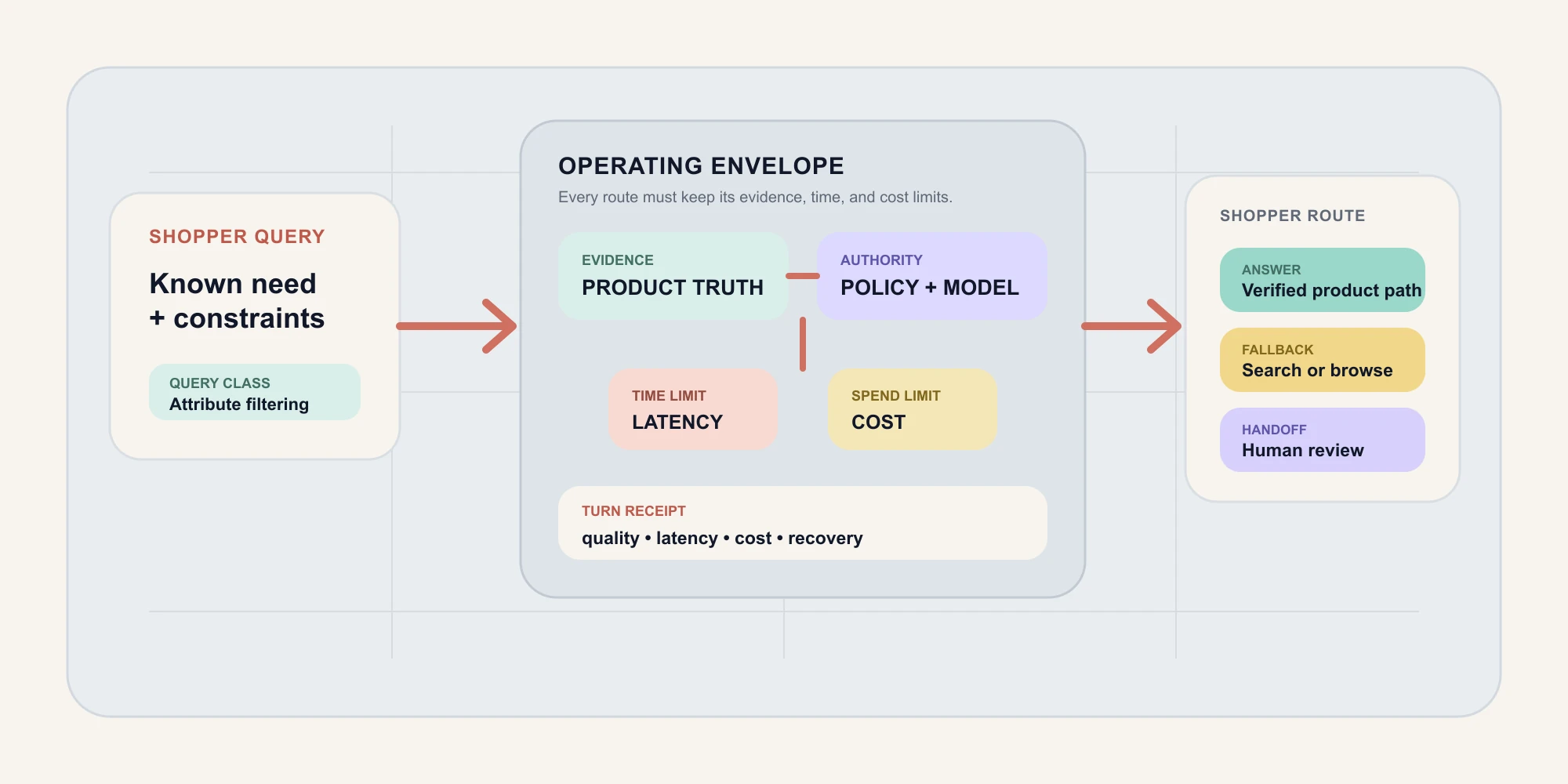
An AI shopping assistant needs limits for answer quality, response time, variable cost, retries, data use, and recovery. Without them, a team can approve persuasive answers while missing the slow, expensive, or unhelpful paths that real shoppers find first.
The answer is only one line in the budget
Reader question: What are we actually approving?
A shopping answer can be accurate and still fail commercially. It can arrive after the shopper has left, cost more than the assisted margin can support, expose unnecessary data, or end without a usable product path.
Define the assistant as a controlled journey:
shopper question -> approved product truth -> answer or clarification -> product path -> fallback or handoff
Then assign an owner and evidence to each boundary.
| Budget | Prewritten decision | Evidence to retain |
|---|---|---|
| Quality | What facts may the assistant state, and when must it abstain? | Expected answer, cited product fields, reviewer verdict |
| Cost | What variable spend is acceptable per completed assisted session? | Provider usage, retrieval and tool charges, retries, platform fee |
| Latency | How long can first useful output and full completion take? | Server timings by step, p50 and p95, timeout reason |
| Recovery | What does the shopper see if a dependency fails? | Fallback route, message, destination, recovered outcome |
| Privacy | Which data is necessary, retained, and shared with each provider? | Data map, retention setting, contract check, redacted log |
| Authority | What can the assistant recommend, compare, or change? | Action policy, approval step, escalation owner |
This is a merchant policy, not a universal benchmark. A high-consideration furniture question and a quick compatibility check may deserve different envelopes.
A fast wrong answer is not a latency win. A correct answer that quietly loops through paid retries is not a reliability win. Approve the whole receipt.
Segment the budget by query class and authority
Reader question: Why is one global budget technically weak?
A request for “black running shoes under $150” is not the same system as “Will this supplement interact with my medication?” The first can often be reduced to approved catalog constraints. The second crosses into a sensitive decision where the store may have neither the evidence nor the authority to answer.
Classify the query before routing it. The classification does not need to be generated by the same model that writes the answer. A deterministic rule, lightweight classifier, or constrained model can assign a route, but the evaluation set must test misclassification because the route controls spend and risk.
| Query class | Minimum evidence | Allowed output | Budget posture | Default escape route |
|---|---|---|---|---|
| Navigation | Known product, collection, or policy destination | Link or short factual response | Prefer deterministic resolution | Search or browse |
| Attribute filtering | Structured catalog fields cover every stated constraint | Filtered products plus disclosed constraint | Short answer, low tool count | Filtered collection |
| Comparison | Comparable attributes and current commercial terms are available | Side-by-side differences with missing fields named | Higher retrieval allowance, strict fact gate | Comparison page or human help |
| Compatibility | Exact model, dimension, ingredient, or fit evidence is present | Verified compatibility or explicit abstention | No inference across missing identifiers | Specialist handoff |
| Exploratory discovery | Preference can be translated into approved merchandising signals | Bounded shortlist and one useful clarification | Controlled generation and result count | Curated collection |
| Sensitive advice | Store policy and qualified evidence authorize the answer | Usually refusal, caveat, or qualified human route | Hard authority gate | Trained human or external professional |
Create a policy record for each class:
query class -> evidence contract -> allowed tools -> token cap -> deadline -> retry policy -> fallback -> owner
This prevents a global prompt from quietly making the most sensitive route as permissive as the simplest one. It also stops a high-cost comparison workflow from becoming the default for a navigational question that native search could answer faster.
Use a risk lexicon only as an early signal. Terms such as “safe,” “compatible,” “medical,” “guaranteed,” or “best for” are ambiguous. The route should combine language, requested action, product category, available evidence, and merchant policy rather than relying on one keyword.
Write one operating receipt for every turn
Reader question: Where does the money and time go?
Use a variable-cost equation that preserves retries and abandoned work:
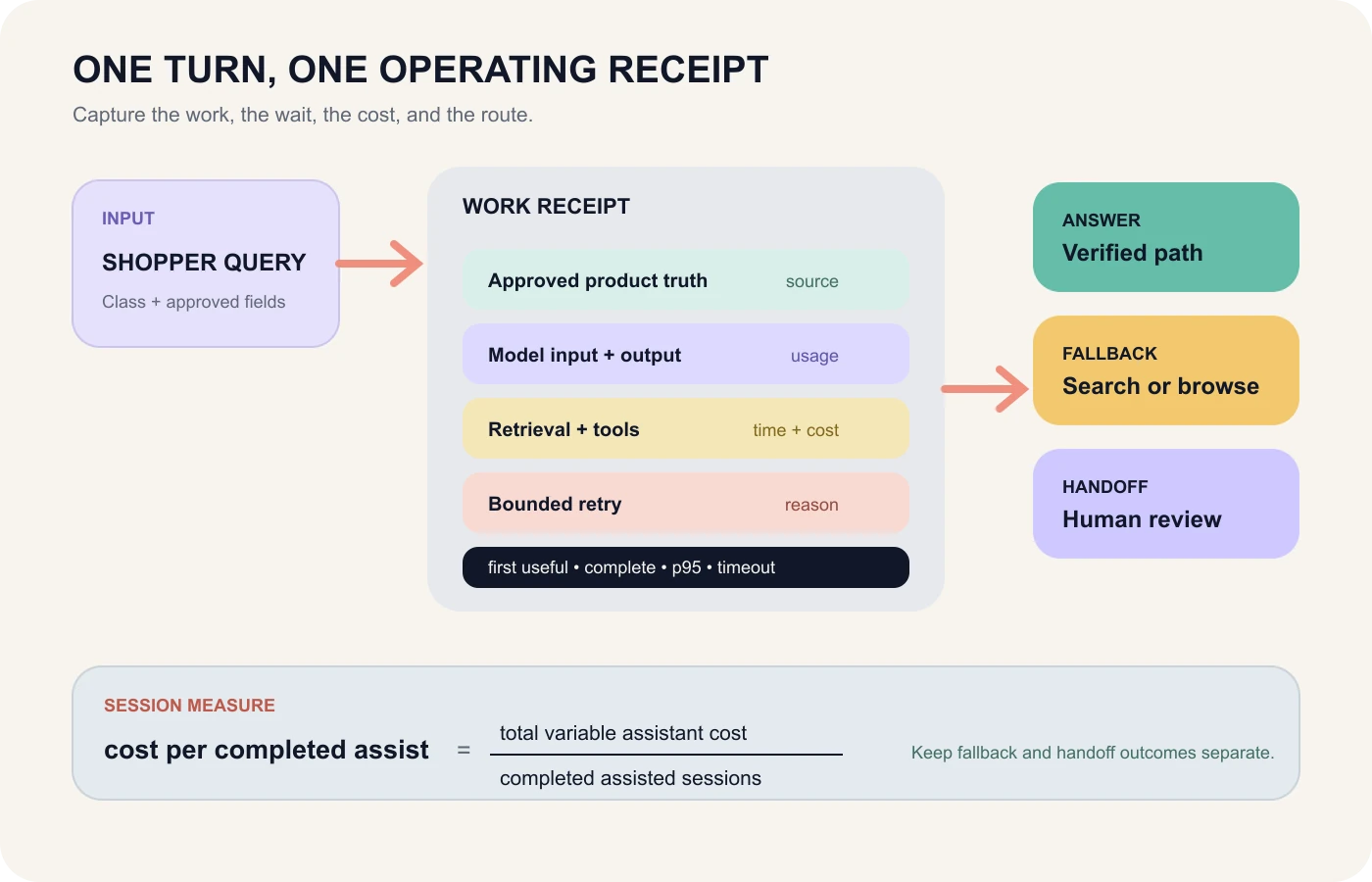
turn cost = model input + model output + retrieval + tools + retry attempts + platform allocation
Then measure:
cost per completed assisted session = total variable assistant cost / sessions that reached the defined useful outcome
Do not divide only by all sessions. A cheap failure is not a completed assist. Keep abandoned, fallback, and human-escalated sessions visible as separate outcomes.
Instrument the receipt as one trace, not as a spreadsheet assembled after an incident. Give the shopper turn a trace ID. Record orchestration, retrieval, model, and tool work as child spans with start time, duration, status, provider request ID where available, usage, cancellation state, and error class. Pin the prompt, policy, retrieval index, product snapshot, model, and fallback versions.
The difference between an attempt and a turn matters. A single turn may create several paid attempts. If the client, application server, provider SDK, and job worker each retry independently, the receipt must expose that multiplication instead of reporting only the final success.
The receipt should contain:
- a pseudonymous session and turn ID;
- query class, such as compatibility, comparison, fit, policy, or discovery;
- model and configuration version;
- input, cached input where supported, and output usage;
- retrieval and tool calls with individual durations and charges;
- retry count and retry reason;
- deadline remaining at each dependency call, cancellation result, and whether late work continued after the shopper was routed elsewhere;
- time to first useful result and time to completion;
- product IDs offered, product facts cited, and confidence or abstention state;
- final route: answer, clarification, deterministic search, category browse, or human handoff;
- reviewer verdict and shopper outcome when available.
Current OpenAI production guidance connects cost and latency: fewer requests, fewer tokens, and a smaller model can reduce both, provided evaluations show that quality remains acceptable. Prompt caching is a provider-specific optimization for repeated prompt prefixes, not a substitute for measuring complete session cost. Check the current pricing and caching rules of the provider actually used before approving a budget.
Add two finance views. Marginal cost per completed assist answers whether another assisted session fits the unit economics. Daily exposure at the concurrency cap shows the maximum variable spend the system can create before someone intervenes. Both require actual provider usage and tool charges, not a token estimate alone.
Set a latency ladder, not one average
Reader question: Which response time matters to a shopper?
An average can hide the exact experience that breaks trust. Record at least:
- Time to acknowledgement: Did the interface respond to the action?
- Time to first useful result: When did the shopper receive a product, clarification, or concrete next step?
- Time to completion: When did the final answer and product path settle?
- p95 completion time: How slow were the worst routine turns?
- Timeout and fallback rate: How often did the assistant stop using the AI path?
Decompose end-to-end latency before optimizing it:
completion latency = queue + orchestration + retrieval + model first-token wait + generation + tool work + network and render
The critical path is the longest chain of dependent work. Adding every span duration can overstate latency when independent calls run in parallel. Looking only at the model can understate latency when queueing, retrieval, or a tool dominates. The trace should show both span duration and parent-child dependency.
Streaming can reduce perceived waiting, but it does not repair a poor product result or an uncontrolled tool chain. OpenAI's latency guidance also recommends avoiding a language model for highly constrained outputs that can be hard-coded or precomputed. For commerce, that can include standard refusal text, a stock disclaimer, a request for one missing attribute, or a deterministic route to native search.
Set a ladder for each query class before testing. Record the decisions below before choosing numeric thresholds; the article does not prescribe universal values.
| Stage | Decision to record | If the limit is crossed |
|---|---|---|
| Acknowledgement | Maximum silent wait before visible progress or routing | Show a clear loading or routing state |
| First useful result | Query-class deadline for a verified product, clarification, or route | Return approved products or ask one bounded question |
| Full completion | Maximum time allowed for optional enrichment | Stop optional tools and finish with available evidence |
| Hard timeout | Absolute end-to-end deadline for the AI path | Cancel the AI path and show the named fallback |
| Retry allowance | Eligible error classes, maximum attempts, and total retry time | Do not retry again; record and escalate |
Measure on representative mobile networks and real catalog sizes. Segment by query class, model, locale, retrieval path, and fallback. One blended number will not tell you which dependency needs work.
Keep separate service objectives for interactive and non-interactive work. Product matching belongs on the shopper's critical path. Evaluation exports, large summaries, and catalog enrichment usually do not. A queue that mixes them can let background work consume the concurrency needed by live questions.
Prevent retries from becoming a capacity incident
Reader question: How does one slow dependency create a much larger failure?
Retries are load. When a provider slows down, more requests remain in flight. If each layer retries, the extra attempts increase queue time and rate-limit pressure, which creates more timeouts and more retries. The commercial symptom may look like a higher model bill, while the engineering cause is retry amplification.
Track an amplification factor:
attempt amplification = provider and tool attempts / shopper turns
Segment it by dependency and error class. A value above one is not automatically wrong because one turn may legitimately use more than one tool. The change from the approved baseline is the signal. A rising factor with falling completion is a stop condition.
| Failure mode | Evidence in the trace | Control |
|---|---|---|
| SDK and application both retry | Repeated provider request IDs or identical child spans | Choose one retry owner and record its policy |
| Late work survives the timeout | Shopper receives fallback while model or tool span continues | Propagate cancellation and verify the provider response |
| Queue absorbs unlimited work | Queue time rises before provider duration changes | Bound queue depth and reject or fall back early |
| Slow tool consumes the whole deadline | Tool span starts without enough time left to finish | Pass the remaining deadline and skip optional tools |
| Partial answer triggers a duplicate turn | Client resubmits while the first request remains active | Use idempotency or turn identity and disable duplicate submission |
| Provider outage becomes store-wide degradation | Error rate and open connections rise together | Open a circuit breaker and route to deterministic fallback |
A circuit breaker should have an observable state. In the closed state, traffic uses the assistant path. After the defined failure or timeout condition, the open state stops new calls and serves fallback. A bounded half-open probe tests recovery without sending normal traffic back at once. Product, support, and engineering should know who may close it manually and what evidence permits automatic recovery.
OpenAI's current rate-limit guidance notes that unsuccessful requests still contribute to per-minute limits and recommends capped retry attempts and total retry time. Do not copy a generic retry library configuration into a storefront without accounting for the outer application deadline, SDK behavior, tool retries, and the cost of work that finishes after the shopper has left.
Give every failure a visible fallback
Reader question: What happens when the assistant cannot safely finish?
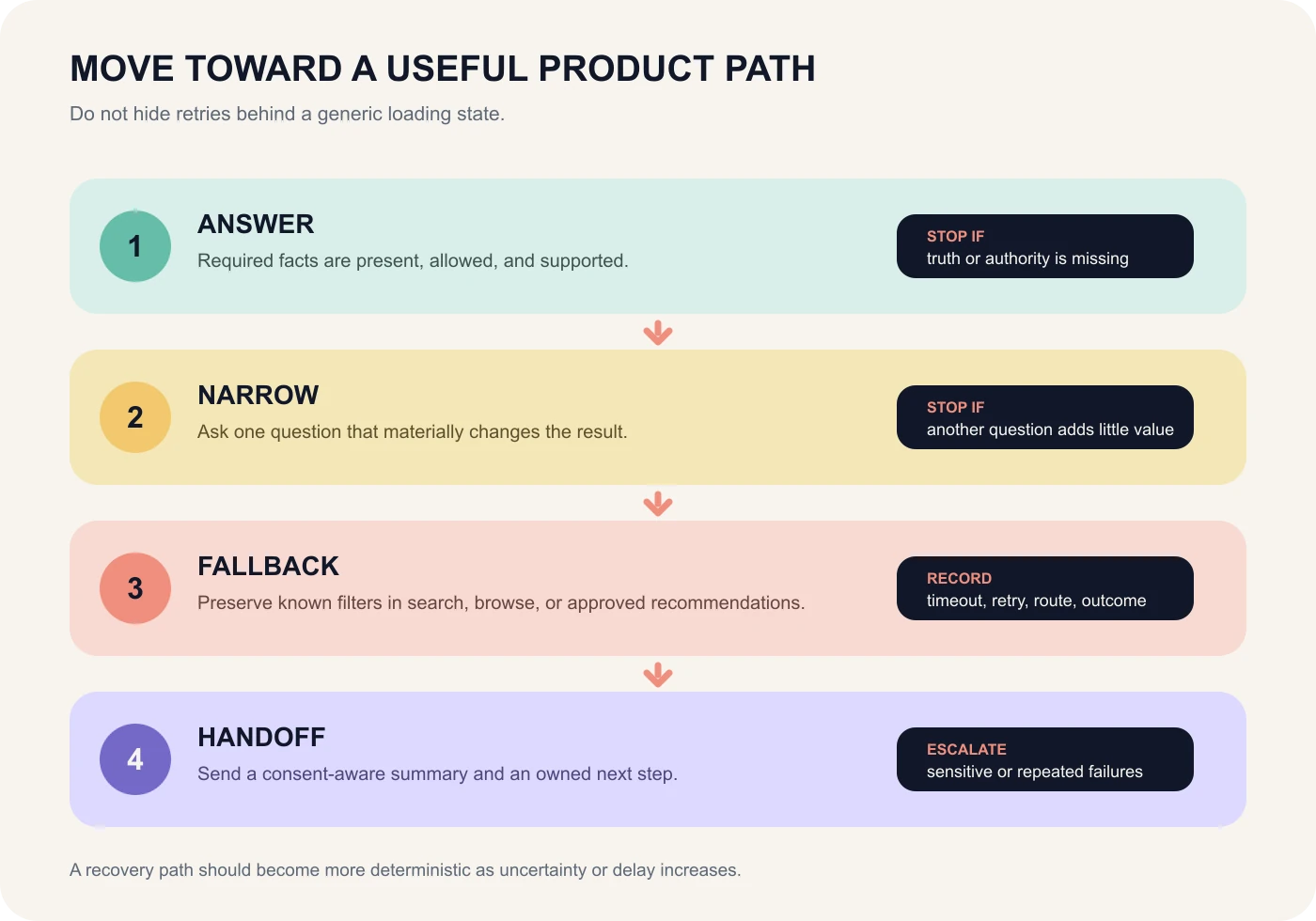
Write the fallback before the happy path. Use a ladder such as:
- Answer: Return products only when required facts are present and allowed.
- Narrow: Ask one question that materially changes the result, such as size, compatibility, or use case.
- Fallback: Route to a deterministic search, collection, or approved recommendations with the shopper's known filters preserved.
- Handoff: Provide a human support route with a concise, consent-aware summary.
Shopify's Predictive Search API can return queries, products, collections, pages, and articles, with a configurable result limit from 1 to 10. Its Product Recommendations API can return related or complementary products with a limit from 1 to 10. These are possible native building blocks for a fallback, not proof that either will fit every catalog or theme.
Rate limits and transient failures need bounded retry behavior. OpenAI's current rate-limit guidance says eligible temporary failures can use Retry-After or exponential backoff with jitter, while retry count and total retry time should be capped. Errors requiring quota, billing, or another action should not be retried automatically.
Make the shopper-facing message precise: “I could not complete that comparison. Here are products matching the filters I could verify.” Avoid pretending that a partial result is a confident recommendation.
Evaluate quality, cost, latency, and recovery together
Reader question: What should the scorecard contain?
Build a stratified evaluation set from approved catalog facts and common decision paths. Sample by query class, product category, catalog completeness, locale, device condition, and commercial importance. Include routine questions, ambiguous requests, unavailable products, contradictory product data, prompt-injection attempts, missing attributes, rate-limit responses, tool timeouts, and no-result states.
Freeze the candidate and baseline configurations before the run. Compare them on the same cases. Blind the reviewer to the route where practical, define the grading rubric before seeing results, and require adjudication when reviewers disagree on a critical product fact or allowed recommendation.
Score each turn across one matrix:
| Dimension | Pass condition | Failure and escalation |
|---|---|---|
| Product truth | Claims match approved product and policy fields | Block answer, fix source, rerun affected cases |
| Relevance | Product route fits stated constraints | Clarify or fall back; merchandising reviews repeated misses |
| Completeness | Required caveats and next step are present | Do not count the session as completed |
| Cost | Receipt stays within the query-class envelope | Inspect tokens, tools, retries, and vendor fees |
| Latency | First useful result and completion meet both median and tail limits | Identify slow step; shorten, cache, replace, or fall back |
| Recovery | Injected failures reach the promised fallback | Pause release until every critical path recovers |
| Privacy | Only approved fields cross each boundary | Stop test, delete test data where possible, review the data map |
| Human control | Escalations arrive with enough evidence to decide | Fix summary and ownership before live use |
Do not collapse every dimension into one weighted score. Product-truth, unauthorized advice, privacy leakage, and failed critical fallback are non-compensating failures. A faster or more relevant answer cannot cancel them. Use hard gates first, then compare graded dimensions such as relevance, completeness, cost, and latency among candidates that passed.
Report slice results and uncertainty, not just the aggregate. If the overall pass rate is stable but compatibility queries regress, the route is not ready for compatibility traffic. If the sample is small, report counts and cases rather than a precise percentage that suggests more certainty than the test supports.
NIST's AI Risk Management Framework calls for defined human-AI oversight roles and quantitative and qualitative measurement, including rigorous testing and documented results. OpenAI's safety guidance also recommends adversarial testing and human review, especially where mistakes carry higher stakes.
Keep facts, analysis, and unknowns separate in the review record. “The provider returned 429” is a fact. “The retry budget is too high” is an analysis. “Whether a different model will preserve quality at lower cost” is an unknown until the evaluation is rerun.
Run a safe shadow pilot
Reader question: How can we learn without touching the live store or customer data?
Run an offline or synthetic-shadow pilot against an approved evaluation set. A sample of 100 turns can be a practical starting worksheet, but it is illustrative, not statistically universal. “Shadow” here means production-like execution without exposing the answer to shoppers. It does not authorize mirroring real customer prompts into a new provider.
- Choose representative query classes and difficult edge cases.
- Use synthetic shopper details and approved catalog data. Do not send names, emails, order history, health details, or other customer data.
- Freeze the model, prompt, retrieval source, product snapshot, and fallback version for the run.
- Simulate timeouts, rate limits, empty retrieval, malformed tool output, and unavailable products.
- Store a redacted receipt for every turn.
- Have a trained reviewer grade product truth, relevance, caveats, and route quality against the approved source.
- Compare the assistant path with the deterministic search or merchandising baseline.
- Review the tail: the slowest, most expensive, and least confident turns.
Add failure injection after the baseline is stable. Force a retrieval miss, stale product snapshot, provider timeout, 429 response, malformed tool result, empty recommendation set, and circuit-open state. Confirm that the trace names the failed dependency, cost stops accumulating after the deadline, and the shopper route matches policy.
Then use a staged release gate:
| Stage | Audience | Authority | Expansion evidence |
|---|---|---|---|
| Offline | Frozen evaluation cases | No shopper output | Hard gates and slice scorecard pass |
| Internal canary | Trained team using synthetic scenarios | No store action | Trace, fallback, and escalation are operable |
| Bounded opt-in | Small approved shopper cohort | Recommendation only | Cost, tail latency, truth, and recovery stay inside envelope |
| Controlled expansion | Selected query classes and catalog cohorts | Policy-defined | Observation window closes without a rollback trigger |
Do not expand by traffic percentage alone. Expand by the query classes, products, markets, and failure paths that have evidence. Keep unapproved classes on the deterministic route.
Provider data policies vary by endpoint and configuration. For example, OpenAI says API data is not used for model training unless the customer opts in, while its current documentation lists different abuse-monitoring and application-state retention behaviors across endpoints. Treat that as a provider-specific fact, not a privacy conclusion. Confirm the contract, endpoint, region, retention, subprocessors, deletion path, and store configuration before any customer data is in scope.
Define the success signal, rollback, and exit
Reader question: When is the pilot good enough to continue?
Write the decision before reading the result.
Success signal: the frozen evaluation set meets the merchant's minimum product-truth and relevance scores, stays inside both cost and latency envelopes, and reaches the promised fallback in every critical injected failure. The deterministic baseline must remain available.
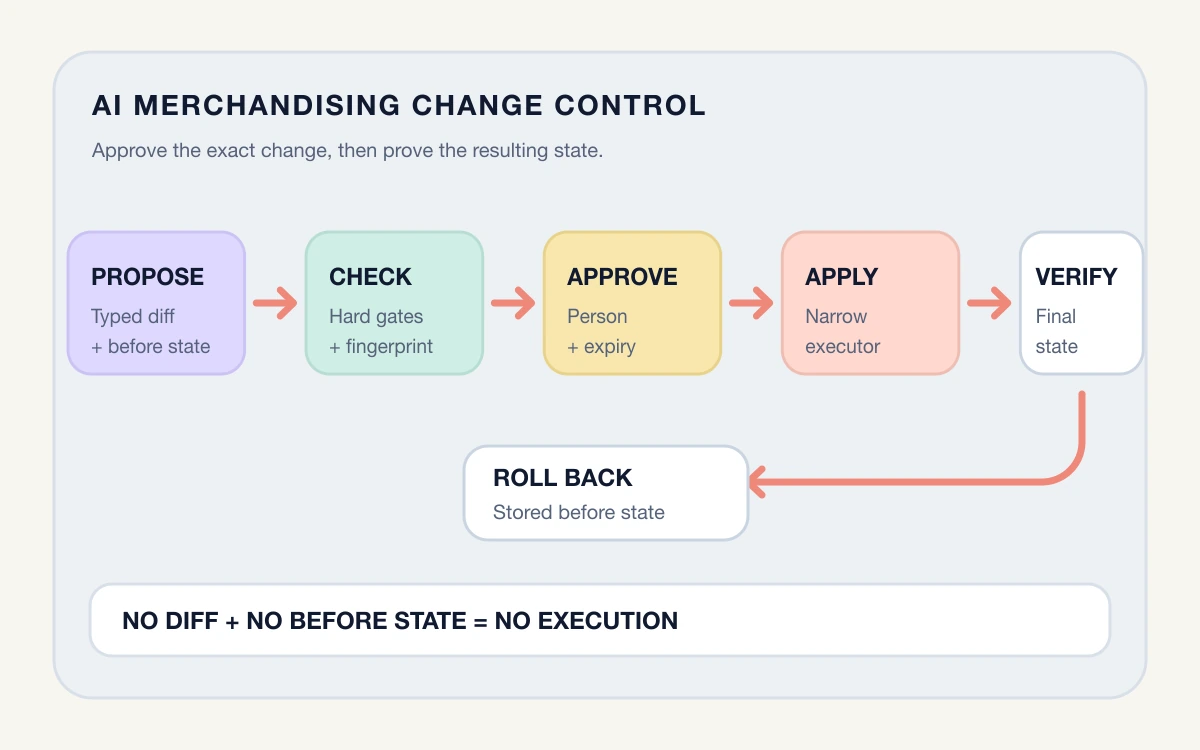
Rollback condition: pause the assistant path when a product-truth failure reaches a shopper, the p95 limit is breached for the defined observation window, cost per completed assist crosses its envelope, the fallback fails, an unapproved data field is transmitted, or support cannot own escalations. Route shoppers to the last verified deterministic experience.
Rollback must be rehearsed at the routing layer, not documented only as a vendor toggle. Test that opening the circuit stops new provider and tool calls, cancels work where supported, preserves shopper filters, serves the approved fallback, leaves an incident receipt, and does not strand a session in an endless loading state.
Vendor exit condition: leave or replace the provider when it cannot meet the agreed quality, latency, cost, privacy, observability, export, or support requirements after the written remediation window.
Keep these portable artifacts:
- evaluation cases and reviewer decisions;
- prompts, policies, and version history;
- approved product-truth schema and retrieval documents;
- redacted per-turn receipts and metric definitions;
- fallback routes and shopper messages;
- model and tool adapters behind documented interfaces;
- deletion, export, and credential-revocation steps.
The objective is not to make switching effortless. It is to avoid discovering during an incident that the evaluation set, logs, fallbacks, and operating knowledge belong only to the vendor.
Frequently asked questions
How much should an AI shopping assistant cost?
What latency should a shopping assistant target?
Should an AI assistant retry after an error?
What should happen when the assistant is uncertain?
Can the pilot use customer conversations?
How do we avoid vendor lock-in?
No commercial relationship, sponsorship, affiliate arrangement, or endorsement involving Shopify, OpenAI, or another AI provider is known or implied. Platform capabilities, pricing, and policies can change, so verify them again before implementation.
Sources
- OpenAI developer documentation: Cost optimization, accessed August 31, 2026
- OpenAI developer documentation: Prompt caching, accessed August 31, 2026
- OpenAI developer documentation: Latency optimization, accessed August 31, 2026
- Shopify developer documentation: Predictive Search API reference, accessed August 31, 2026
- Shopify developer documentation: Product Recommendations API reference, accessed August 31, 2026
- OpenAI developer documentation: Rate limits, accessed August 31, 2026
- NIST AI Risk Management Framework Core, accessed August 31, 2026
- OpenAI developer documentation: Safety best practices, accessed August 31, 2026
- OpenAI developer documentation: Data controls in the OpenAI platform, accessed August 31, 2026