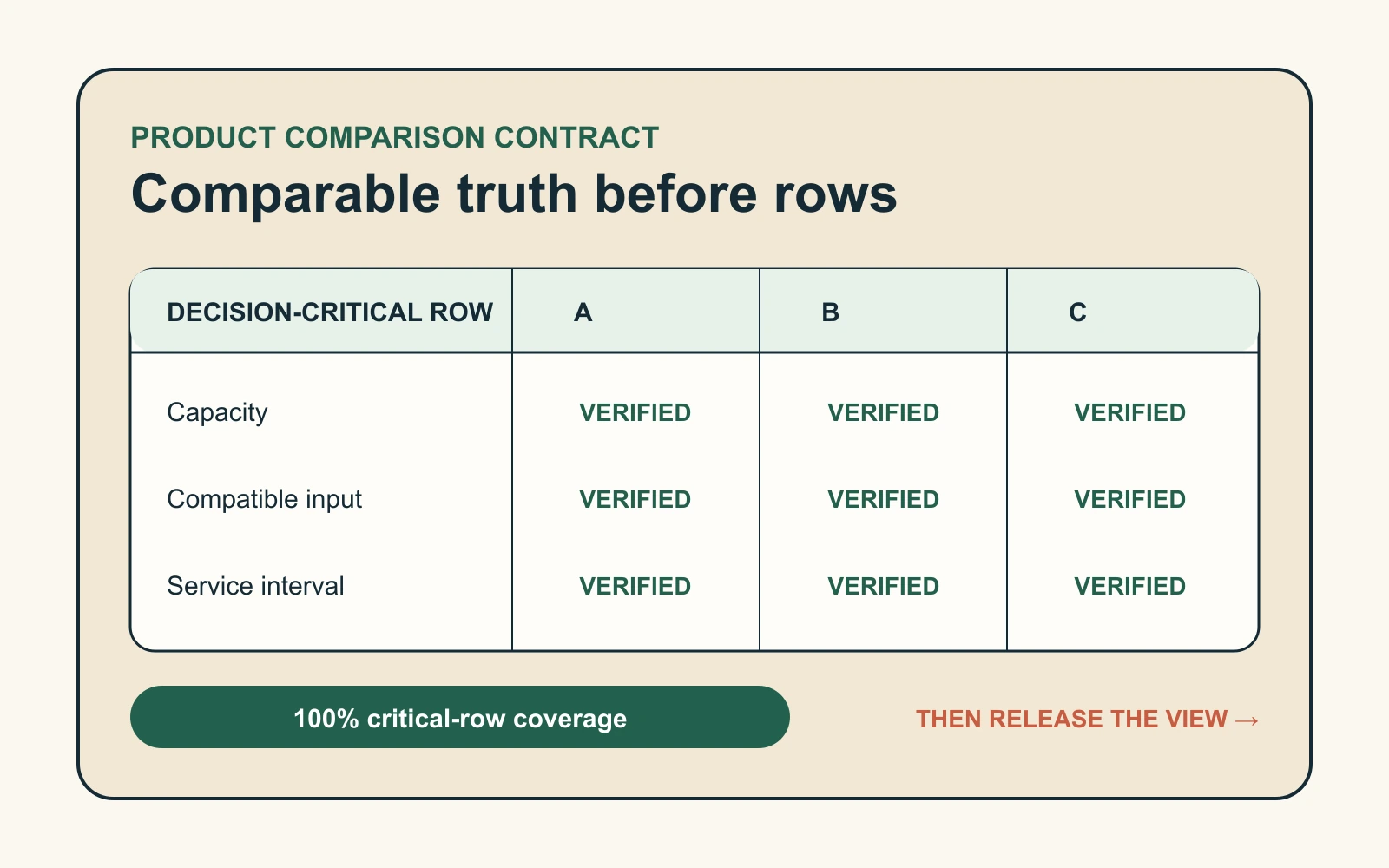

A global promotion calendar can become a queue of dates looking for discounts. The team sees an event, chooses a percentage, then tries to find products, margin, inventory, and a local message that make it work.
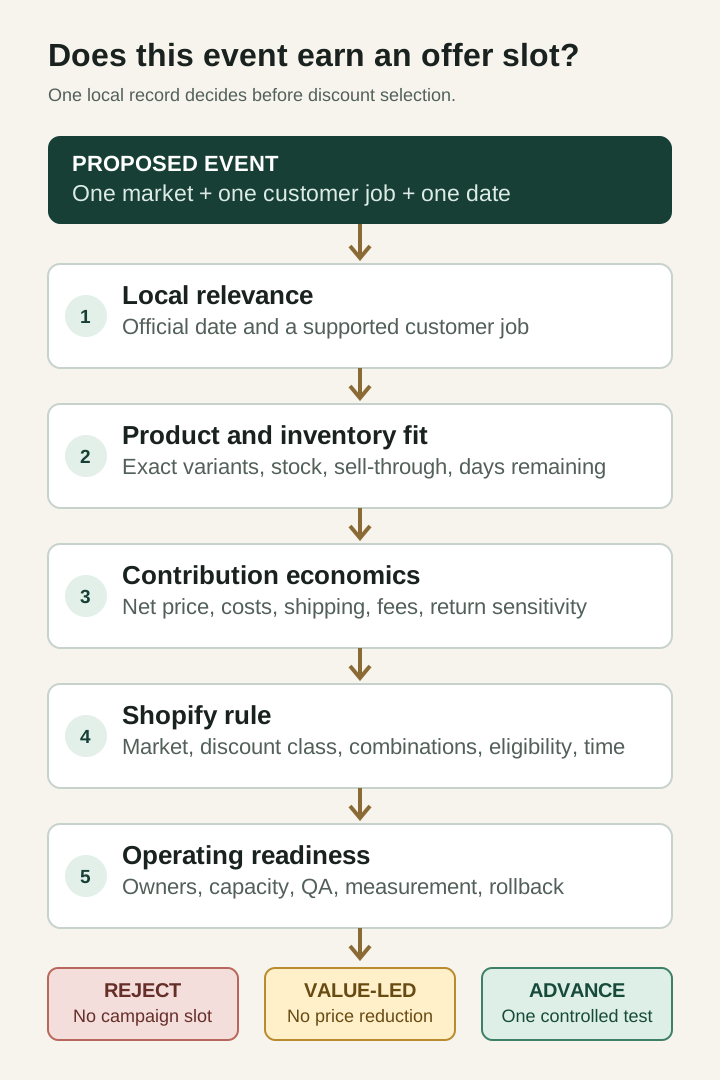
Reverse that sequence. Treat every proposed event as an eligibility record. The event earns an offer slot only when the market reason, sellable inventory, contribution floor, Shopify configuration, and operating capacity agree.
Make each calendar row prove six things
Use one row per market, event, and customer job. A global Black Friday row is too broad if the product set, prior-price obligations, fulfilment promise, or campaign timing differs by market.
| Decision field | Pass evidence and stop rule |
|---|---|
| Local reason | Verify the official date and a customer job supported by first-party demand or service data. Stop if the date is the only reason to run it. |
| Product set | Name eligible variants, stock by location, sell-through, and days remaining. Stop if the offer depends on scarce or unreliable stock. |
| Economics | Model net price, product cost, payment fees, fulfilment, shipping subsidy, and return sensitivity. Stop below the approved contribution floor. |
| Shopify rule | Record discount class, market, combinations, eligibility, start, and end. Stop when an active promotion creates an untested collision. |
| Operations | Name the inventory owner, support brief, delivery capacity, QA window, and rollback owner. Stop when nobody can repair the offer. |
| Measurement | Define the campaign ID, eligible session, primary metric, guardrails, and review date. Stop when exposure and outcomes cannot be reconciled. |
Shopify inventory reports can show sell-through and estimated days of inventory remaining. Those reports also have limitations. Days remaining becomes unavailable when a variant has no sales rate, and current sell-through data can have processing delay. Use the report as evidence, not certainty.
Localisation changes the mechanism, not just the copy
Shopify discounts can be assigned to selected markets, but codes work across markets by default. Fixed-amount discounts and free-shipping minimum purchase values use the store's default currency and convert at checkout. That makes a single global amount a moving local promise.
Timing has a similar boundary. Shopify bases a discount's start and end time on the store time zone. A midnight campaign in one market can therefore begin on the wrong local day elsewhere unless the team designs the window deliberately.
Price rules also vary. EU guidance says a price-reduction announcement, including a Black Friday offer, generally needs the lowest price applied by that trader during at least the prior 30 days. Australian guidance warns against a was price that was not used for a reasonable period or a sale price that has effectively become normal. These are documented examples, not a global legal checklist. The eligibility record should name the market owner and the current primary guidance reviewed.
Select the offer after the event passes
The approved product set should determine the mechanism.
- Use a value-led collection or guide when demand exists but discount evidence is weak.
- Use a product or collection reduction when the exact variants need movement and the prior-price record is supportable.
- Use a bundle or gift when the customer job requires complementary products and the incremental cost is controlled.
- Reject the event when it needs a blanket discount to create relevance.
Then document the Shopify discount contract. Product discounts apply before order discounts, and shipping discounts apply last. Multiple discounts combine only when their settings and eligibility allow it. If incompatible discounts compete, Shopify can apply the best available discount instead. That customer-friendly behavior can still break the campaign's intended economics or promise.
Run one shadow review this week
Choose one event six to twelve weeks away and do not build a live promotion yet.
- Growth names the local customer job and verifies the date through an official source.
- Merchandising proposes the exact variants and records stock, sell-through, and days remaining.
- Finance models the candidate at net price and sets a contribution floor.
- The Shopify owner lists active automatic discounts, codes, app discounts, market rules, and the store time zone.
- Operations confirms fulfilment capacity, support coverage, QA cases, and rollback ownership.
- The group records one result: reject, run value-led merchandising, or advance one mechanism to a controlled test.
For an approved test, use contribution profit per attributed eligible session as the primary metric. Track conversion, average order value, gross margin, discount cost, stockouts, fulfilment delay, returns, cancellations, support contacts, and discount errors as diagnostics or guardrails.
Shopify Campaigns can report sessions, orders, and sales, but its campaign metrics do not factor in returns. Keep the decision provisional until order, profit, refund, and return data have been reconciled after the normal return window.
Know when the calendar should say no
Do not use this framework to manufacture urgency, justify a permanent sale, or replace market-specific legal review. It is also a weak tool when variant costs are missing, inventory is not tracked reliably, or the team cannot isolate campaign exposure.
The useful output is not a fuller calendar. It is fewer, better-qualified events with a documented reason, safe mechanism, owner, measurement plan, and stop path.
Inficial can help map the economics, merchandising rules, measurement, and implementation behind a local Shopify offer calendar.
Sources
- Inventory reports, Shopify Help Center, accessed August 24, 2026
- Profit reports, Shopify Help Center, accessed August 24, 2026
- Discounts and gift cards in Markets, Shopify Help Center, accessed August 24, 2026
- Combining discounts, Shopify Help Center, accessed August 24, 2026
- Discount codes, Shopify Help Center, accessed August 24, 2026
- Understanding Campaigns, Shopify Help Center, accessed August 24, 2026
- Guidance on Article 6a of the Price Indication Directive, European Commission, accessed August 24, 2026
- Price displays, Australian Competition and Consumer Commission, accessed August 24, 2026