
Free shipping can make an offer easier to understand. It can also turn a healthy order into a weak one if the threshold is copied from a competitor or chosen from average order value alone.
The founder decision is not simply, “Will more people buy?” It is, “Will the extra orders and larger baskets create enough contribution profit to pay for the shipping we absorb?” Contribution profit here means the money left after product cost, discounts, payment fees, fulfilment costs, and the shipping subsidy. It is not the same as gross revenue.
Why average order value is not enough
A threshold above current average order value sounds sensible because it appears to encourage a larger basket. The average hides the details that determine whether the offer works: margin varies by product, shipping varies by destination and package, and a discount can change the subtotal used by checkout.
Shopify supports free shipping through a shipping rate or a free shipping discount. A rate can use an order-value condition. A discount can include minimum purchase rules, market eligibility, date limits, and a cap that excludes shipping rates above a chosen amount. Those controls are useful, but they do not choose an economically sound threshold for you.
Contribution profit = net product revenue - product cost - discounts - payment fees - pick and pack cost - shipping subsidyUse the same definition before and during the test. If you alter the formula halfway through, the comparison stops being useful.
Build three threshold candidates from your own carts
Export six to eight recent weeks of eligible US orders. Remove test orders, wholesale orders, fraud, and periods dominated by a promotion you will not repeat. For each order, collect product revenue after discounts, product cost, shipping charged to the customer, actual carrier or label cost, fulfilment cost, payment fees, destination zone, items, and refunds.
- A conservative threshold that protects current contribution.
- A reachable threshold that is one logical add-on above a common cart.
- An aggressive threshold that reduces the customer hurdle but increases your subsidy.
Do not treat the model as a forecast. It cannot tell you how shoppers will change their carts. Its job is to reject obviously fragile options before they reach customers.
Look at the products shoppers would reasonably add. If the gap is usually $12, but the catalog jumps from $8 to $35, the threshold may create frustration rather than useful merchandising. A refill, compatible accessory, or frequently paired product creates a clearer path than a random “under $15” collection.
Measure the result that pays the bill
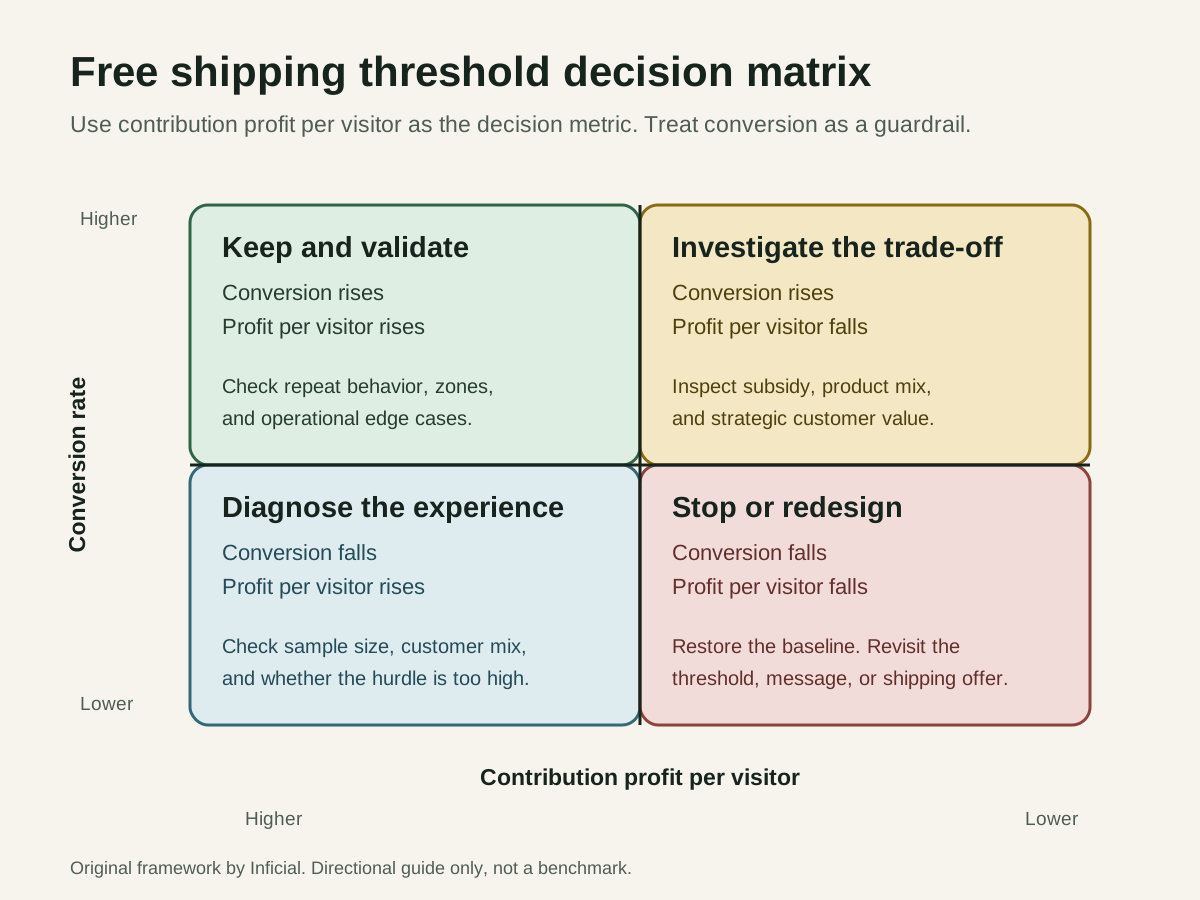
Use contribution profit per visitor as the primary decision metric. It connects purchase behavior to the variable costs of fulfilling the promise.
- Conversion rate
- Average order value
- Shipping subsidy per order
- Contribution profit per order
- Units per order
- Refund and cancellation rate
- Customer contacts about eligibility or discount failures
The matrix prevents a common mistake. If conversion rises while contribution profit per visitor falls, the offer is not automatically a win. Check whether new-customer value, repeat behavior, or a strategically important inventory objective justifies the short-term cost. That is analysis, not permission to ignore the loss.
If traffic supports a controlled experiment, split eligible US visitors between the current policy and one candidate. Keep products, paid-media targeting, and other sitewide promotions stable where possible. Lower-traffic stores can use a carefully matched sequential test, but seasonality and campaign mix make its result less certain. Record that limitation in the decision.
Configure the promise carefully
For a durable sitewide threshold, an order-value shipping rate is usually easier for customers than a code they must remember. For a short campaign or defined segment, an automatic or code-based free shipping discount can provide tighter eligibility and dates.
Before launch, test carts just below, exactly at, and just above the threshold. Test discounted products, excluded products, large shipping rates, subscriptions, and every relevant US shipping zone. Shopify applies product discounts before order discounts and shipping discounts last, so combination settings can change eligibility. If you sell across markets, note that a free shipping discount minimum is set in the store’s default currency and converted at checkout.
If the offer will appear in Google Merchant Center, keep the feed and storefront promise aligned. Google provides a free-shipping-threshold attribute by country. Its Promotions policy separately requires a valid redemption code for a standalone shipping promotion. A permanent threshold and a temporary promotion are not the same setup.
A founder test to run this week
Take your last 100 eligible US orders and simulate three thresholds. For each candidate, list the affected orders, added shipping subsidy, current contribution profit, and products that could naturally close the basket gap. Reject any candidate that depends on low-margin items, unusually cheap shipping zones, or filler merchandising.
Choose one surviving candidate and write a one-page test plan: audience, duration, primary metric, guardrails, exclusions, QA carts, and a stop condition. The goal this week is not to promise an uplift. It is to make one threshold safe enough to test and clear enough to evaluate.
When free shipping is the wrong lever
Avoid a broad threshold when bulky products create volatile costs, margins vary sharply, the catalog has no sensible add-on path, or customers value a faster paid service more than a slow free option. A transparent flat rate, product-specific shipping profile, bundle, or pickup offer may be easier to understand and operate.
Free shipping is an offer with a fulfilment cost. Treat it with the same discipline as a product discount: model it, test it, and keep it only when the customer benefit and unit economics agree.
Inficial can help design the measurement, merchandising path, and Shopify implementation for a controlled free shipping threshold test. The goal is a useful customer promise that the unit economics can support.
Sources