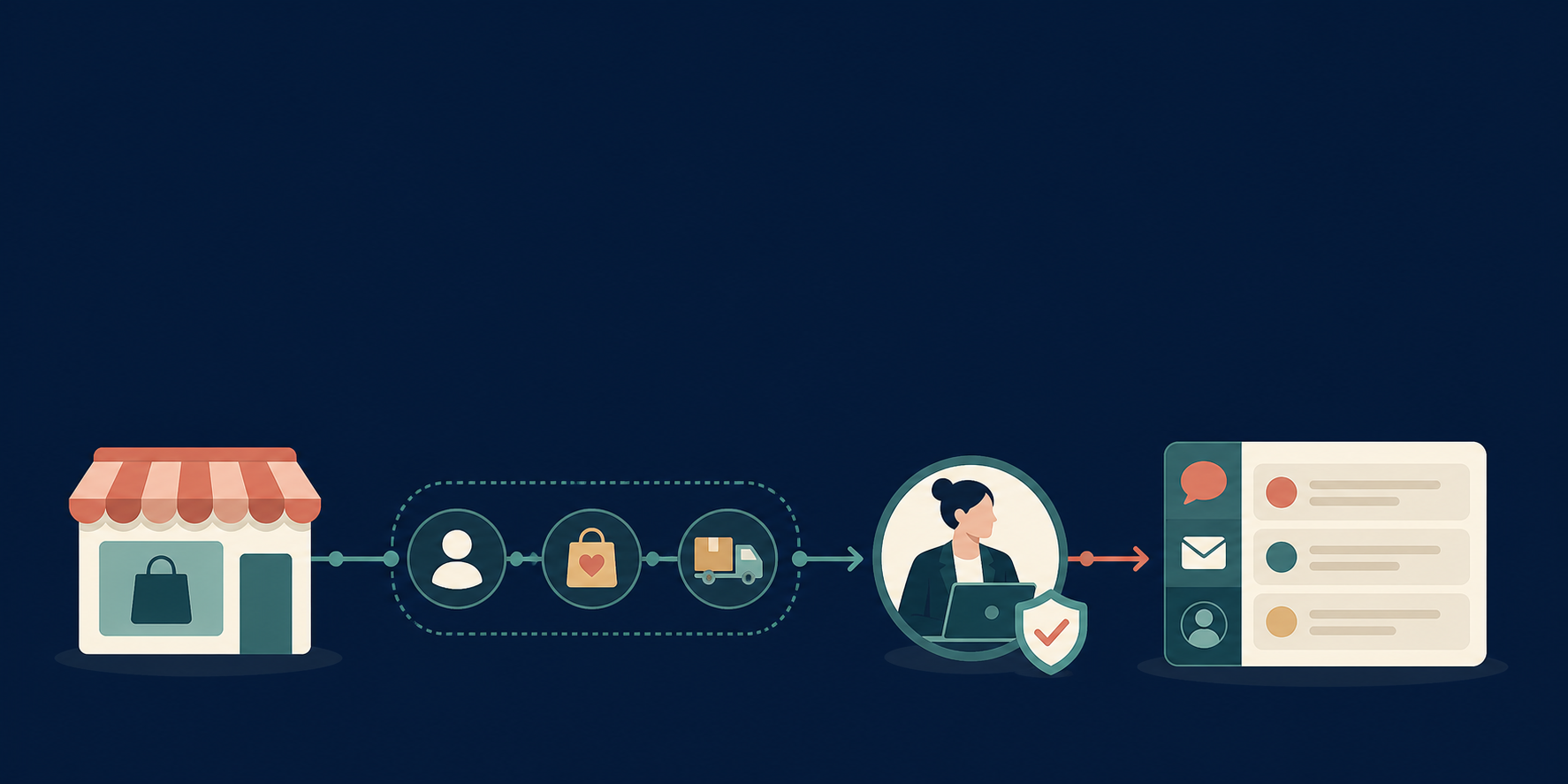

Connecting Shopify and Gorgias can save agents from switching between messages, orders, shipping details, and customer history. It can also let them create discounts, edit addresses, cancel orders, and issue refunds.
The decision is bigger than choosing a shared inbox. A sound setup gives agents useful context, limits consequential actions, and assigns ownership for maintenance and removal.
Decide whether the support problem justifies another system
Reader question: What should improve if the connection is worthwhile?
Start with one month of support work. Count conversations by channel and topic, then note how often agents open Shopify, copy tracking details, change an order, or wait for approval. Record the slow handoffs and risky mistakes.
Gorgias is more likely to fit when several channels need one queue, multiple agents need routing and shared context, or Shopify order data is used repeatedly. If the problem is only low-volume onsite chat, a larger helpdesk may add cost without removing a meaningful constraint.
Choose two or three success measures before installing, such as first-response time, unresolved ticket age, handoff rate, order-status contacts, and refund exceptions. Vendor-attributed revenue or automated-resolution claims are not proof of incremental value.
Check Shopify Inbox before buying a helpdesk
Reader question: Can Shopify's native option cover the actual need?
Shopify Inbox is currently free. It supports online-store chat, product and discount sharing, images, staff conversation management, customer profiles, order context, quick replies, availability hours, and a default track-my-order instant answer.
Shopify also documents an Inbox agent in early access for certain merchants. Treat it as a capability to test, not a universal baseline.
| Decision area | Shopify Inbox first | Gorgias connection first |
|---|---|---|
| Main channels | The need is primarily online-store chat | Email, chat, social, contact forms, or other support channels need one queue |
| Team workflow | A small team can manage simple assignment and replies | Routing, views, rules, macros, analytics, and specialized roles are required |
| Commerce context | Product links, customer profile, cart, and relevant order details are enough | Agents need deeper Shopify data beside every ticket and connected app context |
| Store actions | Agents can complete sensitive actions in Shopify admin | Approved support roles need selected order actions from the helpdesk |
| Cost model | Free native chat meets the requirement | Ticket-based pricing and implementation effort are justified by saved work |
| Exit burden | The team wants the lightest platform footprint | The team accepts exports, channel migration, workflow rebuild, and theme cleanup |
When the comparison is close, give two trained staff members a representative week in Shopify Inbox. Measure what still requires forwarding, channel switching, manual lookup, or missed ownership. That unresolved work is the evidence for a paid helpdesk.
Map what connects between Shopify and Gorgias
Reader question: Which data and actions cross the boundary?
Gorgias can associate a contact with a Shopify customer, then show order history, spending, tags, shipping, and fulfillment context beside a ticket. It can also use a phone number from the default shipping address to improve matching.
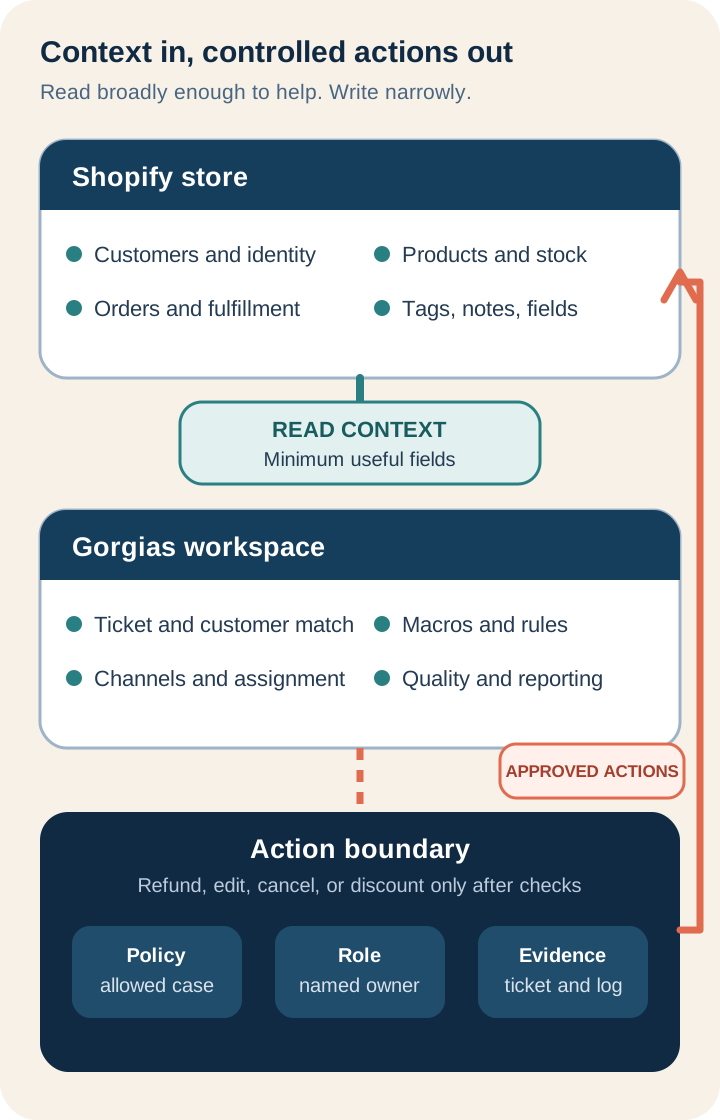
The current Shopify App Store listing says Gorgias can view customer sensitive data and device activity data. It lists edit access for customers, orders, discounts, Online Store pages, script tags, and theme, plus product and inventory access. The merchant should review the live permission screen because app scopes can change.
- Read context: customer identity, order history, products, inventory, fulfillment, shipping, tags, notes, and selected metafields.
- Conversation operations: channel assignment, tags, macros, internal notes, templates, rules, and reporting.
- Store-changing actions: discounts, refunds, cancellations, draft orders, order edits, address changes, tags, and customer updates.
For each field or action, record the purpose, permitted role, approval requirement, audit evidence, and removal step. The installation screen is not an operating policy.
Turn broad permissions into narrow operating rules
Reader question: Who should be allowed to do what?
Gorgias documents Shopify actions for creating or duplicating orders, cancelling and refunding orders, creating draft orders, editing addresses, editing tags, and sharing products. Some actions have important limitations. For example, refunds involving multiple payment methods can be restricted, and order editing is unavailable for certain archived, older, or different-currency orders.
| Action | Default boundary | Evidence to keep | Escalate when |
|---|---|---|---|
| View order status | Trained support agents | Ticket and customer match | Identity or order match is uncertain |
| Share product or tracking link | Trained support agents | Link and source order | Market, currency, or product context differs |
| Create a discount | Limited roles and defined limits | Reason, amount, expiry, ticket | Value exceeds policy or promotion conflicts |
| Change shipping address | Limited roles before fulfillment | Old value, new value, identity check | Order is fulfilled, high value, or fraud risk exists |
| Cancel or refund | Senior support or approval workflow | Reason, amount, restock choice, approver | Split payments, gift cards, disputes, or policy exception |
| Edit or duplicate order | Specialist role | Items, price, tax, inventory, approver | Currency, tax, subscription, or fulfillment is complex |
Start with read-only behavior even if the connection grants broader access. Enable consequential actions only after roles, limits, evidence, and exception handling are approved. A matching email or phone number is useful context, not proof that the requester controls an order.
Assign people to the system, not only seats
Reader question: Who keeps the helpdesk trustworthy after launch?
A helpdesk needs named operational owners.
- Support operations owner: queue design, staffing, service levels, escalations, and quality review
- Shopify operations owner: refund, cancellation, discount, address, fulfillment, and order-edit policy
- Privacy owner: data map, retention, customer requests, processor review, and regional obligations
- Automation owner: rules, macros, AI behavior, test cases, exceptions, and rollback
- Storefront owner: chat placement, theme compatibility, accessibility, consent behavior, and performance
- Billing owner: ticket volume, overages, add-ons, plan changes, and renewal
Gorgias provides roles and account audit logs, with account-change events currently available for up to 12 months. Process ownership still sits with the merchant. If nobody can own queue quality, permission reviews, automation sampling, and billing thresholds, the team is not ready.
Pilot the connection through five gates
Reader question: How can the team launch without creating a second support mess?
Do not connect every channel, rule, AI feature, and order action at once. A staged pilot keeps mistakes observable and reversible.
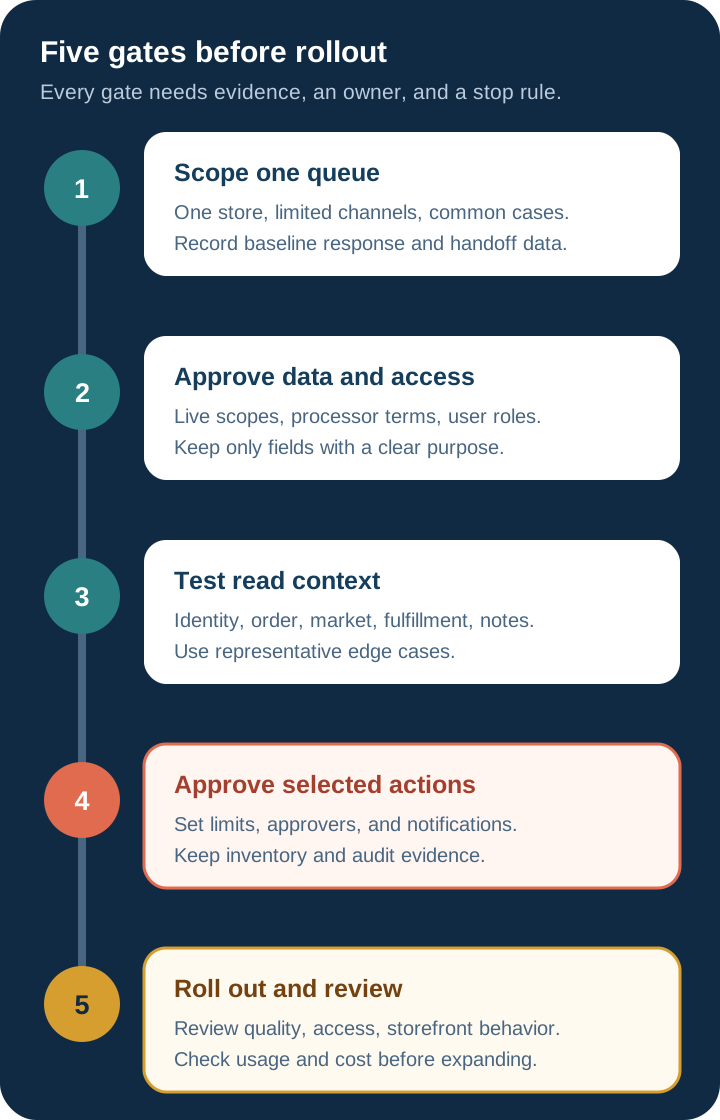
Gate 1: define the queue
Choose one store, one support team, one or two channels, and the most common ticket categories. Record the existing response and handoff baseline.
Gate 2: approve data and permissions
Review the live Shopify permission screen, Gorgias data-processing terms, subprocessors, roles, and the exact data needed. The merchant must decide whether the arrangement meets its obligations.
Gate 3: test read context
Use representative test customers and orders. Check matching, currency, market, fulfillment, and multi-store cases without exposing unnecessary details.
Gate 4: approve selected actions
Test each permitted write action with limits and an approver. Confirm the Shopify change, notification, inventory result, and ticket evidence.
Gate 5: roll out and review
Move a small share of real work into the queue. Review quality, misroutes, access, theme behavior, ticket volume, and charges before expanding.
Test chat and storefront impact
Reader question: What changes on the storefront?
The Shopify data connection and chat widget are separate decisions. Store data can support agents without placing the widget on every page.
Gorgias offers a quick Shopify install across the store or a manual installation for selected pages, headless storefronts, other platforms, or Google Tag Manager. Its documentation notes that strict content security policies may require allowlisted domains. Checkout and thank-you page chat uses a separate app block and requires the quick installation method.
- ✓Test a duplicated theme before changing the published theme.
- ✓Record page speed, script requests, errors, and layout before and after activation.
- ✓Check mobile viewport overlap with accessibility, loyalty, cookie, review, and back-to-top widgets.
- ✓Test keyboard focus, screen-reader labels, zoom, contrast, close behavior, and reduced viewport height.
- ✓Check product, cart, account, search, and checkout journeys across important markets.
- ✓Confirm consent behavior and customer-detail collection for each region served.
- ✓Recheck after theme updates, chat reinstalls, checkout changes, or content security policy changes.
Use settings and app blocks first. Advanced HTML, JavaScript, or Liquid customization adds maintenance and sits outside normal Gorgias support troubleshooting.
Price the complete operating model
Reader question: What will the connection really cost?
Pricing was verified on August 17, 2026 and can change. Prices below are USD from the official Shopify App Store listing.
| Current listed plan | Monthly price | Included tickets | Listed overage | Seats |
|---|---|---|---|---|
| Starter | $10 | 50 | $0.40 per extra ticket | 3 agents |
| Basic | $60 | 300 | $40 per extra 100 | Unlimited agents |
| Pro | $360 | 2,000 | $36 per extra 100 | Unlimited agents |
| Advanced | $900 | 5,000 | $36 per extra 100 | Unlimited agents |
The listing shows a seven-day trial and discounted annual prices on Basic, Pro, and Advanced. A ticket becomes billable when a human agent, AI Agent, or Rule sends at least one message. AI Agent resolutions can add outcome-based fees; Voice, SMS, and overages are separate.
Forecast a normal month, peak month, and service incident. Include implementation, training, privacy review, theme testing, quality sampling, add-ons, and maintenance, not only today's ticket count.
Know the limitations and when not to use Gorgias
Reader question: When does the integration create more burden than benefit?
Gorgias may be unnecessary when support volume is low, onsite chat is the main channel, Shopify Inbox meets the workflow, or agents can safely work in Shopify without repeated context switching. It is also a poor fit when the team has no owner for queue design, permissions, automation, privacy, or billing.
- Broad app permissions need merchant-side operating controls.
- Background customer and order import can take time for larger stores.
- Certain customer-note behavior and Shopify actions have multi-store or transaction limitations.
- Ticket and automation pricing can rise during peaks or after workflow changes.
- Chat adds a storefront dependency and custom code adds maintenance.
- A CSV ticket export is not a complete migration of rules, macros, views, integrations, help-center behavior, staff habits, or every internal record.
- Automated support still needs sampled accuracy, clear escalation, and human judgment for sensitive or unusual cases.
Begin AI automation with human-reviewed drafts or narrow, low-risk intents. Keep refunds, disputes, safety issues, high-value changes, and ambiguous identities behind explicit approval.
Plan maintenance and switching before launch
Reader question: How will the merchant keep or leave the system safely?
Review access, order-action policy, failed rules, AI samples, customer matching, storefront errors, usage, overages, and renewal dates each month.
Plan the exit before the first annual commitment. Gorgias supports CSV exports from ticket views and analytics drill-downs. Exports can include ticket metadata and, in some cases, public message content, but internal notes and some event types are not included in the standard message-content export.
- Export required ticket, customer, help-center, tag, macro, and reporting information.
- Rebuild essential routing, templates, escalation, and self-service in the next system.
- Move email, social, chat, Voice, SMS, and contact-form channels in a controlled sequence.
- Disable store-changing actions and automation before disconnecting data.
- Remove chat app blocks, manual snippets, custom code, and obsolete content security policy entries.
- Test the replacement customer experience and support queue.
- Cancel the Gorgias subscription from its billing settings. Gorgias says uninstalling the Shopify app does not cancel the subscription.
- Uninstall the app and confirm remaining theme code, external charges, data retention, and privacy-request procedures.
Gorgias notes that deleting a Gorgias profile does not remove data from connected apps or internal notes. Document how access and deletion requests are reconciled across every connected system.
Take one safe action this week
Reader question: What can the merchant do without installing anything?
Review the last 50 support conversations in a two-column worksheet. Record the Shopify context each agent needed, then the action taken and whether it required approval.
The pattern will show whether the store needs a better inbox, clearer policy, training change, or deeper Shopify connection. It also becomes the minimum brief for a Gorgias pilot.
Inficial can help compare Shopify Inbox with a paid helpdesk, map the Shopify and Gorgias data boundary, define safe order-action workflows, test storefront chat, and plan a controlled pilot and exit.
No commercial relationship, sponsorship, affiliate arrangement, or endorsement involving Gorgias is known or implied.
Sources
- Gorgias: AI, Helpdesk & Chat, Shopify App Store, accessed August 17, 2026
- Connect a store to Gorgias: Shopify, Gorgias Help Center, accessed August 17, 2026
- Shopify Actions, Gorgias Help Center, accessed August 17, 2026
- How you're billed for using Gorgias, Gorgias Help Center, accessed August 17, 2026
- Configure Chat for your Gorgias helpdesk, Gorgias Help Center, accessed August 17, 2026
- Customize the chat widget with HTML and JavaScript, Gorgias Help Center, accessed August 17, 2026
- Export tickets from Gorgias, Gorgias Help Center, accessed August 17, 2026
- View an audit log of changes to your account, Gorgias Help Center, accessed August 17, 2026
- Gorgias Data Processing Agreement, accessed August 17, 2026
- Cancel an account, Gorgias Help Center, accessed August 17, 2026
- Shopify Inbox, Shopify App Store, accessed August 17, 2026
- Shopify Inbox, Shopify Help Center, accessed August 17, 2026
- Set up instant answers for Shopify Inbox, Shopify Help Center, accessed August 17, 2026
- Uninstalling apps, Shopify Help Center, accessed August 17, 2026