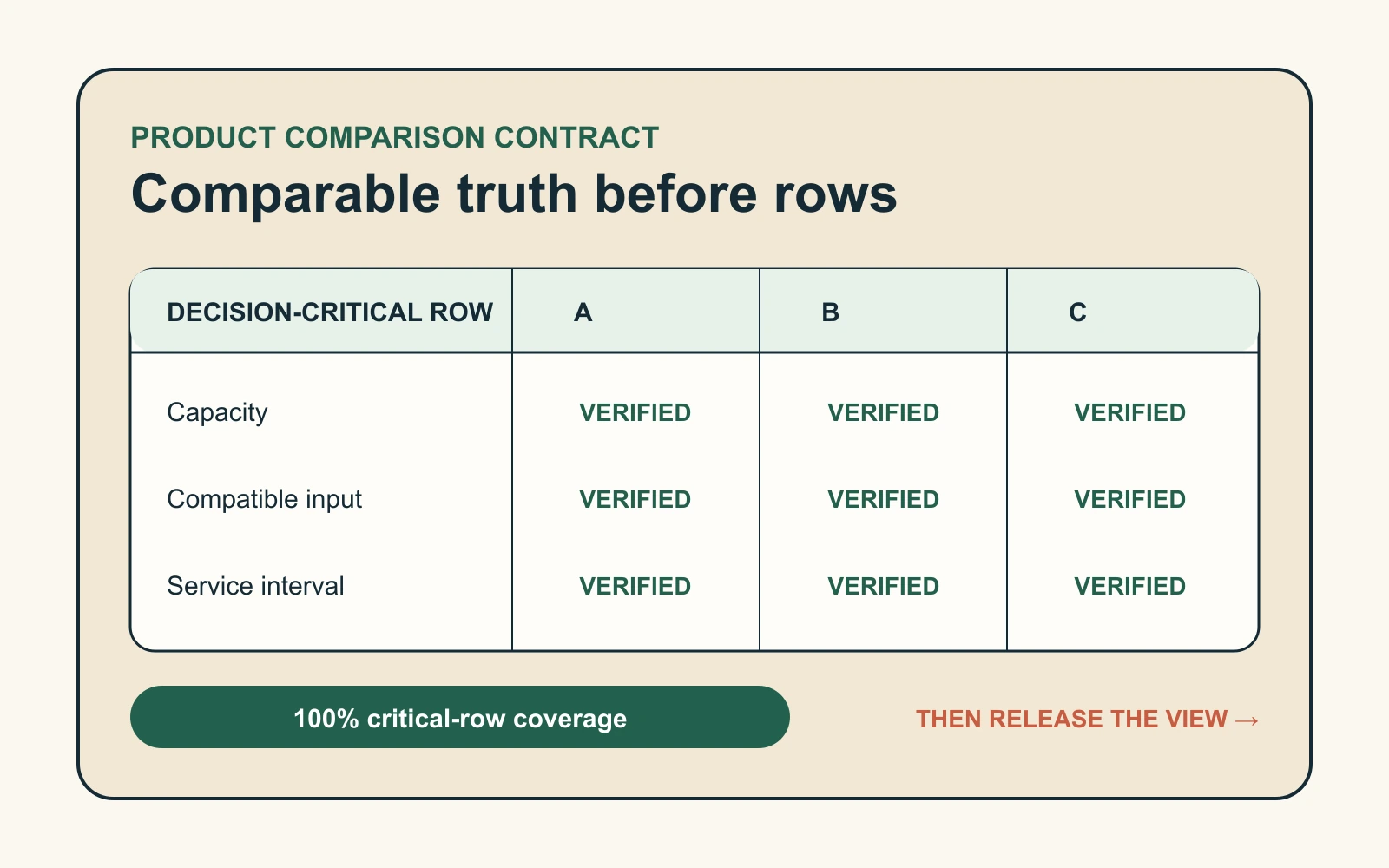

A redesign can change the experience and the instrument used to judge it. The new theme may alter event timing, element visibility, page paths, consent behavior, and the mix of people exposed during launch. A cleaner dashboard can still tell a less reliable story.
The evidence contract freezes the ruler before the interface moves. It states what must remain observable, which comparisons are credible, what can stop exposure, and which outside changes must be logged before the team declares a win or a loss.
Write the verdict before opening analytics
Write one decision statement: "We will keep, revise, or recover the redesign based on its effect on qualified product discovery, cart success, checkout progression, completed orders, margin guardrails, and customer-service burden."
Then assign each measure a role:
| Role | Example | Why it exists |
|---|---|---|
| Primary outcome | Completed orders per qualified session | Main commercial decision |
| Mechanism | Product view to add-to-cart success | Explains how behavior changed |
| Guardrail | Checkout errors or support contacts | Prevents hidden customer harm |
| Data-quality check | Event receipt and order reconciliation | Detects broken measurement |
| Context | Inventory, campaigns, price, market mix | Identifies confounding change |
Do not let the primary outcome become a list of every metric. One primary decision with diagnostic measures is easier to operate than ten competing goals.
Issue an event receipt before exposure
For every decision-critical event, record the event name, trigger, required fields, consent state, expected destination, owner, test order or session, timestamp, and downstream receipt.
Shopify's Pixel Helper can verify that a custom pixel subscribed to an event and whether its callback succeeded. A green event in the helper does not prove that a third-party platform accepted, deduplicated, attributed, or reported it correctly. Test both sides when a third party influences the decision.
Use the cart or checkout response as authority for commercial state. A click event does not prove that the intended variant, selling plan, quantity, discount, or market price entered the cart.
Use guardrails as stop conditions
Set guardrails for errors, cart failures, checkout progression, page responsiveness, customer-service contacts, and gross-margin exposure. Attach an owner and action threshold to each.
Preselect diagnostic cuts that reflect how the redesign behaves:
- mobile and desktop;
- new and returning visitors;
- primary and secondary markets;
- paid, organic, email, and direct traffic;
- high- and low-consideration product groups;
- in-stock and constrained inventory;
- customer-account and guest paths when both exist.
Avoid slicing until only noise remains. Use the cuts to locate a plausible mechanism, not to manufacture a positive result.
Build a counterfactual from stable cuts
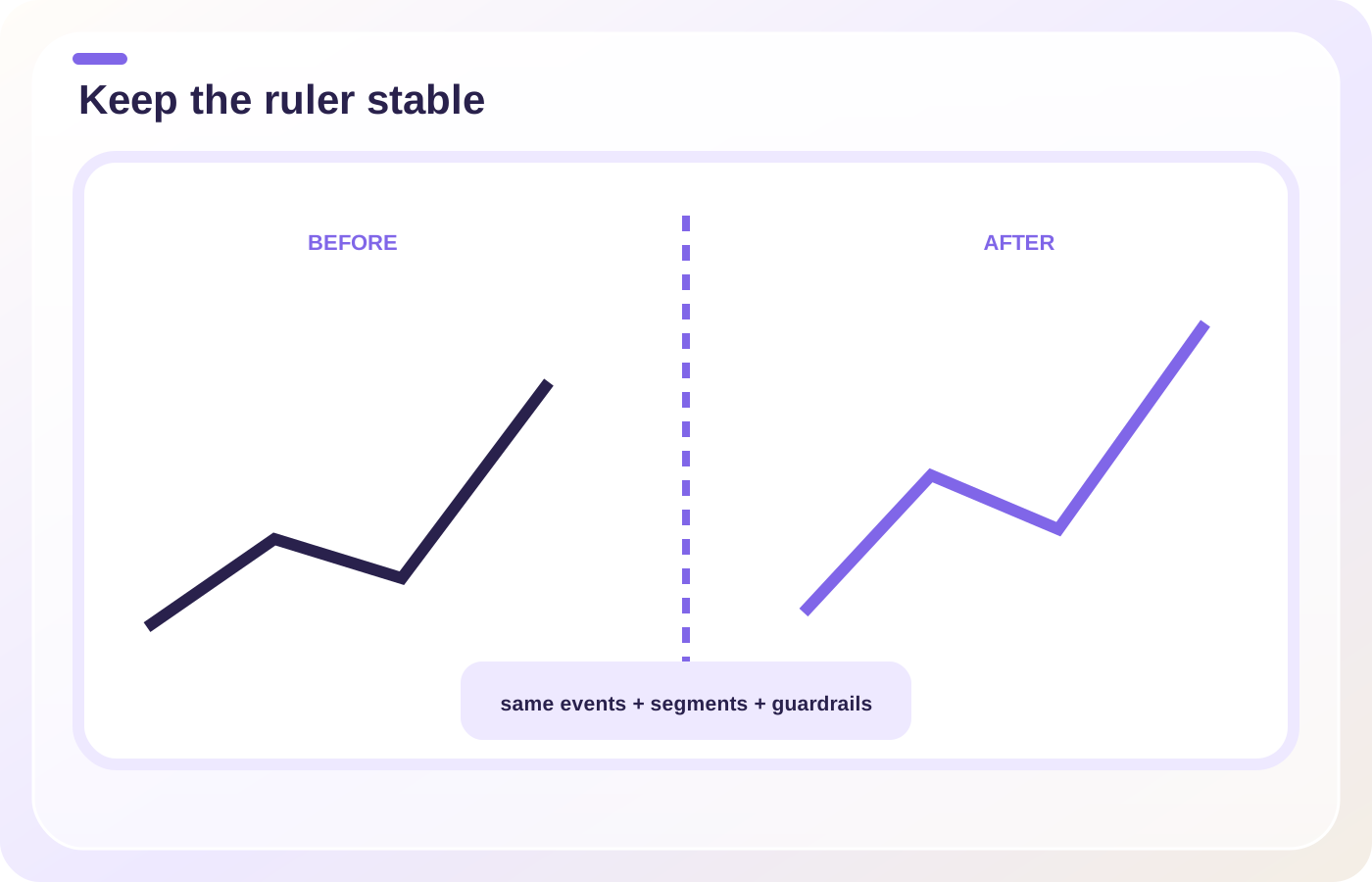
Maintain a launch annotation log for promotions, price changes, inventory gaps, feed errors, consent changes, channel-budget shifts, checkout changes, and incidents. If campaign mix changed at the same moment as navigation, blended conversion cannot isolate navigation impact.
Shopify's web-performance reports show real-user Core Web Vitals and annotate changes such as app installs, theme updates, and new code. The data can be delayed by up to 36 hours and covers a rolling window, so use it as a performance evidence stream, not an immediate release alarm.
Stage exposure to preserve a comparison
If the architecture supports a controlled experiment, randomize at a stable unit and keep assignment persistent. If it does not, use a phased launch by low-risk market, template, or traffic slice only when spillover is understood.
Create four decision states before launch:
- Continue: outcome and guardrails are within the approved range.
- Investigate: a diagnostic measure moves without confirmed customer harm.
- Recover: a critical task or guardrail crosses its stop threshold.
- Iterate: the mechanism is credible, but the treatment needs a narrower correction.
Use four verdict states
Do not declare a redesign winner when event definitions changed, stock removed the main products, the campaign mix shifted sharply, a consent banner changed collection rates, or the analysis window excluded the store's purchase cycle. Report the limitation and extend or redesign the evaluation.
Hold a pre-design evidence session
Choose one current redesign or large theme change. Write the primary outcome, two mechanisms, three guardrails, four context annotations, and the exact event receipts required. If any item lacks an owner or recovery action, the release is not yet measurable.
Sources