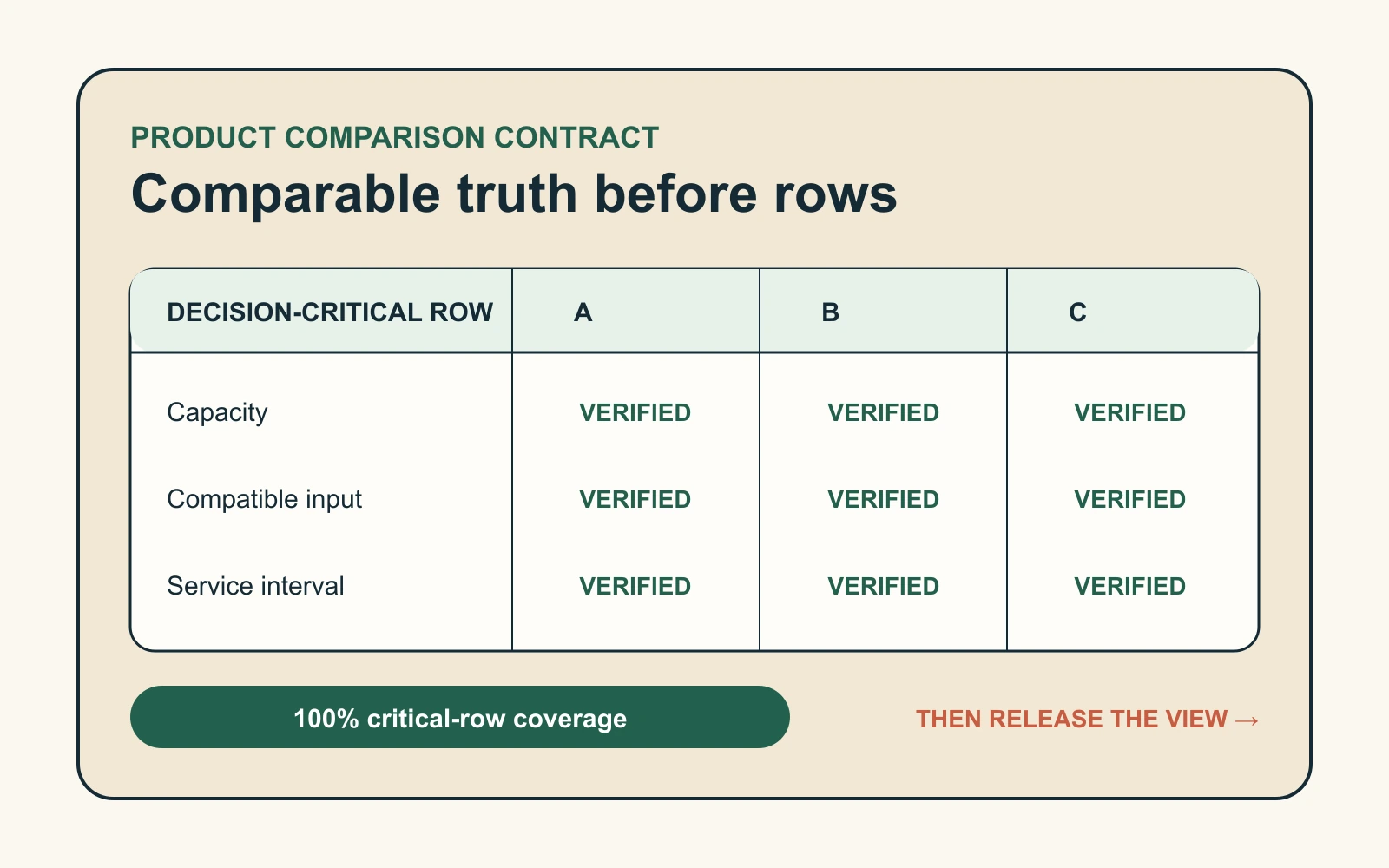

A clearer CTA, better product photography, and fewer trust badges can improve a weak store. They are still foundation work.
Advanced conversion rate optimisation begins when the interface can respond to the customer’s actual decision: what they need, which combinations are valid, what evidence resolves their doubt, and whether that state survives into cart.
These five systems are worth considering after navigation, product data, mobile usability, speed, and analytics are dependable.
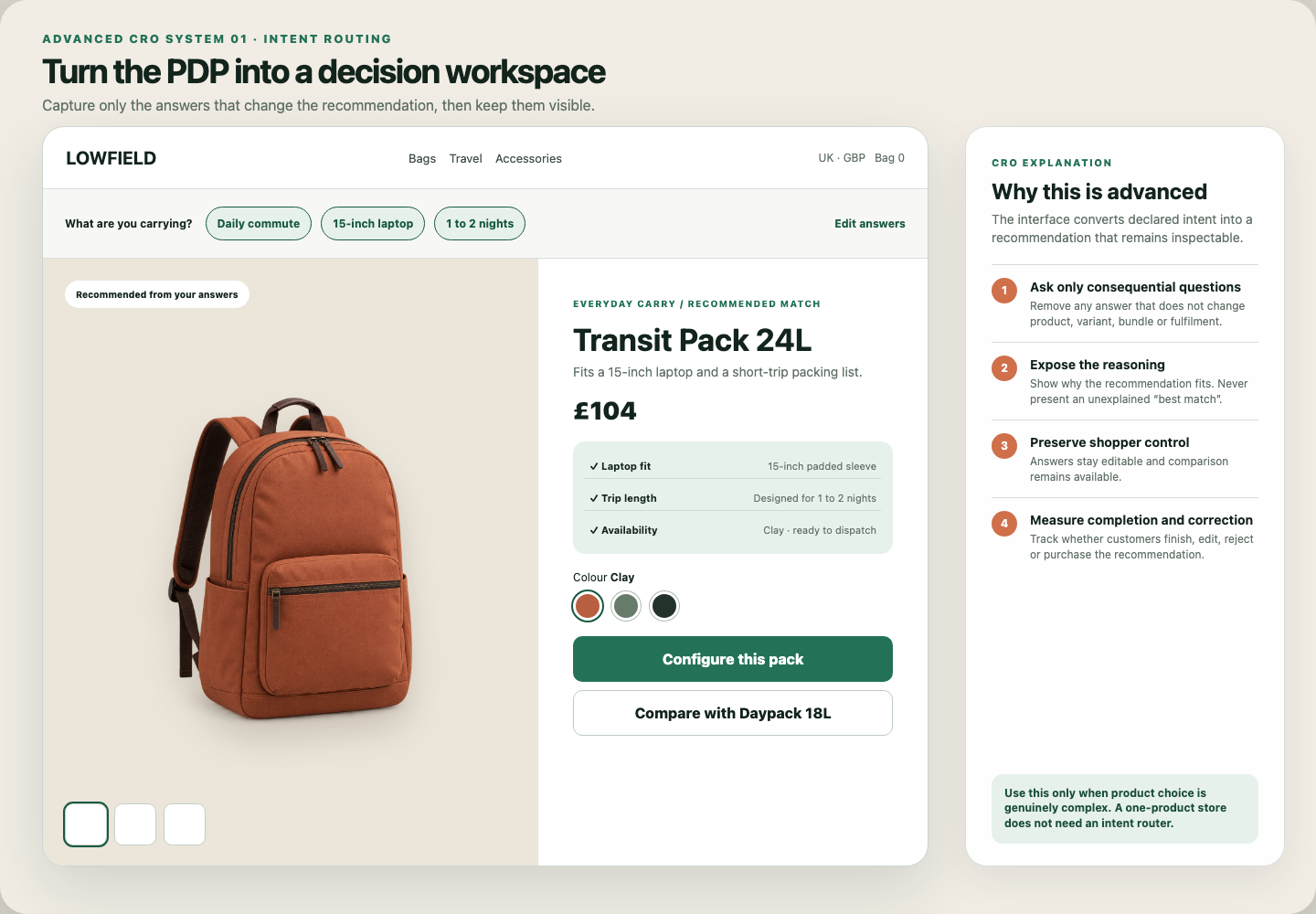
1. An intent router that explains its recommendation
A product quiz often becomes another funnel. An intent router is smaller. It asks only questions that change the product, variant, configuration, or fulfilment path.
For a bag store, laptop size and trip length may change the recommendation. Favourite colour may not. Remove questions that do not alter the result.
The output should show why the product fits each declared requirement. Keep the answers editable and preserve comparison. An unexplained “92% match” is weaker than three visible checks the customer can verify.
2. A constraint-aware configurator
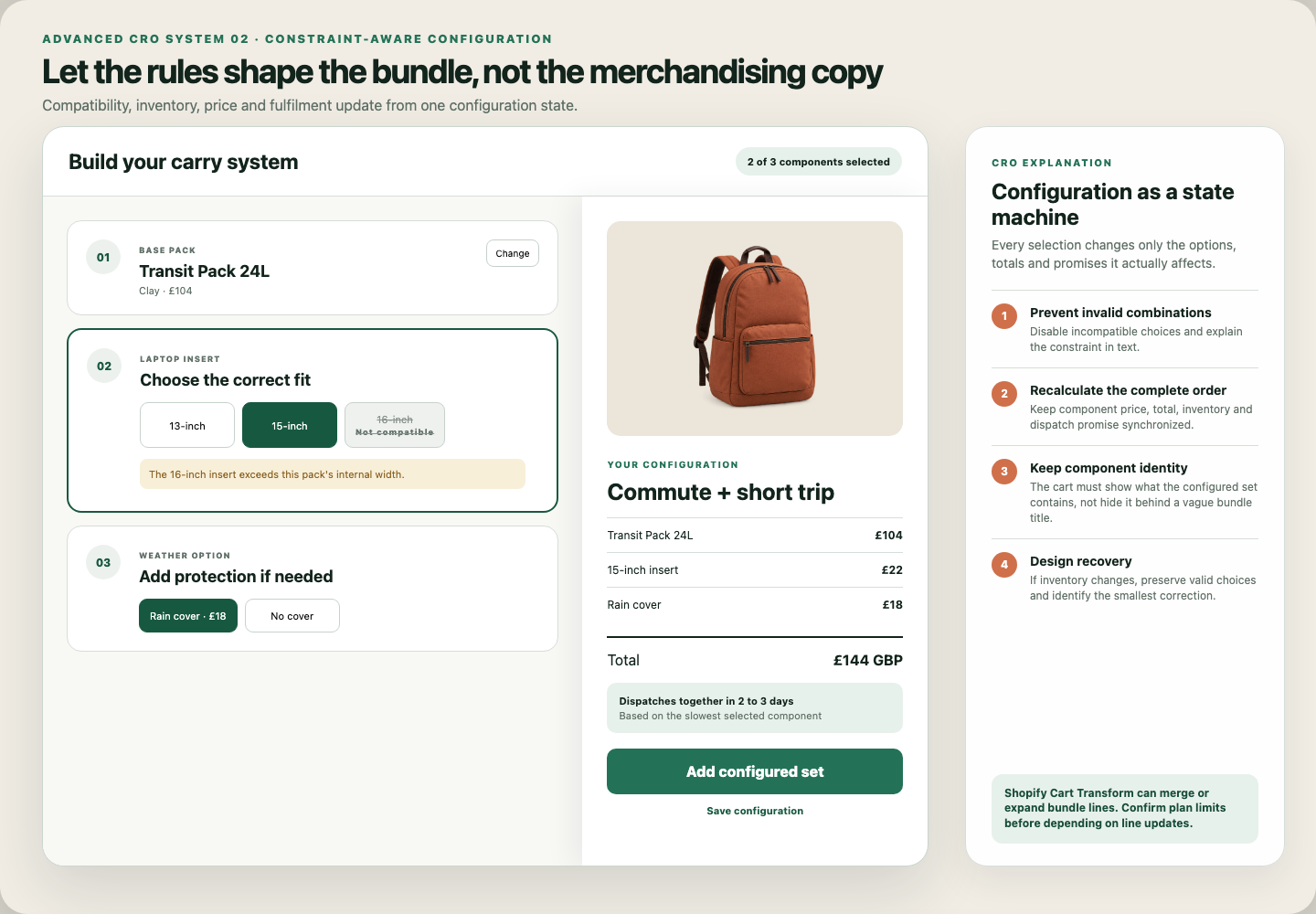
A normal bundle offers more items. A constraint-aware configurator prevents invalid combinations.
Each selection can affect compatible components, inventory, total price, and dispatch timing. These values need one source of truth. When an option is unavailable, disable it and explain the constraint in text. Do not wait for an add-to-cart error.
Shopify Cart Transform can merge component lines into a bundle or expand a bundle into its components. Some presentation updates have plan restrictions, so confirm the required operation before choosing the architecture.
The cart should still reveal component identity. A vague “commute set” line is not enough when the customer needs to confirm size, accessory, and quantity.
3. An evidence router for the active doubt
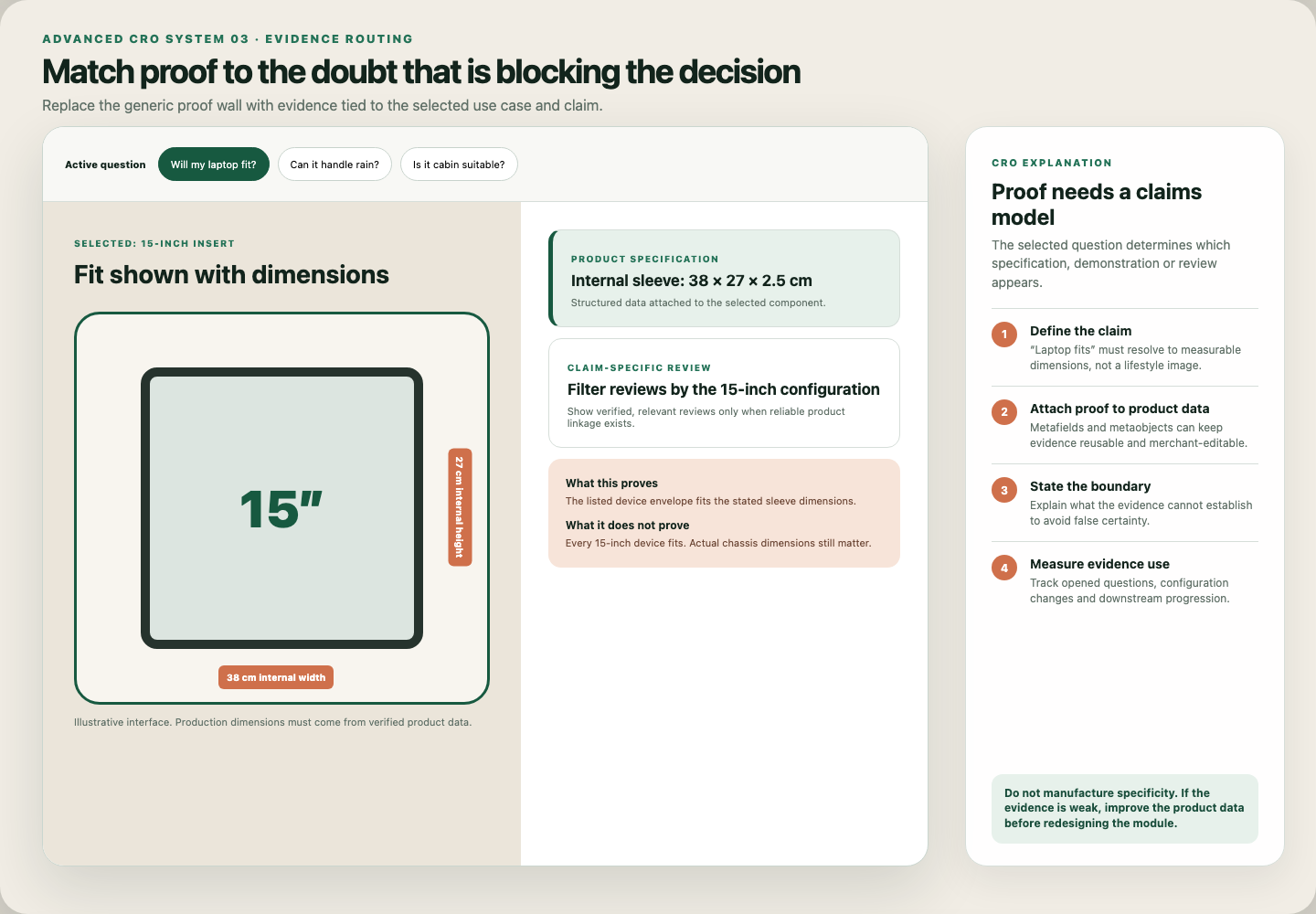
Generic review walls force customers to find their own evidence. Route proof according to the question they are trying to answer.
If the selected concern is laptop fit, show verified internal dimensions, a fit diagram, and reviews linked to that configuration. If the concern changes to weather resistance, switch to the material specification, test method, and care limitation.
Shopify metafields and metaobjects can hold reusable structured evidence. The interface should also state what the evidence does not prove. A “15-inch sleeve” label cannot guarantee every 15-inch device fits because chassis dimensions differ.
4. Market and fulfilment context inside the decision
Localized currency without localized expectations is incomplete. The buying unit should reflect the active market, available products, presentment currency, and the most specific fulfilment promise the store can support.
Shopify themes expose localization context, and Shopify Markets supports localized experiences. Treat geolocation as a starting context, not unquestionable truth. Keep country and language controls reachable.
For a configured set, calculate the promise from the slowest required component. If an exact delivery date cannot be supported, show the known condition instead of inventing precision.
5. State continuity from recommendation to cart
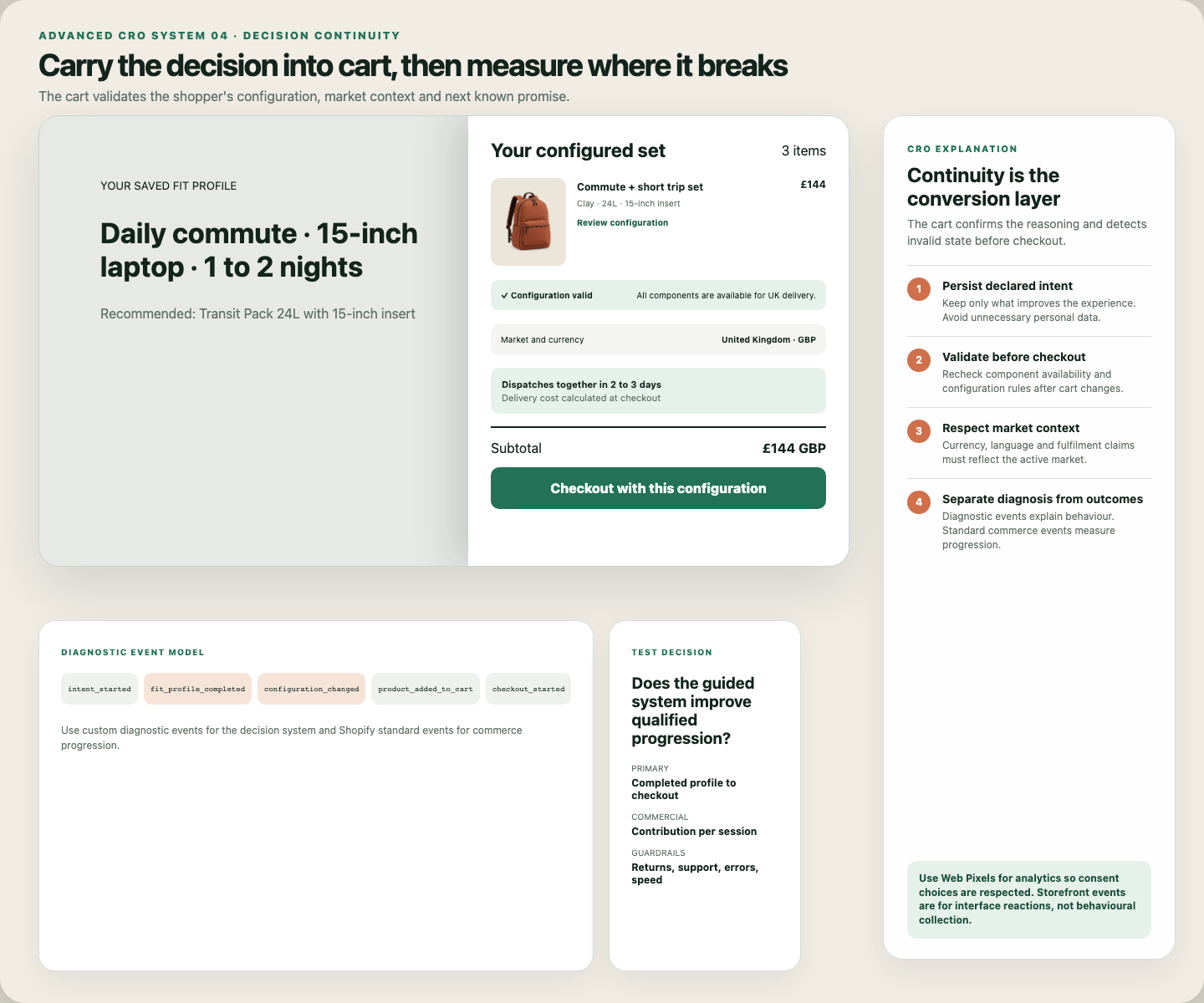
The cart should not forget why the product was chosen. Carry forward the valid configuration, selected market, and the minimum useful intent summary. Revalidate inventory and compatibility after quantity or component changes.
Store only what improves the experience. A laptop-size answer may be useful; personal profiling usually is not.
Shopify standard events measure commerce progression, including product added to cart and checkout started. Add narrowly defined diagnostic events for the new decision system, such as fit_profile_completed, configuration_changed, and evidence_opened. Use Web Pixels for analytics so customer consent choices are respected.
Test the system, not four unrelated widgets
Start with one product family where customers repeatedly ask fit or compatibility questions.
Build the smallest complete path: two consequential intent questions, one explainable recommendation, one configuration rule, one evidence module, and a cart summary that preserves the decision.
Hypothesis: an explainable guided-decision path will improve progression from a completed fit profile to checkout without increasing returns, support contacts, interface errors, or page-load cost.
Use profile-to-checkout progression as the primary metric. Protect contribution per session, returns, support contacts, accessibility, and Core Web Vitals. Review how often customers edit or reject the recommendation because those actions diagnose bad rules.
When this is the wrong investment
Do not build this for a tiny catalogue with an obvious choice. Do not add a configurator when combinations have no real constraints. Do not personalize evidence when the underlying specifications are incomplete.
Advanced CRO is not more interface. It is better state, better rules, and better evidence across the decision.
If your store has a complex buying decision, Inficial can help map the rules, design the Shopify experience, and instrument the test.
Sources
- Cart Transform Function API, Shopify developer documentation, accessed August 19, 2026
- Dynamic data sources, Shopify developer documentation, accessed August 19, 2026
- Product Recommendations API reference, Shopify developer documentation, accessed August 19, 2026
- Shopify Markets, Shopify developer documentation, accessed August 19, 2026
- Standard storefront events and actions, Shopify developer documentation, accessed August 19, 2026
- Standard Events, Shopify developer documentation, accessed August 19, 2026
- About web pixels, Shopify developer documentation, accessed August 19, 2026