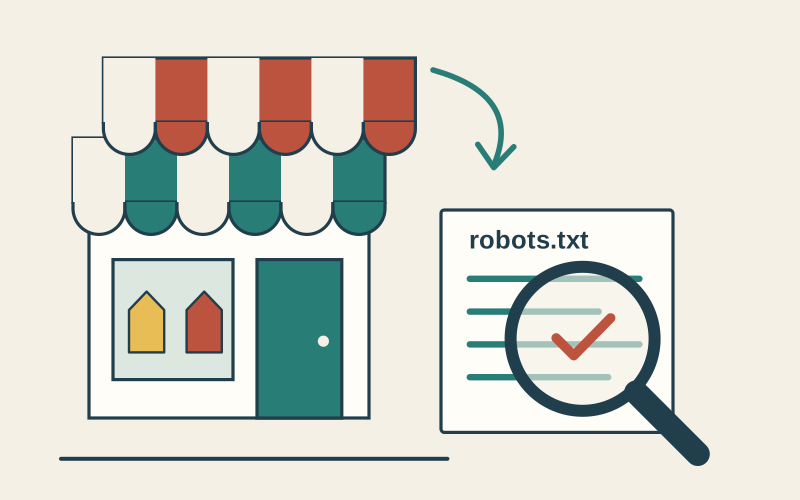
If a Shopify URL redirect is saved but the old page still opens, check whether that page is still live. Shopify's native URL redirects work from broken URLs; they do not override a valid page [1]. Reimporting the same rule won't change that condition.
Start with one exact URL and the destination you expect. This guide covers redirects managed in Shopify's Content > Menus area. Domain forwarding, customer-account routing and app-controlled URLs can involve different systems, so first confirm which setting owns the behavior you're seeing.
Check what the old URL serves
Copy the complete failing URL, including its domain, market subfolder and any query string. Open it on the storefront, outside the theme editor. Record whether you see a real product or content page, a not-found page, or a different destination. A sold-out product is not the same as a missing page: if its page still loads normally, the native redirect won't replace it [1].
Consider an illustrative rule from /products/linen-tote to /products/canvas-tote. If the linen tote remains published and its page is valid, visitors continue to see that page. If the business deliberately retires the page and the old path becomes a 404, it can become eligible for the redirect. The replacement still needs to be relevant and available.

Ask the merchandising or content owner what should happen to the original page. Keeping it live may be the right answer for a temporarily unavailable product. If retirement is intended, preserve the information needed to restore it and check affected sales channels before changing status or visibility. These are business decisions, not just redirect fixes.
Match the failure to a specific check
In Shopify admin, go to Content > Menus > View URL Redirects. Open the relevant rule and compare Redirect from and Redirect to with the URL you actually tested. Shopify says native redirects start working immediately [1]; first check the rule and source rather than assuming every problem needs a propagation delay.

Some paths cannot use native redirects. Shopify lists fixed paths such as /products, /collections and /collections/all, alongside reserved prefixes including /cart, /orders and /apps. Collection tag-filter URLs are another trap: /collections/bags/sale can remain a valid filtering route even when no products match the tag [1]. An empty result does not prove the URL is broken.
For those cases, confirm the platform limitation before asking a developer about a supported alternative. Do not add a blanket theme script that sends every not-found page to the homepage. It can conceal the original problem and send unrelated visitors to an unhelpful destination. Google warns against irrelevant mass redirects because they can confuse users and be treated as soft 404s [2].
Separate cached behavior from the saved rule
A 301 is a permanent redirect, and browsers can cache it. If you edit or remove a rule but one browser continues to reach the previous target, compare the same source URL in another device or a fresh browser context. Shopify recommends clearing the browser cache or testing another device when troubleshooting [1]. Record both results before changing the mapping again.
If the behavior remains unclear, ask the developer to inspect the initial HTTP response and each redirect hop, not just the final address bar. A request that goes through a second redirect can look like a wrong Shopify destination. Google recommends pointing directly to the final destination where possible because chains add latency [2].
Test the market URL and the visibility lifecycle
A successful base-path test is not enough when the reported failure includes a market subfolder or query string. Repeat the exact customer URL and verify that the destination serves the intended language, market and content. Shopify notes that query-string URLs might not behave as expected [1]. Do not assume a query-specific rule works simply because the URL without parameters does.
Shopify's redirect documentation currently gives conflicting general descriptions of market-subfolder inheritance. It also describes individual subfolder redirects for market-specific destinations [1]. For a live store, verify the base path and each affected localized path explicitly. If a market needs a different replacement, document that mapping and test its exact rule; do not expand a passing US test into an untested international rollout.
Visibility changes can alter the result later. Shopify documents that hiding a collection can make its URL eligible for a redirect, while making it visible again automatically deletes that redirect. If you hide it again, you need to recreate the rule [1]. Include republishing in the test plan for seasonal collections instead of treating the first redirect test as permanent proof.
Verify the correction before closing the issue
- ✓The exact reported source URL reaches the intended replacement, including the affected market or parameters.
- ✓The destination loads useful content; it is not another missing page or an unrelated homepage.
- ✓A fresh browser check agrees with the intended rule, and any remaining cached behavior is recorded.
- ✓One neighboring live URL still works normally; the correction did not widen into a blanket redirect.
- ✓The owner has the previous rule and visibility state, the test date and the result.
Update internal links you control to point directly to the replacement. Keep the redirect for visitors using older links. If this single-URL issue exposes a migration-wide problem, use the broader URL-map review rather than applying unreviewed bulk changes.
- Validate a Shopify migration URL map before bulk changes
- Decide whether old content should be updated, merged or retired
Two related errors that need a different diagnosis
Why does the 404 page jump to the homepage in the theme editor?
Does “Redirect Limit Exceeded” mean the store has too many URL redirect entries?
Start with the source page's actual state. Once you can explain why the rule is being skipped or where the request goes next, make one correction and retest that same URL.
Sources